
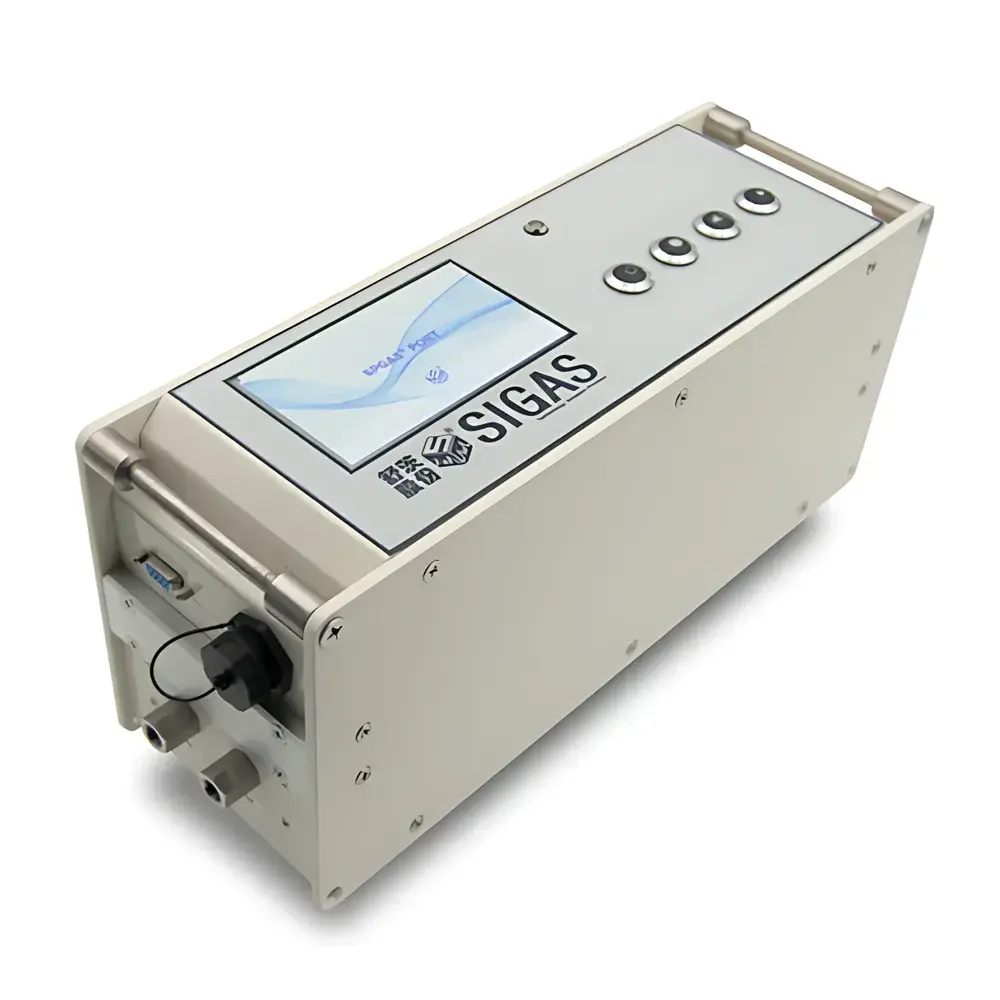
Schütz SPGAS PORT mini Portable Multicomponent Gas Analyzer
| Brand | Schütz / SIGAS |
|---|---|
| Origin | Jiangsu, China |
| Manufacturer Type | Authorized Distributor |
| Country of Origin | China |
| Model | SPGAS PORT mini |
| Price | Upon Request |
| Measurement Channels | 3 |
| Sensor Technologies | NDIR, Electrochemical (EC), and other modular principles |
| Display | 4.9" TFT LCD |
| Response Time (t₉₀) | <30 s @ 36 L/h stable flow |
| Sampling Flow Rate | 3 ± 0.5 L/min (integrated low-noise diaphragm pump) |
| Operating Temperature | 5–40 °C |
| Storage Temperature | –20–60 °C |
| Battery Life | ≥8 h (fully charged, 25 °C) |
| Charging Time | ~5 h (5% to 90%, 25 °C) |
| Power Input | 100–260 VAC, 47–63 Hz |
| DC Output | 24 VDC, 0–6 A |
| Safety Certifications | UL 62368-1, CSA C22.2 No. 62368-1, TÜV EN 62368-1, CCC GB4943.1 |
| Preheat Time | ≤15 min (NDIR), ≤10 min (EC), cold start @25 °C |
| Ingress Protection | IP54 (enclosure) |
| Data Interface | RS232 (DB9-F), USB Type-A, optional Bluetooth 2.0 (2.4 GHz, ~10 m line-of-sight, BQB/FCC certified) |
| Data Export | FAT32-formatted USB flash drive (up to 16 GB) |
| Display Resolution | 0.1 g/m³ |
| Alarm Outputs | Relay & visual/audible alerts |
| Zero Calibration | One-button auto-zero, configurable auto-zero on power-up |
| Internal Filtration | Integrated particulate and hydrophobic protection filter |
| Gas Inlet | 1/8" NPT female |
| Sample Gas Requirements | 5–40 °C, non-condensing, particulates <100 µg/m³ (<1 µm), external filtration recommended for harsh environments |
Overview
The Schütz SPGAS PORT mini is a field-deployable, compact multicomponent gas analyzer engineered for high-reliability quantitative measurement of toxic, combustible, and environmentally regulated gases in dynamic industrial and environmental settings. Utilizing interchangeable sensor modules—principally non-dispersive infrared (NDIR) and electrochemical (EC) detection technologies—the instrument delivers trace-level sensitivity and robust selectivity across up to three simultaneous measurement channels. Its architecture follows the fundamental principles of optical absorption spectroscopy (for CO₂, CH₄, SF₆, etc.) and amperometric current generation (for O₂, CO, H₂S, NO₂, SO₂, Cl₂, NH₃), enabling compliance with established analytical methodologies referenced in ISO 12039, ASTM D6245, and EN 14625. Designed for operational continuity in uncontrolled field conditions, the SPGAS PORT mini integrates a thermally stabilized sampling system, active flow control, and real-time compensation for ambient temperature, pressure, and humidity—ensuring metrological consistency without requiring laboratory-grade infrastructure.
Key Features
- Modular sensor architecture supporting NDIR, electrochemical, PID, and catalytic bead configurations—field-swappable without recalibration.
- Integrated low-noise diaphragm pump maintaining precise 3 ± 0.5 L/min sample flow, independent of backpressure fluctuations.
- One-touch zero calibration with programmable auto-zero activation at power-on—eliminating manual drift correction during routine inspections.
- 4.9-inch high-contrast TFT display showing real-time concentration values, battery status, alarm states, calibration progress, and system diagnostics.
- Dual-stage internal filtration: hydrophobic membrane + sintered stainless-steel particulate filter (≤1 µm cut-off), protecting sensitive transducers from moisture and aerosol contamination.
- Full local operation via tactile keypad (start/stop measurement, pause, purge/flush sequence), plus remote configuration and data review via PC-based software.
- RS232 serial interface (DB9-F) compliant with Modbus RTU protocol; optional Bluetooth 2.0 module enables secure wireless telemetry in open-area deployments.
- USB-A port supports direct data dump to FAT32-formatted flash drives (up to 16 GB); onboard memory retains >100,000 timestamped records with user-defined logging intervals.
- Configurable display units (g/m³, % vol, µmol/mol), dual-stage alarm thresholds (pre-alarm & critical), and adjustable response damping for noisy process environments.
Sample Compatibility & Compliance
The SPGAS PORT mini is validated for continuous sampling of clean, dry, non-corrosive gas streams meeting ISO 8573-1 Class 4 particulate and Class 3 moisture specifications. For applications involving humid or particulate-laden exhaust (e.g., stack emissions, biogas, fumigation chambers), an external heated probe with cyclonic pre-filter and Nafion™ dryer is recommended. All sensor modules undergo factory calibration against NIST-traceable standards and are supplied with individual calibration certificates. The analyzer meets electromagnetic compatibility requirements per EN 61326-1 and safety standards UL 62368-1, CSA C22.2 No. 62368-1, TÜV EN 62368-1, and CCC GB4943.1. While not intrinsically safe certified, it is rated IP54 for dust and water ingress resistance—suitable for indoor industrial floors, outdoor shelters, and mobile vehicle-mounted installations under controlled ambient conditions.
Software & Data Management
The included Windows-compatible SIGAS DataLink software provides full bidirectional communication with the analyzer via RS232 or USB virtual COM port. Users can configure channel assignments, alarm setpoints, logging intervals (1 s to 24 h), zero/span schedules, and display preferences. All acquired data—including timestamps, sensor IDs, raw ADC counts, compensated concentrations, and diagnostic flags—are exported in native CSV format compatible with Excel, MATLAB, and LIMS platforms. Audit trail functionality logs all parameter changes with operator ID and timestamp, satisfying basic GLP documentation requirements. Firmware updates are performed securely through signed binary packages; configuration backups and restore functions ensure reproducibility across device fleets.
Applications
- Industrial leak detection and confined space entry verification in semiconductor fabrication, power generation, petrochemical refining, and metallurgical processing.
- Continuous ambient air quality monitoring (AQM) for NOₓ, SO₂, O₃, and VOCs near municipal waste facilities, landfills, and transportation corridors.
- Process troubleshooting and emission source identification during maintenance outages or unexpected upsets in combustion systems and abatement units.
- Stack gas analysis for regulatory reporting under EPA Method 3A, EN 15267, or local permitting requirements—when paired with certified sampling probes.
- Phosphine (PH₃) and methyl bromide (CH₃Br) monitoring during grain fumigation cycles, with automated dose tracking and residual clearance verification.
FAQ
What sensor technologies are supported in the SPGAS PORT mini?
NDIR (for CO₂, CH₄, SF₆, refrigerants), electrochemical (for O₂, CO, H₂S, NO₂, SO₂, Cl₂, NH₃), photoionization (PID) for aromatic and aliphatic VOCs, and catalytic bead (LEL) for combustible gases.
Is the device suitable for use in explosive atmospheres?
No. The SPGAS PORT mini is not ATEX, IECEx, or UL HazLoc certified. It must be operated only in non-hazardous locations per NEC Class I, Division 2 guidelines.
Can data be exported in real time to a SCADA system?
Yes—via RS232 serial output using ASCII or Modbus RTU protocol; integration with OPC UA servers requires third-party gateway configuration.
How often does the unit require calibration verification?
Field zero checks are recommended before each shift; span verification with certified gas is advised every 30 days or after exposure to extreme concentrations, per ISO 17025 QA protocols.
Does the analyzer support automatic pressure and temperature compensation?
Yes—integrated barometric and thermistor sensors feed real-time corrections into the measurement algorithm, ensuring accuracy across 76–116 kPa and 5–40 °C operating ranges.
Related Products







