
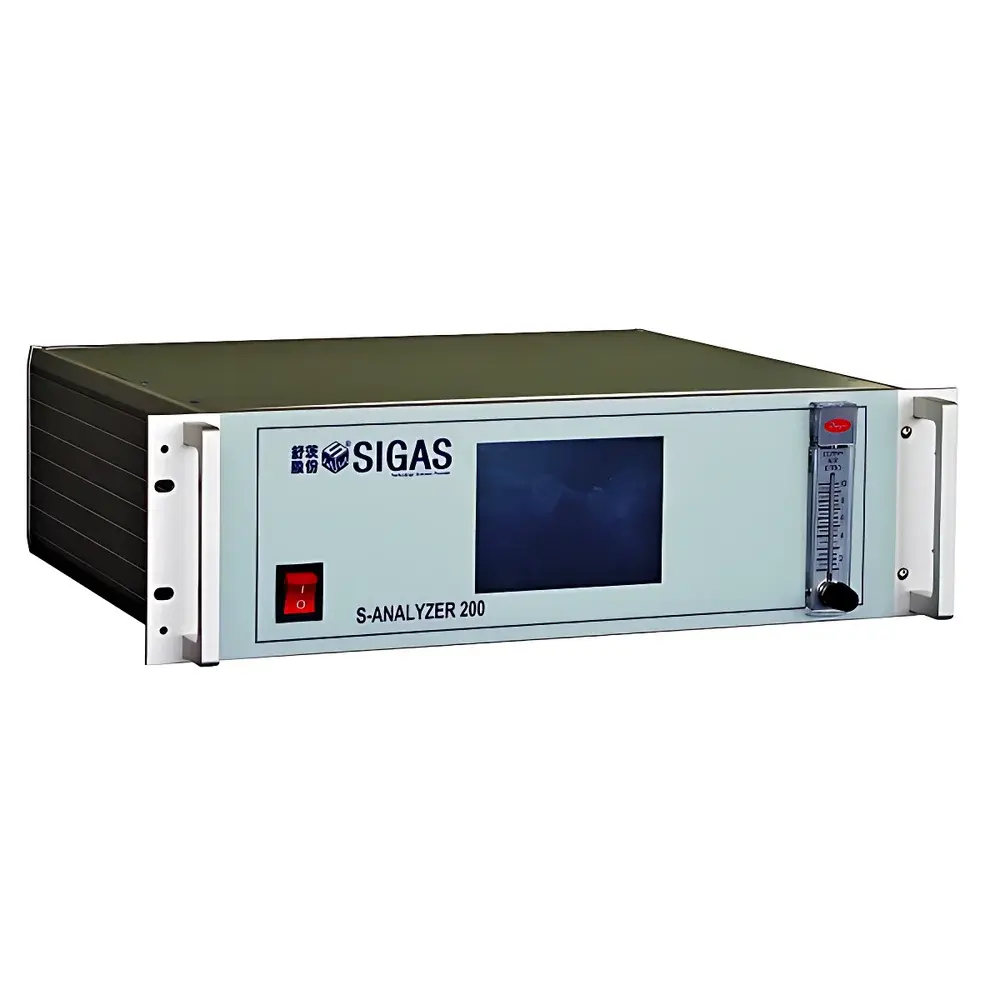
Schütz SA-200 NDUV Online UV Gas Analyzer
| Brand | Schütz SIGAS |
|---|---|
| Origin | Jiangsu, China |
| Model | S-ANALYZER 200 NDUV |
| Instrument Type | Online Gas Analyzer |
| Detection Principle | Non-Dispersive Ultraviolet (NDUV) Absorption |
| Maximum Permissible Error | ≤ ±2% FS |
| Zero Drift | ≤ ±2% FS / 24 h |
| Span Drift | ≤ ±2% FS / month |
| Repeatability | ≤ ±1% FS |
| Response Time | <25 s (at 60 L/h stable flow) |
| Warm-up Time | 3–30 min (at 20°C, depending on detector configuration) |
| Resolution | 0.01% (O₂ channel), 0.1 µmol/mol (for SO₂/NO/NO₂/etc.) |
| Operating Flow Rate | (0.2–1.2) L/min (±0.02 L/min stability required) |
| Inlet Temperature | 5–35°C |
| Inlet Pressure | ≤116 kPa |
| Dew Point | 5°C ±0.1°C (mandatory for SO₂/NO channels) |
| Particulate Load | ≤100 µg/m³, ≤1 µm |
| Zero Gas | 99.999% N₂ |
| Span Gas | 75–125% of full scale |
| Mid-point Calibration Gas | 37.5–62.5% of full scale |
| Analog Output | 4–20 mA (normal operation), 2 mA (fault/alarm/preheat) |
| Digital Outputs | 6 relay channels (configurable for fault, auto-calibration control, and concentration alarms) |
| Communication | RS232 (DB9 female), RS485 Modbus RTU |
| Power Supply | 198–242 V AC, 50/60 Hz, <125 W |
| Enclosure Rating | IP41 (EN 60529) |
| Weight | ~10 kg (net), ~19 kg (packaged) |
| Display | 5.6" color LCD touchscreen with tri-screen interface (numerical status, detailed parameters, real-time concentration curves) |
Overview
The Schütz SA-200 NDUV Online UV Gas Analyzer is an industrial-grade, rack-mountable (19-inch standard chassis) multicomponent gas analyzer engineered for continuous, real-time monitoring of up to five gaseous species in demanding process and environmental applications. It employs non-dispersive ultraviolet (NDUV) absorption spectroscopy—a robust optical technique based on the Lambert-Beer law—to quantify trace and major gas constituents via their characteristic UV absorption bands. Unlike dispersive systems requiring gratings or prisms, the SA-200 utilizes narrowband AlGaN-based UV LEDs (230–360 nm) coupled with precision interference filters to isolate target absorption lines—eliminating moving parts, enhancing long-term stability, and minimizing maintenance. The dual-beam optical architecture—splitting filtered UV light into sample and reference paths—enables active compensation for lamp intensity drift and window fouling, directly supporting the specified zero and span drift performance (≤±2% FS over 24 h and 30 days, respectively). Designed for uninterrupted operation in 24/7 industrial environments—including semiconductor cleanrooms, thermal power plants, chemical synthesis lines, waste incineration facilities, and tunnel ventilation systems—the analyzer meets fundamental requirements for reliability, repeatability (≤±1% FS), and metrological traceability under ISO 14001 and IEC 61511 functional safety contexts.
Key Features
- Integrated 5.6-inch high-contrast color touchscreen with intuitive tri-screen navigation: Screen 1 displays real-time concentration values for up to three gases simultaneously; Screen 2 presents contextual parameters including temperature, pressure, and unit scaling; Screen 3 renders dynamic concentration time-series curves with adjustable time windows.
- Triple-point calibration capability—zero (N₂), mid-range (37.5–62.5% FS), and full-span (75–125% FS)—ensures high linearity across the entire measurement range and supports periodic verification per ISO 6145-7 and ASTM D6522 protocols.
- Field-serviceable particulate filter with tool-free replacement—designed for continuous operation without system shutdown—complies with EN 15267-3 particulate ingress specifications (≤100 µg/m³, ≤1 µm).
- AlGaN-LED UV source with proprietary current-regulated driver board extends operational lifetime beyond 3 years, mitigating a key failure mode common in legacy UV analyzers.
- Configurable 4–20 mA analog outputs with programmable scaling and fault-state signaling (2 mA), plus six assignable relay outputs supporting fail-safe actuation of sampling valves, zero/span gas solenoids, and alarm interlocks.
- Full bilingual interface (English/Chinese) with password-protected calibration menus and one-touch factory reset—reducing operator training burden and eliminating need for return-to-factory remediation after misconfiguration.
Sample Compatibility & Compliance
The SA-200 NDUV is validated for measurement of SO₂, NO, NO₂, O₃, NH₃, Cl₂, H₂S, and hydrocarbons (e.g., BTEX) in dry, non-condensing gas streams. Inlet gas conditioning requirements are strictly defined: dew point must be maintained at 5°C ±0.1°C when measuring SO₂ or NO to prevent aqueous-phase interference; particulate loading must remain below 100 µg/m³ (≤1 µm); and inlet pressure shall not exceed 116 kPa absolute. The analyzer complies with electromagnetic compatibility standards (IEC 61326-1), safety regulations (IEC 61010-1), and mechanical protection class IP41 (EN 60529). While not certified to UL or ATEX standards out-of-the-box, its modular design permits integration into SIL2-capable safety instrumented systems (SIS) when deployed with external validation and documented FMEA per IEC 61508.
Software & Data Management
Data acquisition and system diagnostics are managed via embedded firmware supporting Modbus RTU over RS485 and ASCII protocol over RS232. All calibration events—including timestamps, gas concentrations used, operator IDs (if integrated with external authentication), and pre/post-calibration deviations—are logged with immutable audit trails compliant with GLP and FDA 21 CFR Part 11 principles (when paired with validated third-party SCADA or DCS platforms). Analog output signals include built-in diagnostic flags (e.g., low signal-to-noise ratio, lamp degradation warning), enabling predictive maintenance scheduling. Raw spectral data is not exposed externally; concentration calculations are performed internally using factory-characterized absorption cross-sections and temperature/pressure compensation algorithms traceable to NIST SRM references.
Applications
- Continuous emission monitoring systems (CEMS) for coal-fired and biomass power plants, meeting EU Directive 2010/75/EU (IED) and China’s HJ 75-2017 technical specifications.
- In-line process gas analysis in semiconductor etching and CVD chambers, where sub-ppm detection of Cl₂, NF₃, and O₃ ensures wafer yield consistency.
- Tunnel air quality surveillance—detecting NOₓ and CO (via optional IR module integration)—in accordance with CEN/TS 14382 and national road infrastructure codes.
- Landfill and biogas upgrading facilities monitoring H₂S and NH₃ to protect downstream membranes and catalysts.
- Chemical manufacturing QA/QC—verifying purge gas purity (O₂ <1 ppm) prior to reactor charging per ISO 8573-1 Class 1 requirements.
FAQ
What gases can the SA-200 NDUV measure simultaneously?
It supports up to five independent measurement channels; common configurations include SO₂, NO, NO₂, O₃, and NH₃—each assigned a dedicated UV LED and photodetector pair optimized for its absorption band.
Is the analyzer suitable for humid or corrosive sample streams?
No—gas must be non-condensing with dew point controlled to 5°C ±0.1°C. Optional heated sample lines and Nafion dryers are recommended upstream for field deployment in variable ambient conditions.
How often is calibration required?
Zero calibration is recommended daily or before each measurement campaign; span calibration every 7–30 days depending on regulatory requirements and process stability; full triple-point verification annually or after sensor replacement.
Can the SA-200 integrate with existing DCS or SCADA systems?
Yes—via native RS485 Modbus RTU or RS232 ASCII, with register maps provided in the technical manual; analog 4–20 mA outputs support direct connection to PLC analog input cards.
What maintenance does the UV light source require?
None during normal operation—the AlGaN-LED and driver board are designed for >26,000 hours of continuous service; no lamp replacement is needed within the first three years under specified thermal and current operating conditions.







