
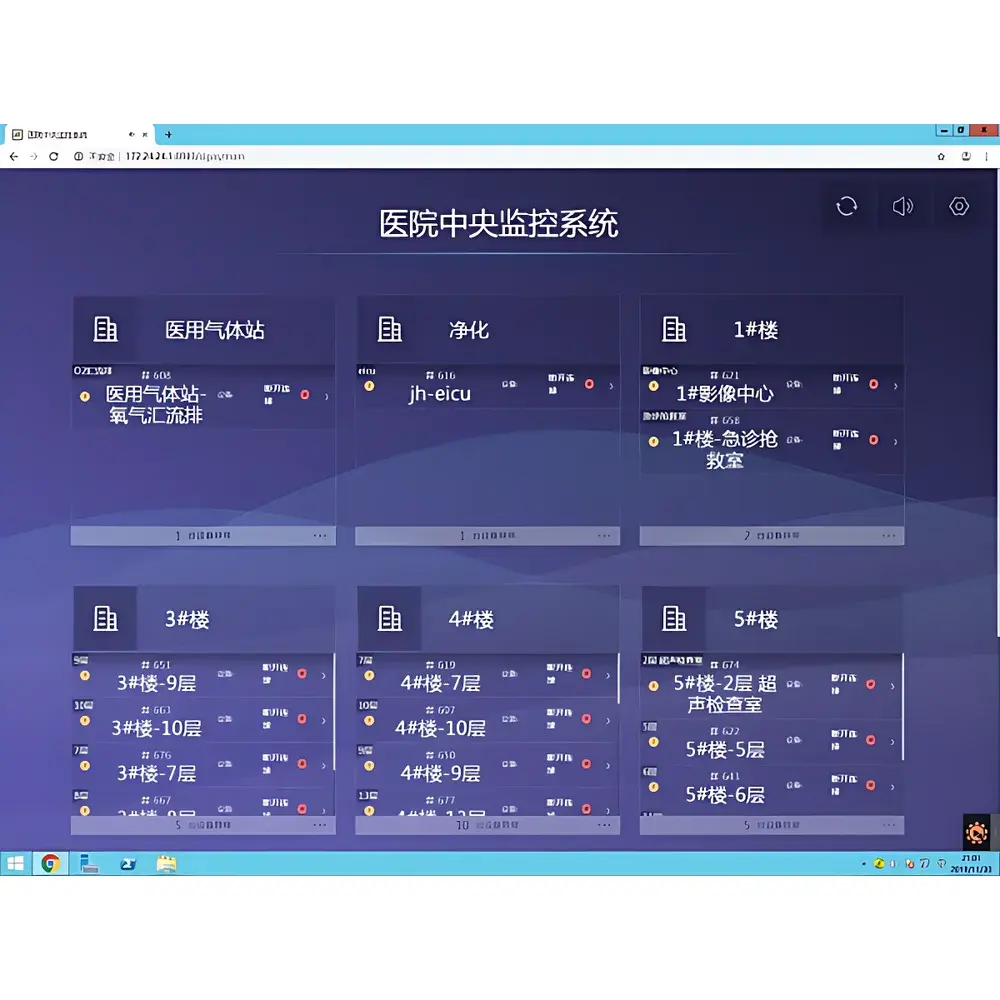
SIGAS Central Medical Gas Monitoring System
| Brand | SIGAS |
|---|---|
| Origin | Germany |
| Manufacturer Type | Authorized Distributor |
| Origin Category | Imported |
| Model | CMGS-2000 Series |
| Pricing | Available Upon Request |
Overview
The SIGAS Central Medical Gas Monitoring System (CMGS-2000 Series) is an engineered, real-time supervisory platform designed for continuous, compliant monitoring of medical gas infrastructure in hospitals, surgical centers, and critical care facilities. It operates on a distributed sensor architecture grounded in industrial-grade pressure transduction, volumetric flow measurement (via thermal mass flow sensors), and vacuum level detection—ensuring traceable, repeatable performance across oxygen (O₂), nitrous oxide (N₂O), carbon dioxide (CO₂), medical air, and medical vacuum lines. The system conforms to ISO 7396-1:2016 (Medical gas pipeline systems — Part 1: Pipeline systems for medical use) and EN ISO 8573-1:2010 (Compressed air purity classes), with integrated validation support for hospital commissioning and periodic requalification per HTM 02-01 (UK) and NFPA 99-2021 (USA). Data acquisition occurs at configurable sampling intervals (default: 1 second), with all analog inputs conditioned to 4–20 mA or 0–10 V standards and digitally timestamped to UTC.
Key Features
- Dual-redundant Ethernet backbone with DHCP-based IP assignment and TCP/IP communication protocol for deterministic latency (<50 ms end-to-end)
- Modular bridge units (SIGAS-NBx series) supporting up to 16 analog input channels per node, each calibrated to ±0.25% FS accuracy per IEC 61298-2
- Central display console with 19-inch industrial-grade touchscreen (1280×1024 resolution), fanless design, and embedded Linux OS for extended uptime (>99.99% annual availability)
- Real-time alarm hierarchy with three-tier severity classification (Warning, Alert, Critical), audible (85 dB @ 1 m) and visual (LED strobe + on-screen highlight) notification
- Automatic root-cause identification via rule-based diagnostic engine—e.g., low O₂ line pressure triggers cross-reference against upstream valve status, dew point sensor readings, and compressor runtime logs
- Fail-safe local storage (128 GB SSD) retaining ≥30 days of full-resolution data during network outage; automatic sync upon recovery
Sample Compatibility & Compliance
The CMGS-2000 monitors gaseous media meeting USP and EP 2.2.37 specifications for medical gases. All wetted components comply with ASTM F2060-20 (Standard Specification for Materials Used in Medical Gas Systems) and are certified for Class D cleanroom compatibility. Pressure sensors are rated for 0–10 bar(g) range with overpressure protection to 15 bar(g); vacuum sensors cover –0.1 to 0 bar(a) with resolution ≤0.1 kPa. Flow measurement supports laminar and turbulent regimes across pipe diameters from ½″ to 4″ (DN15–DN100), validated per ISO 5167-2 for orifice plate integration. The system is CE-marked under MDR 2017/745 Annex II Class IIa and carries TÜV SÜD certification for functional safety (IEC 61508 SIL 2).
Software & Data Management
- Web-based HMI accessible via HTTPS (TLS 1.2+) from any authorized workstation; no client installation required
- Integrated audit trail compliant with FDA 21 CFR Part 11—records user logins, configuration changes, alarm acknowledgments, and manual overrides with digital signature and immutable timestamps
- CSV/Excel export with configurable time windows and parameter selection; optional OPC UA server for integration into BMS (e.g., Siemens Desigo, Honeywell Niagara)
- Automated report generation (daily/weekly/monthly) including gas utilization trends, alarm frequency histograms, and calibration due-date forecasts
- Remote firmware updates via signed package delivery; rollback capability to previous stable version
Applications
The SIGAS CMGS-2000 is deployed in acute care hospitals (Level I–III trauma centers), ambulatory surgery centers, and large-scale clinical research facilities requiring continuous assurance of gas supply integrity. It enables proactive maintenance scheduling by correlating pressure decay rates with valve leakage thresholds, supports infection control through real-time verification of vacuum line integrity (≤–0.08 bar absolute), and provides evidentiary documentation for Joint Commission EC.02.05.01 compliance audits. In hybrid operating rooms, the system interfaces with anesthesia delivery units to verify O₂ concentration upstream of vaporizers—reducing risk of hypoxic gas mixtures.
FAQ
Does the system support integration with existing hospital BMS platforms?
Yes—via native BACnet/IP, Modbus TCP, or OPC UA protocols; engineering support includes mapping of custom object identifiers and alarm priority alignment.
How is calibration traceability maintained across distributed sensors?
Each sensor module ships with NIST-traceable calibration certificate; field recalibration is performed using portable reference standards compliant with ISO/IEC 17025-accredited labs.
Can alarm notifications be routed to mobile devices or pagers?
Yes—via SMTP email gateway or SNMP trap forwarding to enterprise alerting systems (e.g., PagerDuty, ServiceNow); SMS requires third-party GSM gateway integration.
What cybersecurity measures are implemented to protect patient-adjacent infrastructure?
The system enforces role-based access control (RBAC), disables unused services (e.g., FTP, Telnet), implements secure boot with hardware-rooted trust chain, and undergoes annual penetration testing per IEC 80001-1.
Is the central console suitable for installation in non-IT environments such as nursing stations?
Yes—the console meets IP54 ingress protection rating, operates within 0–45°C ambient range, and features anti-glare tempered glass suitable for 24/7 clinical deployment.




