
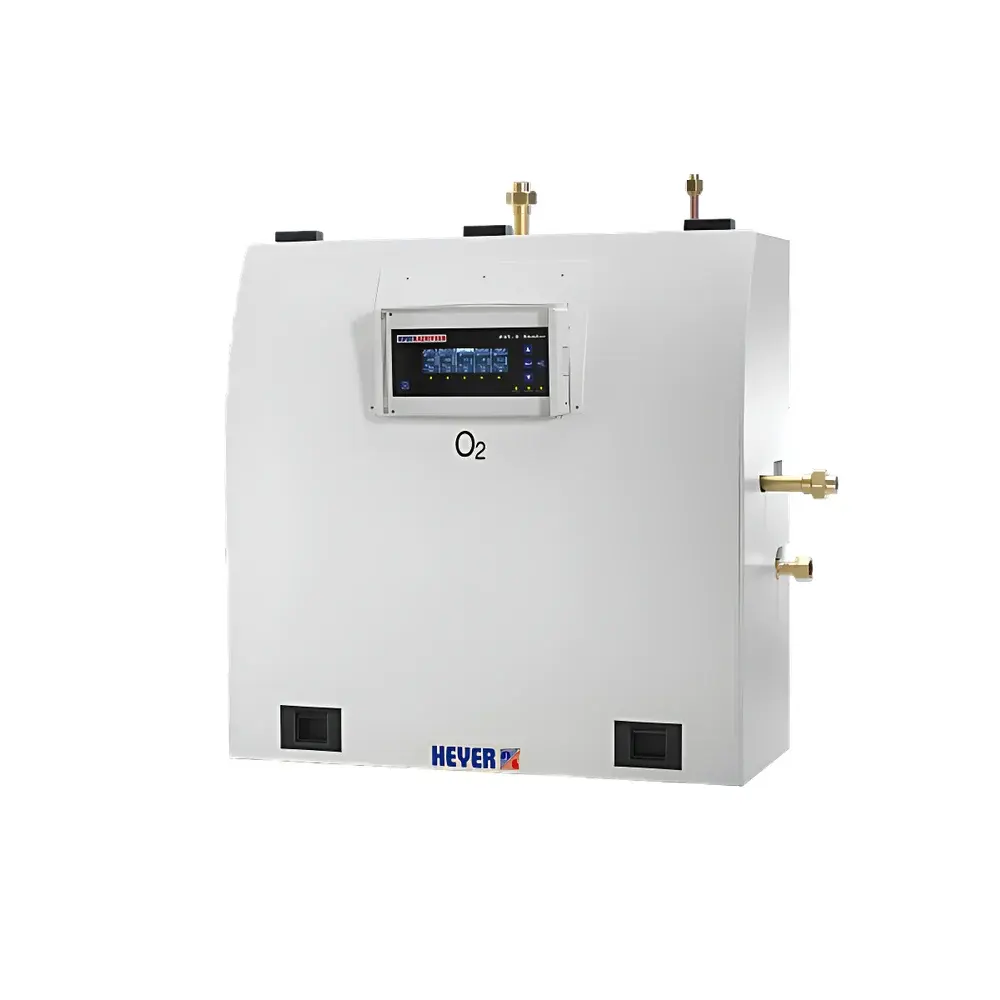
SIGAS AGS 35-50 Medical Gas Source Auto-Switching System
| Brand | SIGAS (Schütz Mess- und Regeltechnik) |
|---|---|
| Origin | Germany |
| Model | AGS 35-50 |
| Supply Configuration | Dual-bank cylinder auto-switching with priority liquid oxygen inlet (AGS 80P compatible) |
| Pressure Monitoring | Continuous real-time differential pressure sensing |
| Control Logic | Automatic switchover triggered by user-defined high/low pressure thresholds |
| Compliance | Designed to meet ISO 8573-1 (compressed air quality), EN ISO 7396-1 (medical gas pipeline systems), and IEC 60601-1 (medical electrical equipment safety) |
Overview
The SIGAS AGS 35-50 Medical Gas Source Auto-Switching System is an engineered pneumatic control solution for uninterrupted, fail-safe delivery of medical gases—including oxygen, nitrous oxide, medical air, and vacuum—in hospital central gas supply infrastructure. It operates on a differential pressure–based switching principle: two independent gas source banks (e.g., high-pressure cylinder manifolds) are monitored in real time; when the active bank’s outlet pressure falls below a user-configurable lower threshold—or exceeds an upper limit indicating regulator failure—the system triggers a seamless, leak-tight transition to the standby bank via a pneumatically actuated, stainless-steel isolation valve. When integrated with a liquid oxygen vaporizer system (e.g., SIGAS AGS 80P), the AGS 35-50 implements hierarchical source prioritization: the medium-pressure LOX-derived supply is designated as primary, while cylinder banks serve as fully automatic secondary and tertiary backups—ensuring continuity even during extended LOX replenishment cycles or vaporizer maintenance.
Key Features
- Fail-safe dual-cylinder manifold switching with <100 ms valve actuation time and zero gas interruption during transfer
- Configurable differential pressure setpoints (adjustable range: 0.1–1.0 bar ΔP) via front-panel digital interface with LED status indicators
- Integrated pressure transducers (0–10 bar full scale, ±0.25% FS accuracy) for continuous monitoring of upstream, downstream, and cross-bank differential pressures
- Stainless-steel (AISI 316L) wetted components compliant with ISO 8573-1 Class 1 for particle, oil, and moisture content in medical gases
- Redundant solenoid-pneumatic actuation with manual override capability for emergency isolation and maintenance lockout
- CE-marked per EN ISO 7396-1:2016 and EN 60601-1:2015+A1:2020; designed for integration into ISO-compliant medical gas pipeline systems
Sample Compatibility & Compliance
The AGS 35-50 is validated for use with gaseous medical oxygen (≥99.5% purity, USP/EP grade), medical air (ISO 8573-1 Class 1:2:2), nitrous oxide (USP), and instrument air per ISO 8573-1 Class 2. It supports both single-stage and two-stage cylinder manifolds rated up to 200 bar service pressure. All internal seals utilize FKM (Viton®) elastomers certified for oxygen service per ASTM G63 and CGA G-4.1. The unit conforms to installation requirements specified in HTM 02-01 (UK), DIN 13260-1 (Germany), and AS/NZS 2896:2022 (Australia/New Zealand). Documentation includes Factory Acceptance Test (FAT) reports, material traceability certificates (EN 10204 3.1), and compliance declarations aligned with EU Medical Device Regulation (MDR 2017/745) Annex II classification for ancillary devices.
Software & Data Management
While the AGS 35-50 operates as a standalone electro-mechanical controller without embedded firmware or network connectivity, it provides dry-contact alarm outputs (NO/NC) and 4–20 mA analog signals for remote pressure telemetry. These interfaces support integration into hospital-wide Building Management Systems (BMS) or centralized medical gas monitoring platforms (e.g., VIGIL, MedView, or custom SCADA). Event logs—including switch events, low-pressure alarms, and manual override activations—are recorded via external PLC or BMS historian with timestamped audit trails meeting FDA 21 CFR Part 11 requirements when deployed in GxP-regulated environments. Optional DIN-rail mounted signal conditioners enable Modbus RTU or BACnet MS/TP protocol translation for legacy infrastructure compatibility.
Applications
- Hospital central utility plants requiring continuous oxygen supply to ICU, operating theatres, and emergency departments
- Mobile medical units and field hospitals where rapid cylinder replacement must not compromise gas delivery integrity
- Pharmaceutical manufacturing cleanrooms using medical-grade compressed air for process instrumentation and product handling
- Research laboratories conducting hypoxia/hyperoxia studies requiring stable, calibrated gas mixtures over extended durations
- Long-term care facilities integrating backup gas sources into existing pipeline networks without retrofitting main distribution panels
FAQ
Does the AGS 35-50 require external power to operate its switching function?
Yes—the system uses a 24 V DC control circuit for logic sequencing and solenoid actuation; however, valve movement is pneumatically powered by the line pressure itself, ensuring mechanical fail-safe closure during power loss.
Can the AGS 35-50 be used with non-oxygen gases such as medical air or nitrogen?
Yes—provided gas-specific pressure ratings, seal compatibility, and regulatory documentation (e.g., ISO 8573-1 verification reports) are confirmed during commissioning.
Is validation support provided for IQ/OQ protocols in GMP environments?
SIGAS supplies vendor-specific URS templates, FAT/SAT checklists, and calibration certificates traceable to DAkkS-accredited labs; site-specific OQ execution remains the responsibility of the qualified user or authorized commissioning partner.
What is the maximum allowable pressure drop across the switching valve during operation?
Under rated flow conditions (up to 1000 L/min at 4 bar), the pressure drop remains ≤0.05 bar—verified per ISO 5167 flow testing methodology and documented in the type test report.
How frequently must the pressure sensors be recalibrated?
Annual calibration is recommended per ISO/IEC 17025 guidelines; field verification using NIST-traceable deadweight testers may be performed quarterly as part of preventive maintenance.
Related Products





