Schütz SGS-Type Blast Furnace Gas Online Monitoring System
| Brand | Schütz Measurement & Control / SIGAS |
|---|---|
| Origin | Jiangsu, China |
| Manufacturer Type | Authorized Distributor |
| Regional Classification | Domestic (China) |
| Model | SGS-Type Gas Analysis System |
| Pricing | Upon Request |
Overview
The Schütz SGS-Type Blast Furnace Gas Online Monitoring System is an integrated, continuous emission monitoring solution engineered for real-time, multi-component analysis of raw and cleaned blast furnace off-gas in iron and steel production facilities. Based on extractive, heated dry-sampling methodology, the system employs gas-specific detection technologies—including non-dispersive infrared (NDIR) for CO, CO₂, CH₄; thermal conductivity (TCD) for H₂ and N₂; and electrochemical or paramagnetic sensing for O₂—to deliver stable, interference-compensated measurements under high-dust, high-moisture, and corrosive process conditions. Designed to meet the functional, safety, and metrological requirements of China’s JJG 693–2011, GB/T 16157–1996, and international standards including ISO 14064-1 (GHG quantification), EN 15267 (QAL1 certification framework), and IEC 61511 (functional safety for SIS), the system supports regulatory compliance for environmental reporting, energy efficiency optimization, and process control in integrated steelworks.
Key Features
- Heated extractive sampling with electrically controlled probe temperature (>180 °C), eliminating condensation and minimizing particulate deposition in the sample line
- Corrosion-resistant wet-end components fabricated from Hastelloy C-276, PTFE-lined stainless steel, or equivalent alloys—rated for continuous operation up to 250 °C process gas temperature
- Multi-stage sample conditioning: cyclonic pre-filtration, heated ceramic filter (0.1 µm absolute rating), thermoelectric cooler with auto-drain via peristaltic pump, and precision mass-flow-controlled delivery to analyzers
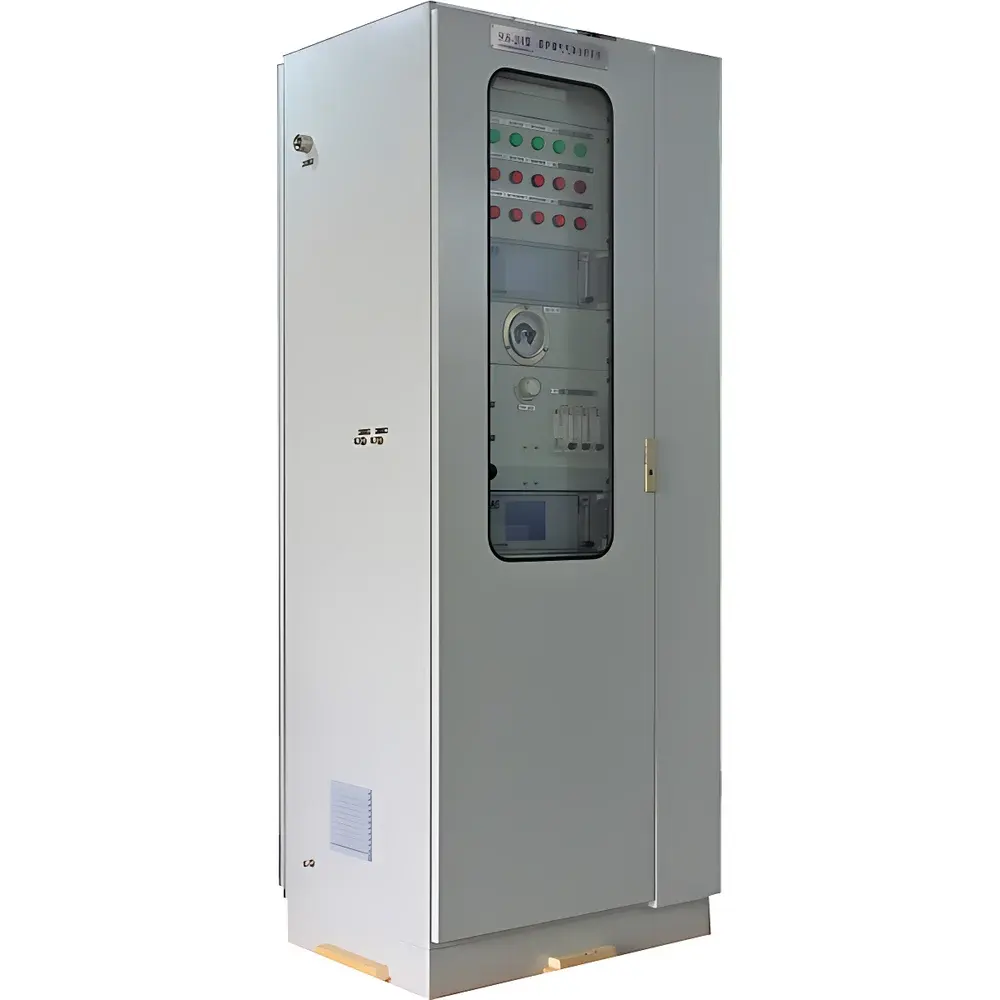
- Integrated positive-pressure explosion-proof stainless-steel analyzer cabinet (Ex d IIB T4 Ga), housing pre-treatment unit, multi-gas analyzers, calibration manifold, and PLC-based control logic
- Real-time cross-interference correction algorithms embedded in firmware, dynamically compensating for spectral overlap (e.g., CO/H₂O, CO₂/CH₄) and matrix effects in complex syngas mixtures
- Triple-point calibration capability (zero, span, and mid-range at 35–75% FS) with automated calibration scheduling, drift tracking, and audit-trail logging compliant with GLP/GMP data integrity principles
- Self-diagnostic architecture with component-level fault detection (e.g., filter clogging, cooler failure, zero-gas depletion), visual alarm indication, and automatic isolation valve activation upon purge air loss
Sample Compatibility & Compliance
The system is validated for direct analysis of uncooled, high-humidity (up to 30% v/v), high-dust (≤5 g/Nm³), and sulfur-laden blast furnace top gas containing CO (0–50% v/v), CO₂ (0–10% v/v), H₂ (0–20% v/v), CH₄ (0–10% v/v), O₂ (0–1% v/v), and N₂ (balance). All gas-contact surfaces comply with ASTM A240/A240M for corrosion resistance and ASME B31.1 for pressure boundary integrity. The analyzer cabinet meets IP65 ingress protection and CNEX-certified flameproof enclosure standards (CNEx19.1258X). System documentation includes full QAL2 (Quality Assurance Level 2) validation reports per EN 14181 and supports third-party QAL3 verification for CEMS accreditation.
Software & Data Management
Embedded firmware provides local HMI navigation, real-time trend visualization, event logging (with timestamp, operator ID, and action type), and configurable alarm thresholds (high/low, rate-of-change, deviation from reference). Data export is supported via isolated 4–20 mA analog outputs (6 channels, 750 Ω max load) and dual serial interfaces (RS-232 for service diagnostics, RS-485 Modbus RTU for SCADA integration). Audit trails retain ≥18 months of calibration records, maintenance logs, and fault history—structured to satisfy FDA 21 CFR Part 11 electronic record requirements when deployed in quality-critical environments. Optional OPC UA server module enables secure, semantic interoperability with MES and digital twin platforms.
Applications
- Blast furnace top gas composition monitoring for coke rate optimization and thermal balance modeling
- Hot blast stove combustion efficiency assessment via O₂/CO ratio trending
- Gas cleaning train performance evaluation (e.g., scrubber removal efficiency for H₂S and alkalis)
- Energy recovery system (TRT, BF gas boiler) feed gas qualification and safety interlock input
- Environmental compliance reporting (SO₂-equivalent emissions, GHG inventory per ISO 14064)
- Preventive maintenance triggering based on H₂/CH₄ rise indicating refractory degradation or tuyère leakage
FAQ
What sampling method does the SGS system use, and why is it preferred for blast furnace gas?
It uses heated extractive dry sampling—eliminating condensation-related errors and enabling direct measurement of reactive species (e.g., H₂) without water vapor interference. This method reduces maintenance frequency and improves long-term accuracy versus dilution or cold-wet systems.
How does the system handle high dust loading typical in BF off-gas?
Through a combination of heated probe filtration (ceramic + sintered metal), automatic pulse-backpurge (using instrument air), and cyclonic pre-separation—validated for uninterrupted operation at ≤5 g/Nm³ total suspended particulates.
Is third-party certification support available for environmental reporting?
Yes—the system architecture and documentation package are designed to facilitate QAL1 (EN 15267-3), QAL2 (EN 14181), and TÜV-certified CEMS validation. Factory acceptance testing includes traceable gas standard calibration per ISO 6145.
What is the recommended maintenance interval, and what tasks are involved?
Scheduled maintenance is quarterly and includes filter replacement, cooler inspection, zero/span verification, and purge air system integrity check. No routine analyzer internal servicing is required between intervals.
Can the system integrate with existing DCS or historian platforms?
Yes—via native Modbus RTU over RS-485, and optionally through OPC UA or 4–20 mA analog signals with HART-enabled transmitters for enhanced diagnostics.