
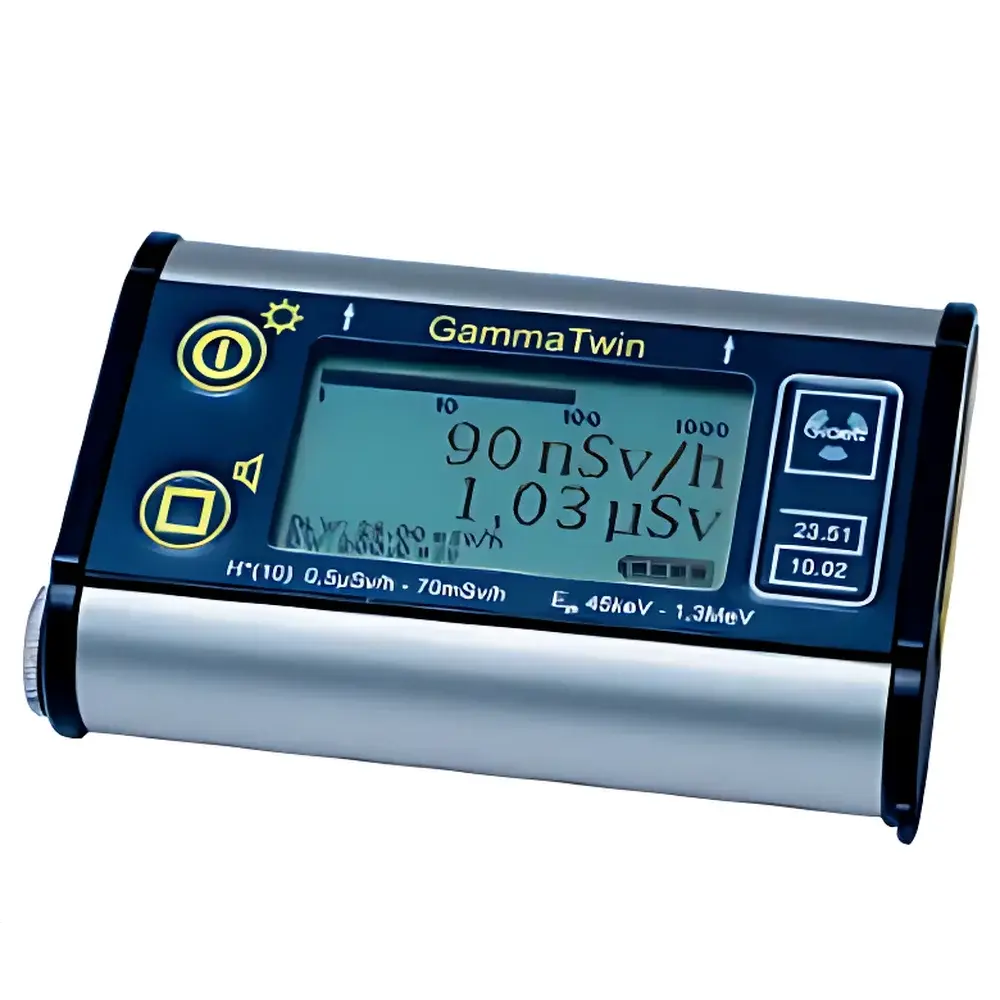
Schutz GammaTwin S Compact Radiation Dose Rate Meter
| Brand | Schutz SIGAS |
|---|---|
| Origin | Germany |
| Type | Portable |
| Detector | Energy-Compensated Geiger-Müller Tube |
| Radiation Types | Simultaneous γ and X-ray Measurement |
| Display | Dual LCD with backlight (dose & dose rate) |
| Dose Range | 0.5 µSv to 1 Sv |
| Dose Rate Range | 0.5 µSv/h to 50 mSv/h |
| Environmental Dose Equivalent | H*(10) and Ḣ*(10) |
| IP Rating | IP54 |
| Dimensions | 28 × 67 × 105 mm |
| Weight | ~200 g (with batteries) |
| Data Logging | Internal non-volatile memory |
| Alarm Thresholds | 4 factory-preset, user-adjustable |
| External Probe Interface | Yes (e.g., ABG170, ZP1083D, NaI-2002) |
Overview
The Schutz GammaTwin S Compact Radiation Dose Rate Meter is an engineered field instrument designed for real-time environmental dose equivalent monitoring in accordance with ICRP and IAEA recommendations. It operates on the principle of energy-compensated Geiger-Müller detection to deliver accurate, traceable measurements of ambient dose equivalent rate Ḣ*(10) and accumulated ambient dose equivalent H*(10) across the photon energy range of 48 keV to 1.3 MeV—covering both diagnostic X-ray and gamma-emitting radionuclides (e.g., 137Cs, 60Co, 192Ir). Unlike personal dosimeters calibrated for Hp(10), the GammaTwin S is explicitly configured for area monitoring and survey applications where spatial dose distribution, rapid source localization, and regulatory-compliant logging are required. Its compact form factor, robust aluminum housing, and IP54 ingress protection make it suitable for deployment in variable outdoor and industrial environments—from emergency response zones to controlled laboratory perimeters.
Key Features
- Energy-compensated GM tube detector ensuring flat energy response within ±30% from 48 keV to 1.3 MeV—validated per IEC 60846-1:2014 for environmental dose rate meters
- Dual-parameter LCD display with backlight: simultaneous numeric readout of H*(10) (nSv–1 Sv) and Ḣ*(10) (nSv/h–50 mSv/h), plus logarithmic analog bar graph for rapid trend assessment
- Non-volatile internal memory retains accumulated dose, alarm settings, and calibration parameters during battery replacement—no data loss or reconfiguration required
- Four programmable dose/dose-rate alarm thresholds; configurable via front-panel interface without PC software
- Acoustic pulse indication mode for discrete event detection—enabling qualitative source tracing without continuous audio output
- Self-diagnostic firmware performs automatic continuity checks on HV supply, counting circuitry, and display integrity at power-on and every 30 seconds during operation
- Standardized BNC connector for optional external probes—including α/β/γ contamination probes (ABG170), β/γ scintillation probes (ZP1083D), and high-sensitivity NaI(Tl) detectors (2002 series)
Sample Compatibility & Compliance
The GammaTwin S is certified for use in environments governed by EURATOM Directive 2013/59, German Strahlenschutzverordnung (StrlSchV), and aligned with ISO 4037-3 for reference radiation fields. It meets type approval requirements under §29 StrlSchV for area monitoring devices used in civil protection, nuclear medicine departments, and industrial radiography facilities. While not intended for individual personnel dosimetry (Hp(10) measurement), its H*(10) readings satisfy regulatory reporting obligations for workplace zoning, emergency response documentation, and routine environmental surveillance. The device supports audit-ready operation: all alarms, timestamped dose accumulation events, and probe-switching logs are stored with millisecond resolution and retained for ≥10,000 entries.
Software & Data Management
Data export is performed via USB-C interface using Schutz’s proprietary configuration and retrieval utility (Windows/macOS compatible). The software enables full parameter review—including calibration coefficients, probe identification codes, and firmware revision history—and generates CSV-formatted reports compliant with GLP documentation standards. Audit trails include operator ID entry (optional), session timestamps, and change logs for alarm thresholds or display modes. The system does not require FDA 21 CFR Part 11 compliance for basic operation but supports electronic signature-enabled report generation when integrated into validated QA/QC workflows.
Applications
- Fire and civil defense teams performing rapid radiological hazard assessment during CBRN incidents
- Industrial NDT technicians verifying shielding integrity and exposure boundaries around X-ray or gamma irradiation setups
- Nuclear medicine departments conducting daily room clearance surveys and waste storage area monitoring
- Research laboratories requiring portable, traceable dose verification for accelerator-based or sealed-source experiments
- Educational institutions demonstrating fundamental radiation physics principles—including inverse-square law validation and shielding attenuation studies
- Environmental agencies conducting baseline surveys near legacy nuclear sites or naturally occurring radioactive material (NORM) handling facilities
FAQ
Does the GammaTwin S comply with international radiation protection standards?
Yes—it conforms to IEC 60846-1:2014 for environmental dose rate meters and fulfills metrological requirements outlined in ISO 4037-3 for calibration against 137Cs reference fields.
Can it be used for personal dosimetry?
No. It measures H*(10) (ambient dose equivalent), not Hp(10) (personal dose equivalent). For personnel monitoring, a dedicated dosimeter with angular-dependent response is required.
What external probes are officially supported?
Schutz certifies compatibility with ABG170 (α/β/γ contamination probe), ZP1083D (β/γ pancake probe), and NaI(Tl)-based 2002-series scintillators for enhanced low-dose-rate sensitivity.
Is firmware upgradable in the field?
Yes—via USB-C connection and Schutz’s signed firmware update utility, with version rollback capability and SHA-256 integrity verification.
How long is the typical battery life under continuous operation?
With standard AA alkaline cells, operational endurance exceeds 2,000 hours in standard monitoring mode; lithium AA cells extend this to >3,500 hours while maintaining performance at -10 °C.
Related Products







