
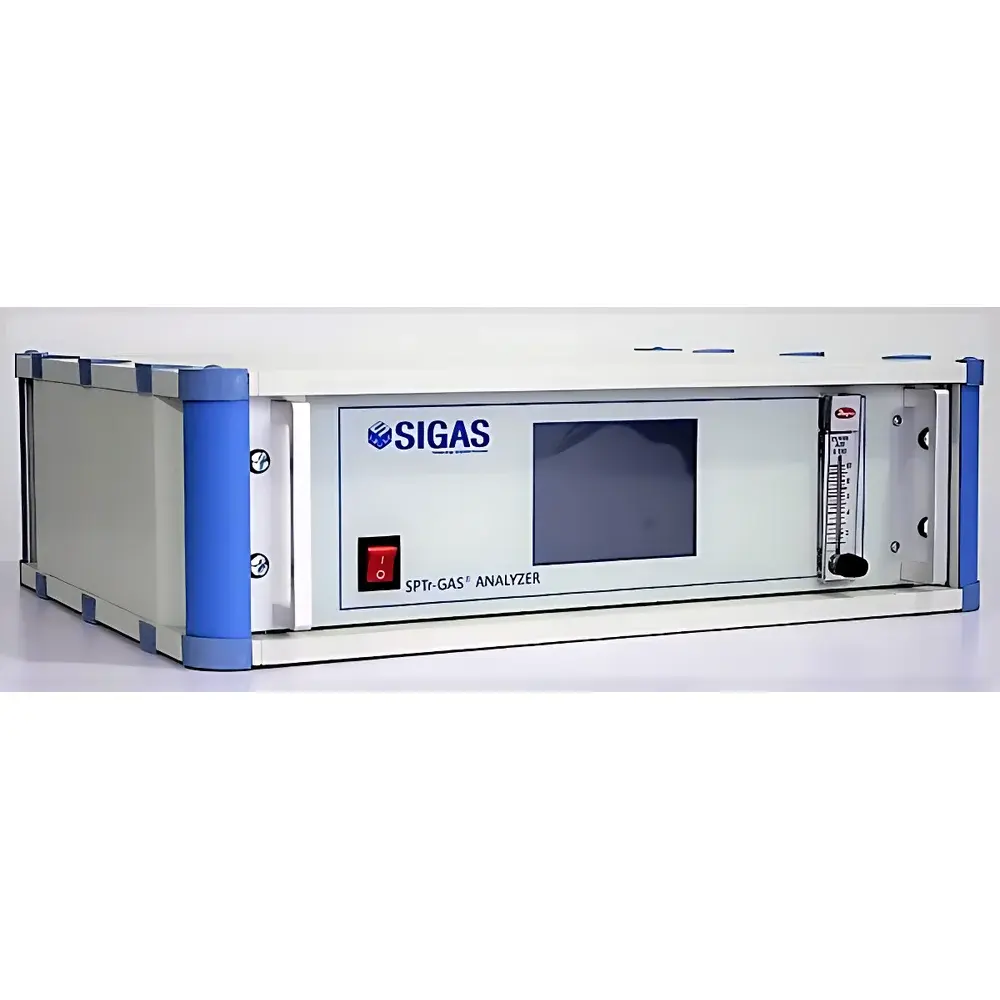
SIGAS SPTr-GAS® ANALYZER V3.0 Photoacoustic Trace Gas Analyzer
| Brand | SIGAS |
|---|---|
| Model | SPTr-GAS® ANALYZER V3.0 |
| Detection Principle | Photoacoustic Spectroscopy (PAS) |
| Target Gases | NH₃, CH₃Br, C₂H₆O, C₃H₈O, CH₄O, SO₂, SF₆, C₂Cl₄, NF₃, N₂O, C₈H₈, C₂HCl₃F₂, C₂HCl₂F₃, CClF₃, CF₄, CHClF₂, CHF₃, C₂F₆, CCl₂F₂, C₂HCl₃, C₈H₂₀O₄Si, etc. |
| Response Time | < 20 s |
| Detection Limit | < 0.01 % FS (varies by range) |
| Measurement Range | Configurable per application (e.g., NH₃: 0–100 ppm or 0–1 g/m³ |
| CH₃Br | 0–2 g/m³) |
| Accuracy | ±0.1 % FS typical (±0.5 ppm for sub-ppm ranges) |
| Zero Stability | < 0.1 % FS/24 h |
| Operating Temperature | Maintained at 50 °C (±0.5 °C) internally |
| Humidity Compensation | Integrated IR humidity sensor inside PAS cell |
| Display | 5.6” resistive touchscreen LCD |
| Analog Output | 4–20 mA (2 mA fault signal) |
| Digital Interface | RS232 (9600 baud, 8N1) |
| Power | 198–242 V AC, 50/60 Hz |
| Weight | ~15 kg |
| Enclosure Rating | IP42 |
| Compliance | EN60320-C1 power inlet, EN60529, CE-marked |
Overview
The SIGAS SPTr-GAS® ANALYZER V3.0 is a high-sensitivity, continuous-emission trace gas analyzer engineered for real-time, quantitative detection of low-concentration gases in ambient air and industrial process streams. It employs photoacoustic spectroscopy (PAS), a physically robust optical absorption technique wherein modulated infrared light induces periodic thermal expansion within the target gas—generating measurable acoustic pressure waves proportional to concentration. Unlike conventional NDIR systems, PAS eliminates interference from scattered light and window fouling, delivering inherently stable baseline performance without optical alignment drift. The instrument maintains its optical detection chamber at a precisely controlled 50 °C to minimize condensation and suppress temperature-induced signal fluctuations. An integrated IR-based humidity sensor resides directly within the PAS cell, enabling real-time compensation for water vapor cross-sensitivity—a critical capability for field-deployed environmental monitoring and semiconductor fab applications where ambient RH varies widely.
Key Features
- Photoacoustic detection architecture with intrinsic immunity to optical path contamination and beam misalignment
- Thermally stabilized PAS cell (50 °C ±0.5 °C) ensuring consistent acoustic transduction and minimizing thermal noise
- Onboard IR humidity sensing co-located with the measurement volume for dynamic, physics-based water vapor correction
- Triple-point calibration support (zero, span, and mid-range) to maintain linearity across extended operating ranges
- Integrated sampling system: internal diaphragm pump, three-way automated solenoid valve manifold, and replaceable particulate filters at each inlet point
- Dual-screen interface: primary screen for menu navigation, status diagnostics, and alarm configuration; secondary screen for real-time concentration trend visualization (ppm, μmol/mol, mg/m³)
- Field-serviceable design: carbon filter and particulate filters accessible without disassembly—enabling uninterrupted 24/7 operation
- Configurable analog output (4–20 mA) with dedicated fault signaling (2 mA), plus RS232 serial port for integration into SCADA or DCS platforms
- Full bilingual UI (English/Chinese) with password-protected calibration and alarm threshold settings to prevent unauthorized modification
- Factory reset function accessible via software—eliminating need for return-to-factory service after configuration errors
Sample Compatibility & Compliance
The SPTr-GAS® ANALYZER V3.0 is validated for use with clean, dry, non-corrosive background matrices—primarily synthetic air or high-purity nitrogen. Its modular optical filter wheel and tunable laser source (where applicable) allow reconfiguration for over 30 target analytes, including NH₃, CH₃Br, SO₂, SF₆, volatile organic compounds (VOCs), and fluorinated greenhouse gases (e.g., R-11, R-12, R-116). All measurements adhere to fundamental principles outlined in ISO 12039 (ambient air—determination of sulfur dioxide—PAS method) and ASTM D6348 (standard test method for determination of gaseous compounds by gas chromatography). While not certified under US EPA Methods TO-14A or TO-15, its performance characteristics—including response time <20 s, repeatability ≤0.1 % FS, and zero drift <0.1 % FS/24 h—meet technical requirements for continuous emission monitoring (CEM) in Tier 2 regulatory contexts. The unit complies with CE marking directives (EMC 2014/30/EU, LVD 2014/35/EU) and mechanical safety per EN60529 (IP42 ingress protection).
Software & Data Management
The embedded firmware supports timestamped data logging at user-selectable intervals (1 s to 60 min), stored internally on non-volatile flash memory (≥30 days at 1-min resolution). Raw acoustic amplitude, compensated concentration, humidity, and temperature values are recorded with 16-bit resolution. RS232 output delivers ASCII-formatted packets containing all active channel data, diagnostic flags (e.g., pump fault, filter clog warning), and system health metrics. No proprietary drivers or cloud dependency are required—data ingestion is compatible with standard Modbus RTU gateways, LabVIEW DAQ modules, or Python-based data acquisition scripts. Audit trails for calibration events, parameter changes, and alarm triggers are retained with UTC timestamps and operator ID fields, satisfying basic GLP documentation requirements. Firmware updates are performed via USB mass-storage mode using signed binary files—no external programming hardware needed.
Applications
- Ambient air quality networks: Continuous monitoring of NH₃, SO₂, and VOCs near agricultural zones, urban corridors, and industrial perimeters
- Semiconductor manufacturing: Real-time detection of etchant residuals (NF₃, ClF₃, SF₆) and cleaning agents (CH₃Br, C₂Cl₄) in tool exhaust lines
- Pharmaceutical cleanrooms: Trace solvent monitoring (acetone, isopropanol, ethanol) during lyophilization and coating processes
- Greenhouse gas research: High-temporal-resolution flux studies of N₂O and CH₄ in soil-atmosphere exchange experiments
- Hazardous material storage: Leak detection of refrigerants (R-134a, R-1234yf), fire suppressants (FM-200), and fumigants (CH₃Br)
- Calibration lab support: Reference-grade verification of electrochemical and MOS sensors via dynamic gas dilution
FAQ
What gases can the SPTr-GAS® ANALYZER V3.0 detect?
It is pre-configured for NH₃, CH₃Br, SO₂, SF₆, C₂H₆O, C₃H₈O, CH₄O, and over 20 additional species—including halogenated hydrocarbons, fluorocarbons, and aromatic VOCs. Custom configurations for other gases are available upon request.
Does the analyzer require frequent calibration?
Zero calibration is recommended daily for critical applications; span calibration every 7–30 days depending on stability requirements. The triple-point calibration routine ensures long-term linearity without reliance on external reference standards.
How does it handle humidity interference?
An integrated IR hygrometer measures water vapor concentration directly inside the PAS cell, enabling real-time mathematical correction of spectral overlap effects—no external drying or permeation tubes required.
Can it operate unattended for extended periods?
Yes. With its sealed, heated optical chamber, self-diagnostic firmware, and field-replaceable filters, the unit supports continuous 24/7 operation in industrial environments compliant with IP42 specifications.
Is the data output compatible with industrial control systems?
Yes. The 4–20 mA analog output meets IEC 61131-2 standards, and RS232 communication uses industry-standard ASCII framing—enabling seamless integration with PLCs, DCS, and environmental data management platforms.
Related Products







