
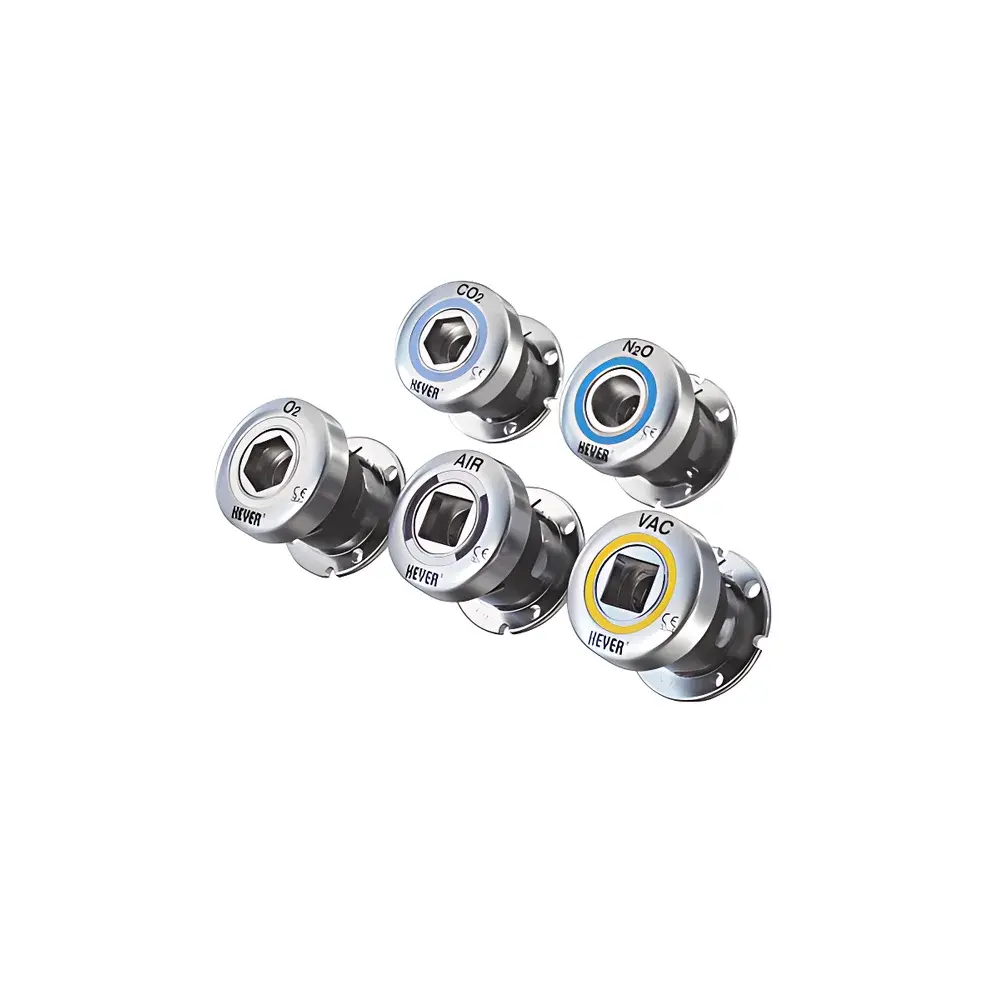
Heyer Aerotech Medical Gas Outlet Terminal
| Brand | Heyer Aerotech (SIGAS/Schütz Meßtechnik) |
|---|---|
| Origin | Germany |
| Product Type | Medical Gas Outlet Terminal |
| Compliance | DIN EN ISO 7396-1 |
| Mounting Options | Wall-mounted (load-bearing & non-load-bearing), equipment rail, ICU headwall, ceiling-suspended pendants, gas supply boxes from multiple OEMs |
| Gas Interface | Dual-seal, keyed coupling system preventing cross-gas misconnection |
| Certification | CE-marked per EU MDR 2017/745 |
Overview
The Heyer Aerotech Medical Gas Outlet Terminal is a precision-engineered interface component designed for integration into hospital-grade medical gas pipeline systems. It operates on the principle of positive mechanical keying and dual-seal coupling—ensuring gas-specific physical incompatibility between outlet and inlet connectors to eliminate accidental misconnection of medical gases (e.g., oxygen, nitrous oxide, medical air, vacuum, nitrogen). Manufactured in Germany and certified to DIN EN ISO 7396-1:2016, this terminal meets the stringent performance, safety, and material requirements defined for central medical gas supply systems in clinical environments—including operating theatres, intensive care units (ICUs), emergency departments, and modular treatment rooms. Its architecture supports continuous, leak-tight delivery under regulated pressure conditions (typically 4–5 bar for supply gases; –0.04 to –0.07 bar for vacuum), with validated flow rates compliant with ISO 8573-1 Class 3 for particulate and oil content.
Key Features
- Gas-specific keyed coupling system: Each outlet features uniquely shaped internal profiles and sealing geometries that only accept corresponding gas-specific plugs—preventing cross-gas connection per ISO 7396-1 Annex C.
- Modular mounting flexibility: Compatible with flush-mounting in load-bearing and lightweight walls, surface-mounting on equipment rails and headwalls, and integration into third-party suspended pendants and gas supply boxes from major manufacturers including Dräger, Skytron, and Getinge.
- Dual-seal design: Incorporates primary elastomeric O-ring sealing and secondary metal-to-metal contact at the coupling face, ensuring integrity across 10,000+ mating cycles and minimizing maintenance frequency.
- Corrosion-resistant construction: Housing fabricated from AISI 316L stainless steel or electroless nickel-plated brass, tested per ISO 10993-5 for biocompatibility and ASTM B117 salt-spray resistance (>96 h).
- Integrated pressure relief and flow restriction: Optional built-in pressure-reducing valves and calibrated orifices available for specific gas types to maintain downstream compliance with HTM 02-01 and NFPA 99 Chapter 5 requirements.
Sample Compatibility & Compliance
The Heyer Aerotech Medical Gas Outlet Terminal is engineered exclusively for use with medical-grade gases conforming to EN ISO 8573-1 (compressed air), EN ISO 8573-7 (oxygen), and EN ISO 8573-9 (nitrogen). It is not intended for industrial or laboratory gases. All materials in contact with gas streams comply with USP and cytotoxicity testing, and the terminal carries CE marking under Regulation (EU) 2017/745 (MDR) as a Class IIa active therapeutic accessory. Documentation includes full Declaration of Conformity, traceable material certifications, and test reports verifying leakage rate ≤ 1 × 10⁻⁴ mbar·L/s at 1.5× maximum working pressure (per EN ISO 7396-1 §7.4.2). Installation must follow HTM 02-01 (UK), VDE 0100-710 (Germany), and NFPA 99 (USA) wiring and bonding guidelines.
Software & Data Management
As a passive mechanical terminal, this device does not incorporate embedded electronics, firmware, or digital communication interfaces. However, it is fully compatible with hospital-wide medical gas monitoring systems (MGMS) that utilize external pressure transducers, flow meters, and alarm modules—such as those conforming to IEC 62304 Class B software safety classification. When integrated into networked infrastructure, the terminal supports audit-ready documentation workflows aligned with ISO 13485:2016 quality management systems and FDA 21 CFR Part 11 requirements for electronic records—provided upstream sensors and controllers are validated accordingly. Maintenance logs, calibration certificates, and leak-test records are managed via facility CMMS platforms compliant with ISO 55001 asset management standards.
Applications
- Critical care environments: Installed in ICU headwalls and anaesthesia workstations where rapid, error-free gas selection is essential during life-support procedures.
- Operating room infrastructure: Integrated into surgical pendants and booms to deliver oxygen, medical air, and suction simultaneously with electromagnetic interference (EMI)-free reliability.
- Mobile and modular healthcare units: Deployed in field hospitals, containerized clinics, and telemedicine-equipped ambulances due to its vibration-resistant mounting and IP54-rated ingress protection (optional).
- Renovation and retrofits: Designed for compatibility with legacy piping systems using copper or stainless steel tubing (OD 10 mm / 3/8″), supporting phased upgrades without full pipeline replacement.
FAQ
Is this terminal suitable for high-flow applications such as neonatal ventilators or ECMO circuits?
Yes—when specified with large-bore internal passages (≥Ø8 mm) and paired with appropriately sized supply piping, it supports peak flow rates up to 120 L/min for oxygen and 150 L/min for medical air, meeting ISO 7396-1 Annex D flow resistance thresholds.
Can the terminal be sterilized or cleaned with hospital-grade disinfectants?
Surface cleaning with 70% isopropyl alcohol, sodium hypochlorite (≤0.5%), or hydrogen peroxide-based agents is permitted; autoclaving, ethylene oxide, or gamma irradiation is not recommended due to elastomer degradation.
Does Heyer provide installation certification or commissioning support?
Yes—certified field engineers offer on-site pressure testing, leak verification per BS EN 13745, and documentation alignment with local regulatory submissions (e.g., MHRA, TÜV SÜD, or Joint Commission EC.02.05.01).






