
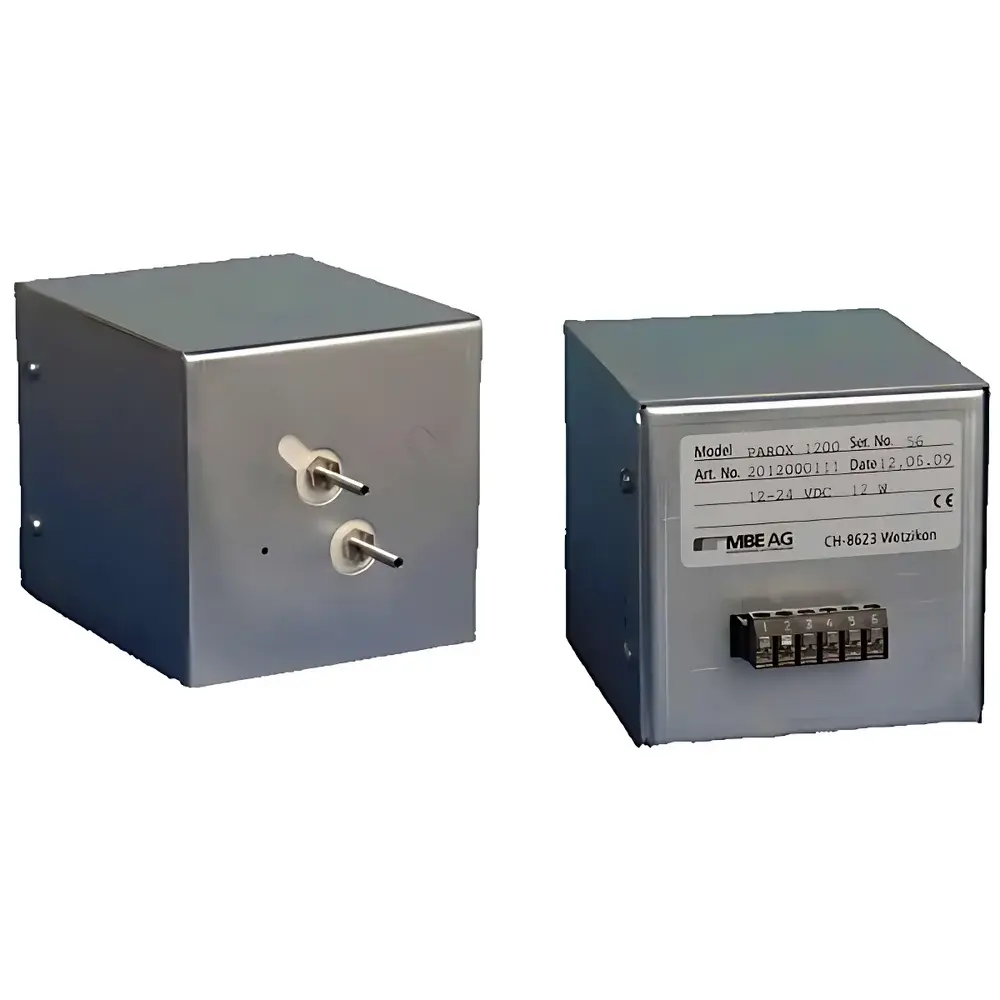
SIGAS PAROX 1200 Intelligent Paramagnetic Oxygen Sensor
| Brand | SIGAS |
|---|---|
| Origin | Switzerland |
| Model | PAROX 1200 |
| Measurement Principle | Paramagnetic Detection |
| O₂ Range Options | 0–25 %, 0–100 %, or Custom (e.g., 0–x %, x–100 %) |
| Output Signals | 0–1 V, 0–4 V, 4–20 mA |
| Gas Inlet Ports | 3 mm, 1/8", or 5 mm internal thread |
| Flow Requirements | Direct flow (10–150 mL/h), Internal fixed bypass (17–70 L/h), External flow control (10–90 L/h, optional module) |
| Gas Preheating | Optional integrated heater |
| Lifetime | >5 years typical operational service life under specified conditions |
| Cross-sensitivity | Negligible to CO₂, N₂, Ar, CH₄, H₂O (vapor), and common industrial gases |
| Operating Temperature | -10 °C to +50 °C |
| Enclosure Rating | IP65 |
| Compliance | CE, RoHS, ATEX Category 3G (optional variant) |
Overview
The SIGAS PAROX 1200 is an intelligent paramagnetic oxygen sensor engineered for high-accuracy, long-term stability in continuous gas composition monitoring. Unlike electrochemical or zirconia-based sensors, the PAROX 1200 exploits the intrinsic magnetic susceptibility of molecular oxygen—a physical property unique among common diatomic gases. In a homogeneous magnetic field, O₂ molecules are drawn toward regions of higher field intensity, generating a measurable force proportional to concentration. This principle enables absolute, drift-free measurement without consumable components or catalytic surfaces. The sensor integrates a micro-machined dumbbell suspension system with optical detection and active temperature compensation, delivering repeatable readings across its full dynamic range. Designed for OEM integration into gas analyzers, process skids, safety systems, and environmental monitoring stations, the PAROX 1200 operates reliably in ambient and mildly aggressive industrial atmospheres—provided gas streams are filtered to remove particulates and condensables exceeding manufacturer-recommended limits.
Key Features
- True paramagnetic measurement principle—no chemical reaction, no electrolyte depletion, no zero drift from aging
- Exceptionally low cross-sensitivity to CO₂, nitrogen, argon, methane, hydrogen, and water vapor—validated per ISO 10724 and ASTM D1946 test protocols
- Modular configuration: Selectable O₂ range (0–25 %, 0–100 %, or custom span), analog output type (0–1 V, 0–4 V, or 4–20 mA), and mechanical interface (3 mm tube, 1/8″ NPT, or 5 mm internal thread)
- Three flow management options: direct low-flow mode (10–150 mL/h), internal fixed bypass (17–70 L/h), or external flow regulation (10–90 L/h with add-on laminar flow controller)
- Optional integrated gas preheater (±0.1 °C stability) for dew point suppression and improved response in humid or low-temperature applications
- Robust stainless steel and ceramic housing rated IP65; ATEX-certified variants available for Zone 2/22 hazardous areas (Category 3G, II 3G Ex nA IIC T4 Gc)
Sample Compatibility & Compliance
The PAROX 1200 is compatible with dry or moderately humid (non-condensing) sample gases including air, flue gas, inert blanketing mixtures (N₂/Ar), fermentation off-gas, and medical breathing circuits. It is not intended for use with strongly oxidizing halogenated compounds, ozone-rich streams (>10 ppm), or corrosive acid gases (e.g., Cl₂, SO₂, HF) unless conditioned via certified scrubbers and particulate filters. All units comply with EU Directive 2014/30/EU (EMC), 2011/65/EU (RoHS), and carry CE marking. Optional configurations meet ATEX 2014/34/EU and IECEx requirements. Data integrity supports GLP/GMP workflows through configurable analog output linearity (±0.5 % FS) and thermal stability (<0.02 % FS/°C). Calibration traceability is maintained to NIST-traceable O₂ standards.
Software & Data Management
While the PAROX 1200 operates as a standalone analog transducer, its output is fully compatible with industry-standard SCADA, DCS, and PLC platforms (e.g., Siemens S7, Rockwell ControlLogix, Schneider Modicon). For advanced diagnostics and configuration, SIGAS provides the PAROX Configuration Utility—a Windows-based tool enabling real-time signal validation, span adjustment, temperature offset tuning, and firmware updates via RS-485 interface (Modbus RTU protocol). Audit trails, calibration logs, and sensor health metrics (e.g., thermal gradient history, signal noise RMS) can be exported in CSV format. When integrated into validated systems, the sensor meets FDA 21 CFR Part 11 requirements for electronic records and signatures when paired with compliant host software.
Applications
- Combustion efficiency optimization in boilers, incinerators, and thermal oxidizers
- Oxygen monitoring in nitrogen generation systems and inert gas blanketing for petrochemical storage
- Process control in pharmaceutical lyophilization, modified atmosphere packaging (MAP), and bioreactor aeration
- Environmental emissions reporting per EPA Method 3A and EN 14792 for stack O₂
- Safety interlock triggering in confined space entry monitors and laboratory fume hood controllers
- Research-grade O₂ quantification in atmospheric simulation chambers and climate-controlled growth facilities
FAQ
What is the recommended calibration frequency?
Annual calibration is advised for general industrial use; semi-annual calibration is recommended for applications requiring compliance with ISO 50001 or regulatory reporting mandates.
Can the sensor measure oxygen in high-CO₂ environments, such as biogas?
Yes—its paramagnetic selectivity ensures minimal interference from CO₂ up to 95 % v/v, provided the gas is filtered to <0.3 µm and dew point is maintained above −20 °C.
Is zero calibration required?
No. The sensor uses absolute physical measurement and does not require zero gas; span calibration using certified 20.9 % O₂ in N₂ is sufficient for routine verification.
What maintenance is needed over its service life?
No routine maintenance is required beyond periodic inlet filter replacement and visual inspection of the optical chamber window for contamination.
How does temperature fluctuation affect accuracy?
Integrated dual-point temperature compensation maintains output stability within ±0.1 % O₂ across the full operating range (−10 °C to +50 °C).







