
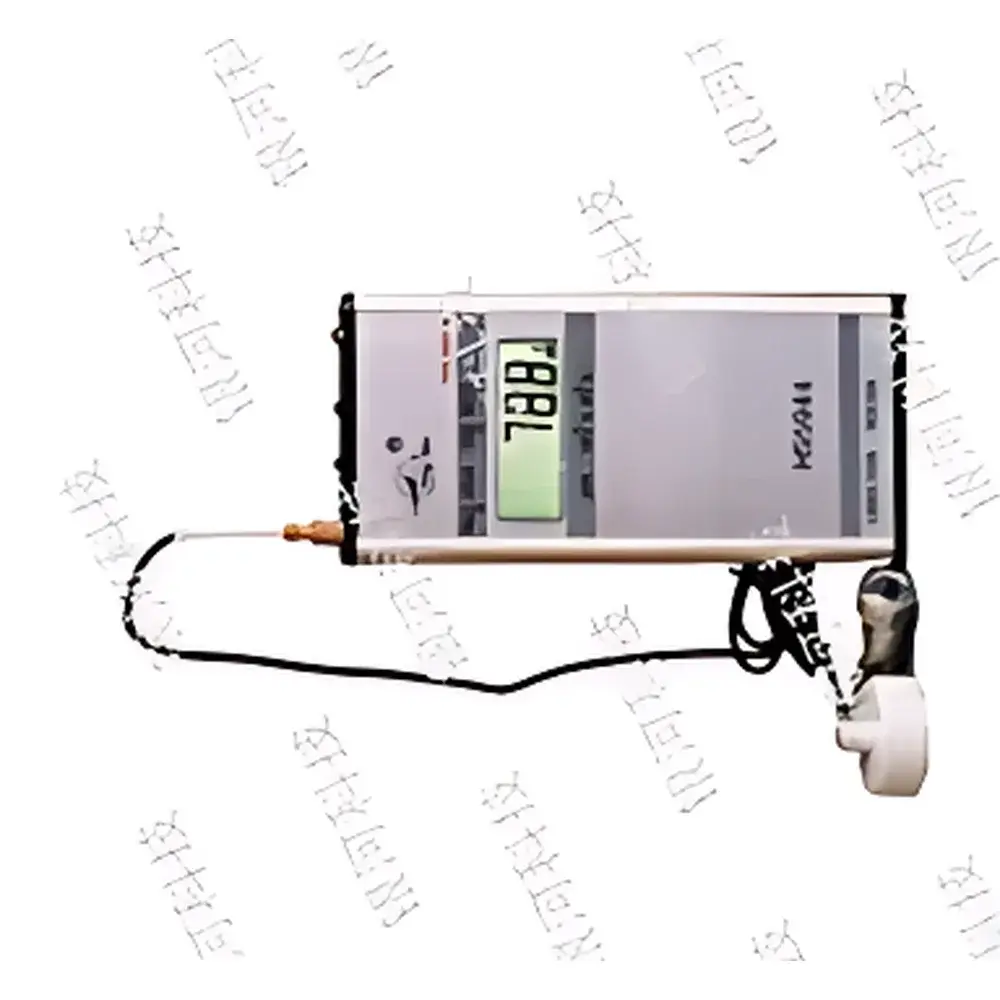
HS5944 Digital Pocket Vibration Meter
| Origin | Jiangsu, China |
|---|---|
| Manufacturer Type | Authorized Distributor |
| Origin Category | Domestic (China) |
| Model | HS5944 |
| Pricing | Available Upon Request |
| Sensor Type | Piezoelectric Accelerometer (Charge Sensitivity: ~3 pC/m·s²) |
| Acceleration Range | 0.1–199.9 m/s² (5–10,000 Hz, –3 dB) |
| Velocity Range | 0.01–19.99 cm/s (10–1,000 Hz) |
| Displacement Range | 1–1999 µm (10–1,000 Hz) |
| Detection Modes | True RMS, Peak, Peak-to-Peak |
| Display | 3.5-digit LCD with Max-Hold Function (Update Interval: ~1 s) |
| Analog Output | 3.5 mm Dual-Core Jack, Full-Scale Output: 2 V RMS |
| Accuracy | ±5% |
| Power Supply | DC 9 V (6F22 Battery) |
| Dimensions | 138 × 65 × 29 mm |
| Weight | 290 g |
Overview
The HS5944 Digital Pocket Vibration Meter is a compact, handheld instrument engineered for field-deployable and laboratory-grade mechanical vibration assessment. It operates on the principle of piezoelectric transduction—utilizing a charge-mode accelerometer to convert dynamic mechanical motion into proportional electrical signals. Designed in strict conformance with ISO 2954:2012 (Mechanical vibration of rotating and reciprocating machinery — Requirements for instruments measuring vibration severity), the HS5944 supports quantitative evaluation per ISO 2372 (vibration severity evaluation for machines with operating speeds from 10 to 200 r/s) and ISO 2373 (vibration measurement and evaluation for rotating electrical machines). Its tri-parameter capability—simultaneous acquisition of acceleration, velocity, and displacement—enables comprehensive vibration signature analysis across frequency bands critical for early fault detection in rotating equipment, structural integrity verification, and condition-based maintenance protocols.
Key Features
- Integrated piezoelectric accelerometer with nominal charge sensitivity of 3 pC/m·s², optimized for broadband response from 5 Hz to 10 kHz (–3 dB limits)
- Simultaneous real-time measurement of acceleration (0.1–199.9 m/s²), velocity (0.01–19.99 cm/s), and displacement (1–1999 µm) with selectable detection modes: true RMS, peak, and peak-to-peak
- High-resolution 3.5-digit LCD display featuring automatic max-hold functionality for transient event capture; refresh cycle stabilized at approximately 1 second
- Analog output via standardized 3.5 mm dual-core jack delivering full-scale 2 V RMS signal—compatible with oscilloscopes, data loggers, and SCADA systems for continuous monitoring integration
- Portable architecture: ultra-compact form factor (138 × 65 × 29 mm), lightweight design (290 g), and battery-powered operation (single 9 V 6F22 cell) enabling extended field use without external power dependency
- Calibration traceability aligned with international vibration metrology practices; accuracy maintained within ±5% across all measurement ranges and detection modes
Sample Compatibility & Compliance
The HS5944 is validated for direct-contact surface measurements on rigid metallic and composite structures—including motor housings, gearboxes, pump casings, turbine bearings, and compressor frames. It meets the mechanical and electrical requirements specified in ISO 2954 for portable vibration meters used in industrial machinery health monitoring. While not certified to IEC 61000-4 immunity standards or ATEX/IECEx for hazardous areas, its non-intrusive design and low-power operation make it suitable for routine inspection in general-purpose industrial environments. The instrument’s measurement methodology complies with ISO 10816 series (evaluation of machine vibration by measurements on non-rotating parts) and supports documentation workflows aligned with ISO 55001 (asset management) and ISO 13374 (condition monitoring and diagnostics data processing). For regulated industries, raw analog output can be interfaced with FDA 21 CFR Part 11-compliant data acquisition systems when paired with appropriate audit-trail-enabled software.
Software & Data Management
The HS5944 operates as a standalone meter with no embedded firmware-based storage or wireless connectivity. However, its analog output channel enables seamless integration with third-party data acquisition platforms—including LabVIEW, MATLAB, and custom Python-based DAQ scripts—allowing time-synchronized waveform capture, spectral analysis (FFT), and trend logging. When connected to compliant systems, measurement records—including timestamped RMS/peak values, sensor ID, and operator metadata—can be archived with full GLP/GMP-aligned audit trails. Users are advised to implement external calibration verification logs per ISO/IEC 17025 requirements, especially when deploying the instrument for quality control or predictive maintenance reporting under ISO 9001 or ISO 14001 frameworks.
Applications
- Routine vibration screening of rotating equipment in power generation plants, HVAC systems, and manufacturing lines
- Preventive maintenance audits in oil & gas facilities, water treatment infrastructure, and rail transport rolling stock
- Vibration qualification testing during mechanical assembly and post-repair validation
- Baseline signature acquisition for machinery fingerprinting and anomaly detection model training
- Educational use in mechanical engineering laboratories for hands-on instruction in vibration theory, sensor physics, and signal conditioning principles
- Environmental noise and structural vibration correlation studies where low-cost, high-mobility instrumentation is required
FAQ
Does the HS5944 support frequency spectrum analysis?
No—the HS5944 provides only time-domain amplitude metrics (RMS, peak, peak-to-peak) and does not include built-in FFT or spectral decomposition capabilities.
Is the sensor replaceable or user-calibratable?
The integrated piezoelectric sensor is factory-mounted and not designed for end-user replacement; calibration must be performed by an accredited metrology laboratory using traceable reference shakers.
Can the HS5944 be used for bearing defect diagnosis?
While capable of detecting elevated broadband vibration levels associated with bearing wear, it lacks envelope analysis or demodulation functions required for definitive fault frequency identification—supplementary tools such as dedicated bearing analyzers are recommended for diagnostic-level interpretation.
What is the recommended recalibration interval?
Per ISO 17025 guidance, annual recalibration is advised for routine industrial use; more frequent verification (e.g., before critical measurements) is recommended when operating in harsh thermal or mechanical environments.
Is the device intrinsically safe for use in explosive atmospheres?
No—the HS5944 has no explosion-proof housing or certification (e.g., ATEX, IECEx, UL HazLoc); it is intended for use in non-hazardous locations only.



