
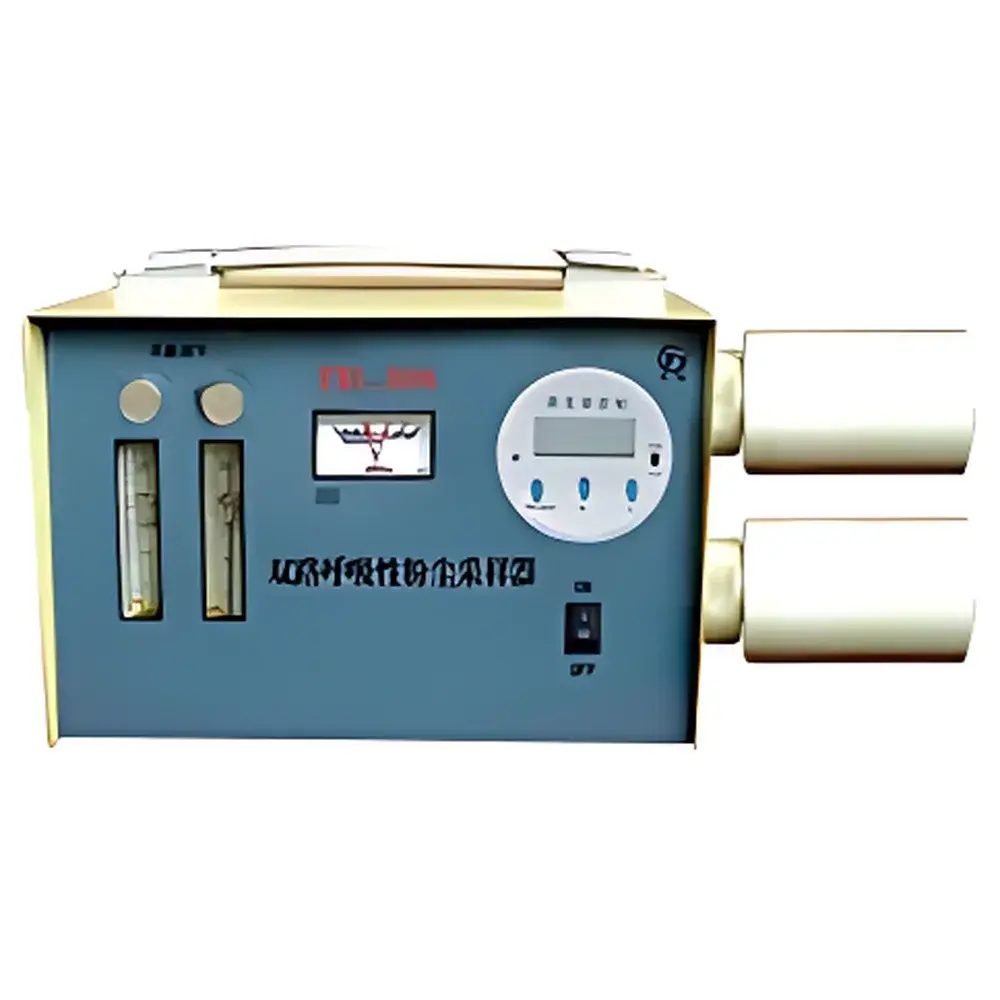
TH-30S Dual-Channel Respirable Dust Sampler
| Origin | Jiangsu, China |
|---|---|
| Manufacturer Type | Authorized Distributor |
| Origin Category | Domestic (China) |
| Model | TH-30S |
| Pricing | Available Upon Request |
| Flow Range Options | 5–30 L/min |
| Constant-Flow Control | Microprocessor-Based |
| Display | LCD |
| Power Supply | AC/DC Dual-Mode, Optional Rechargeable Ni-Cd Battery |
| Negative Pressure | >3000 Pa |
| Timer Range | 0–99 h 59 min |
| Continuous Operation | ≥180 min |
| Noise Level | <80 dB(A) |
| Operating Temperature | −20 °C to +40 °C |
| Relative Humidity | ≤85 % RH |
| Dimensions | 180 × 130 × 125 mm |
| Weight | ≈2.0 kg |
| Sampling Targets | Respirable Fraction (BMRC-curve compliant at 20 L/min) and Total Dust |
| Impact Plate | Φ25 mm glass slide coated with silicone oil |
| Compliance Reference | BMRC (British Medical Research Council) respirable dust convention |
Overview
The TH-30S Dual-Channel Respirable Dust Sampler is an engineered field instrument designed for quantitative assessment of airborne particulate matter in occupational and environmental monitoring applications. It operates on the principle of size-selective sampling using inertial impaction—specifically calibrated to the British Medical Research Council (BMRC) respirable dust convention when operated at a nominal flow rate of 20 L/min. This ensures that particles with aerodynamic diameters ≤ 4 µm are preferentially collected on the filter medium, while larger particles are removed upstream by the impactor stage. The dual-channel architecture enables simultaneous collection of respirable and total dust fractions, supporting comparative exposure analysis per ISO 7708:2022 and OSHA Method ID-142. Its compact form factor (180 × 130 × 125 mm), low mass (~2.0 kg), and integrated microprocessor-controlled constant-flow system make it suitable for personal (belt-mounted) and area-based sampling in industrial hygiene surveys, mining operations, construction sites, and municipal environmental health assessments.
Key Features
- Dual independent sampling channels with individually adjustable and stabilized flow rates—supporting concurrent respirable and total dust measurement without cross-interference.
- Microprocessor-driven constant-flow control system with real-time LCD display, ensuring flow stability within ±3% across the selected range (e.g., 5–30 L/min, 3–30 L/min, etc.).
- High-efficiency vane-type vacuum pump delivering sustained negative pressure >3000 Pa, enabling reliable operation even under elevated filter loading or high-resistance media.
- Programmable digital timer with resolution to 1 minute and maximum duration of 99 hours 59 minutes—fully compliant with NIOSH Manual of Analytical Methods (NMAM) Chapter 2
- AC/DC dual-power architecture with optional rechargeable Ni-Cd battery pack; full charge supports ≥180 minutes of continuous operation at 20 L/min.
- Low-noise design (<80 dB(A)) optimized for extended use in confined or noise-sensitive workspaces.
- Robust mechanical housing rated for operation across −20 °C to +40 °C ambient temperature and ≤85% relative humidity.
Sample Compatibility & Compliance
The TH-30S accommodates standard 25 mm and 40 mm diameter membrane filters (e.g., PVC, mixed cellulose ester, or polyvinyl chloride) mounted in certified respirable and total dust sampling heads. When used with the included Φ25 mm glass impactor plate pre-coated with silicone oil, the respirable head achieves particle-size cutoff characteristics aligned with the BMRC curve: 100% collection efficiency for particles ≥7.07 µm, 50% at 5 µm, and 10% at 2.2 µm—meeting the performance criteria specified in EN 481:1993 and ISO 7708:2022 Annex A. All sampling components—including impactor plates, filter cassettes, and silicone oil—are supplied as part of the standard configuration, eliminating third-party compatibility risks. The instrument itself does not require calibration certification but is intended for use with gravimetric analysis workflows traceable to NIST SRM standards.
Software & Data Management
The TH-30S operates as a standalone hardware platform with no embedded firmware-based data logging or wireless transmission capabilities. All operational parameters—including start time, elapsed duration, and final flow confirmation—are recorded manually by the user in accordance with GLP-compliant field documentation practices. The device includes a built-in voltage indicator for real-time battery status monitoring during sampling and charging cycles. While no proprietary software is provided, raw gravimetric data (pre- and post-sampling filter masses, flow rate, duration) may be imported into validated laboratory information management systems (LIMS) or statistical analysis packages (e.g., JMP, Minitab) for exposure modeling per AIHA RP-1 or ISO 9001:2015 Clause 8.2.2. Calibration records, maintenance logs, and sampling event metadata must be retained per OSHA 1910.1200 and EU REACH Article 36 requirements.
Applications
- Occupational exposure assessment in coal mining, stone crushing, foundry operations, and pharmaceutical manufacturing where respirable crystalline silica (RCS) or metal fume hazards are present.
- Compliance verification against permissible exposure limits (PELs) defined in OSHA 1910.1000, ACGIH TLVs®, and China’s GBZ 2.1–2019.
- Baseline air quality surveys in urban environments, waste transfer stations, and demolition zones.
- Epidemiological cohort studies requiring standardized, field-deployable dust collection across multiple geographic locations.
- Validation of local exhaust ventilation (LEV) system performance through paired upstream/downstream sampling configurations.
FAQ
What flow rate must be used to ensure compliance with the BMRC respirable dust definition?
A constant flow rate of 20 L/min is required when using the respirable sampling head with the Φ25 mm silicone-oil-coated impactor plate.
Can the TH-30S operate continuously for an 8-hour shift?
Yes—when powered by the fully charged Ni-Cd battery pack and operated at 20 L/min, it delivers ≥180 minutes of uninterrupted sampling; external DC power or AC adapter is recommended for extended-duration monitoring.
Is the instrument compatible with ISO/IEC 17025-accredited laboratories?
Yes—its mechanical design, traceable flow performance, and adherence to BMRC separation characteristics support method validation under ISO/IEC 17025:2017 Clause 7.2.2 for gravimetric dust analysis.
Does the TH-30S meet FDA 21 CFR Part 11 requirements?
No—the device lacks electronic record generation, audit trail functionality, or user authentication; it is intended for manual data capture in non-regulated or GLP-aligned settings only.
How often should the impactor plate be cleaned or replaced?
Each Φ25 mm glass impactor plate is single-use per sampling event; reuse is prohibited due to potential silicone oil degradation and particle carryover risk.







