
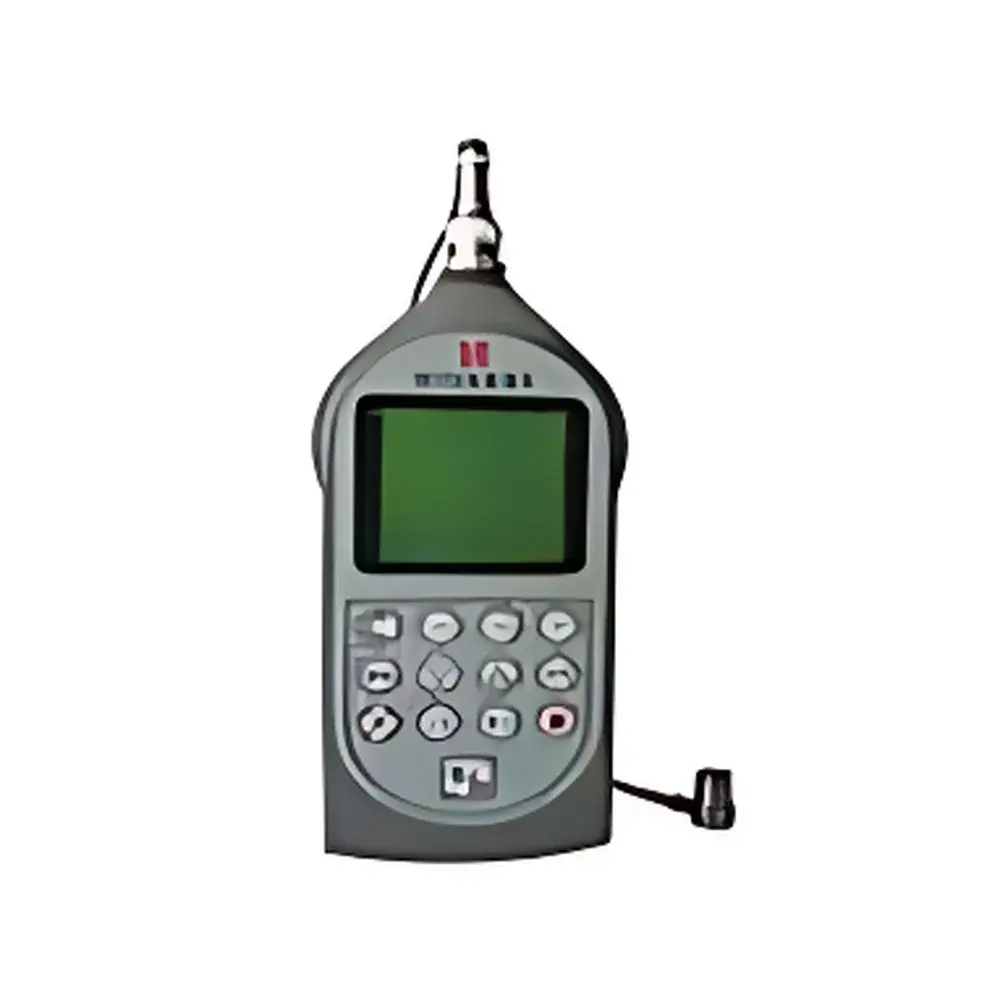
AWA5936 Vibration Meter by AWA (Zhejiang Aihua Group Co., Ltd.)
| Origin | Jiangsu, China |
|---|---|
| Manufacturer Type | Authorized Distributor |
| Origin Category | Domestic (PRC) |
| Model | AWA5936 |
| Pricing | Upon Request |
| Signal Input | TNC Connector |
| Sensor Compatibility | Piezoelectric Accelerometer (1–100 pC/m·s⁻²) |
| Integration Method | Digital Parallel Filtering (Simultaneous a/v/s) |
| Frequency Range | Acc: 10 Hz–8 kHz |
| Vel | 10 Hz–4 kHz |
| Displ | 10 Hz–250 Hz |
| Dynamic Range | Acc: 80 dB |
| Vel | 100 dB |
| Displ | 80 dB |
| A/D Resolution | 24-bit |
| Sampling Rate | 48 kHz |
| Basic Accuracy | ±5% @ 15.92 Hz |
| Display | 128×128 LCD with 16-level Contrast & LED Backlight |
| Data Storage | 128 Sets of Leq & L₁s |
| Optional | SD Card Module (Mass Storage, Audio Recording up to 1 h) |
| Power | 4×AA (LR6), or External 5 V DC |
| Operating Temp | −10 °C to +50 °C |
| RH | 20–90% |
| Dimensions | 260×80×30 mm |
| Compliance | GB/T 14790.1–2009 (Hand-Arm Vibration), ISO 5349-1, ISO 2631-1, ISO 2631-2, ISO 5347 (Transducer Calibration) |
Overview
The AWA5936 Vibration Meter is a portable, digitally processed instrumentation platform engineered for precision measurement of mechanical vibration in industrial, occupational health, and structural monitoring applications. Based on real-time digital signal processing (DSP) architecture, it simultaneously acquires and computes acceleration (a), velocity (v), and displacement (s) waveforms using parallel digital integration filters—eliminating analog drift and enabling traceable, reproducible results across all three physical domains. Designed to meet the metrological requirements of hand-arm vibration assessment per GB/T 14790.1–2009 (equivalent to ISO 5349-1), as well as whole-body vibration evaluation per ISO 2631-1 and ISO 2631-2, the instrument supports Wh-frequency weighting, F/S time-weighting, and linear averaging for standardized exposure quantification. Its 24-bit analog-to-digital converter and 48 kHz sampling rate ensure high-fidelity capture of transient events and broadband spectral content, while the 80–100 dB dynamic range accommodates both low-amplitude machinery diagnostics and high-intensity impact testing scenarios.
Key Features
- Simultaneous real-time computation of acceleration, velocity, and displacement RMS, peak, and peak-to-peak values using parallel digital integration—no mode switching or recalibration required
- Dual time-weighting (F: τ = 125 ms; S: τ = 1 s) and linear integration averaging executed concurrently for comprehensive exposure assessment
- Configurable integration periods from 1 second to 24 hours, supporting both short-duration spot checks and long-term monitoring campaigns
- Onboard FLASH RAM stores up to 128 sets of Leq and L₁s data; optional SD card module enables extended logging, synchronized audio annotation (1 s–1 h), USB mass storage emulation, and direct file transfer
- TNC input interface compatible with industry-standard IEPE and charge-mode accelerometers (1–100 pC/m·s⁻²); automatic sensitivity scaling applied during post-processing
- 128×128 monochrome LCD with adjustable contrast and LED backlight ensures legibility under varied ambient lighting conditions—including low-light field environments
- Robust mechanical design (260×80×30 mm, IP54-rated enclosure) optimized for handheld operation in workshops, construction sites, and vehicle cabins
Sample Compatibility & Compliance
The AWA5936 interfaces exclusively with piezoelectric accelerometers via its TNC input connector. It supports charge-output sensors (requiring external ICP®/IEPE signal conditioning) and high-impedance charge-mode transducers when paired with appropriate preamplifiers. Calibration traceability aligns with ISO 16063-21 (vibration calibrators) and ISO 5347 (transducer sensitivity verification). Regulatory compliance includes GB/T 14790.1–2009 (hand-transmitted vibration), ISO 2631-1 (whole-body vibration—seated/standing), ISO 2631-2 (whole-body vibration—supine), and ISO 5349-1 (hand-arm vibration syndrome risk assessment). While not FDA- or EU-MDR-certified, its data structure and timestamping (±1 min/month accuracy) support GLP-aligned documentation workflows where raw waveform export and metadata integrity are essential.
Software & Data Management
Data acquisition and post-processing are supported via PC-based analysis software (Windows-compatible, supplied separately), which imports binary or CSV-formatted files exported via USB or SD card. The software enables FFT-based spectral analysis, octave/half-octave band filtering, time-history replay, and automated report generation compliant with ISO 5349 and ISO 2631 templates. All stored measurements retain full metadata—including date/time stamp, sensor ID, weighting configuration, integration duration, and battery status—enabling audit-ready traceability. Firmware updates are delivered via USB, preserving calibration coefficients and user-defined configurations across revisions. No cloud connectivity or remote telemetry is implemented; all data remains under local operator control, satisfying strict data sovereignty requirements in regulated industries.
Applications
- Machinery condition monitoring: Bearing fault detection, imbalance identification, and resonance mapping via broadband acceleration spectra
- OEM validation testing: Vibration profiling of motors, compressors, pumps, and gearboxes per ISO 10816-3 severity thresholds
- Occupational health & safety: Daily noise and vibration exposure logging for workers operating power tools, grinders, or vibrating platforms
- Automotive NVH analysis: In-cabin vibration characterization, suspension component evaluation, and engine mount performance verification
- Structural dynamics: Low-frequency displacement monitoring of bridges, building façades, and industrial floors subjected to periodic loading
- Research-grade field studies: Long-duration environmental vibration logging in proximity to railways, construction zones, or wind turbine installations
FAQ
Does the AWA5936 support real-time FFT spectrum analysis?
Yes—firmware version 3.2 and later enable real-time 1024-point FFT with selectable Hanning or Flat-top windowing, displayed directly on the LCD.
Can the instrument be calibrated in-house using a reference shaker?
It accepts two-point electrical calibration (sensitivity and frequency response) via built-in signal generator output; however, full mechanical calibration requires accredited lab services per ISO 17025.
Is USB communication compatible with macOS or Linux systems?
The device enumerates as a standard USB CDC ACM serial device; third-party Python or MATLAB scripts can parse its ASCII protocol, though official GUI software is Windows-only.
What is the maximum SD card capacity supported?
Class 10 microSDHC cards up to 32 GB are verified; exFAT-formatted 64 GB cards may function but are not officially validated.
How is Wh-frequency weighting implemented?
Digital FIR filter coefficients conforming to ISO 5349-1 Annex B are applied in real time during acceleration channel processing, with no latency-induced phase distortion.



