
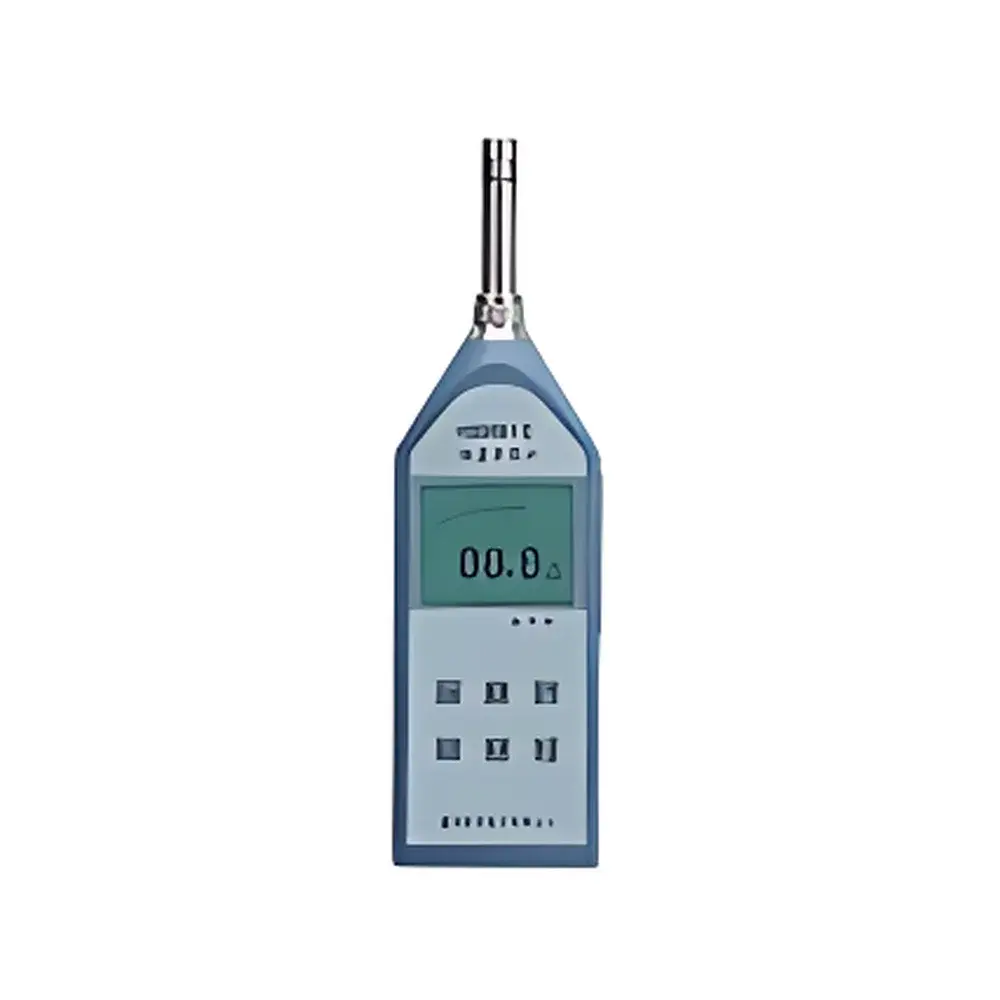
HS5661B Precision Sound Level Meter
| Origin | Jiangsu, China |
|---|---|
| Manufacturer Type | Authorized Distributor |
| Country of Origin | PRC |
| Model | HS5661B |
| Pricing | Available Upon Request |
| Microphone | 1/2″ (12.7 mm) Prepolarized Condenser |
| Frequency Weighting | A- and C-weighting |
| Time Weighting | Fast (F), Slow (S) |
| Detector | True RMS with Peak Factor ≥10 |
| Accuracy Class | IEC 61672-1:2013 / GB/T 3785.1–2010 Class 1 |
| Range Control | Manual, 3-step |
| Dynamic Range per Range | >60 dB |
| Measurement Ranges | 60–120 dB, 80–140 dB, 100–160 dB (re 20 µPa) |
| Display | Large Backlit LCD with Analog Bar Graph & Instantaneous Leq/Lmax/Lmin |
| Output Interfaces | AC Line Output, RS-232 Serial Port |
| Calibration | Compatible with Class 1 Acoustic Calibrators (e.g., 94 dB/114 dB @ 1 kHz) or Pistonphones |
| Power Supply | 4×LR6 (AA) Alkaline Batteries (24 h typical), Optional 6 V DC / 100 mA External Adapter |
| Dimensions (L×W×H) | 230 × 72 × 30 mm |
| Mass | 300 g (incl. batteries) |
| Operating Temperature | −10 °C to +50 °C |
| Compliance | Fully compliant with IEC 61672-1 Class 1 requirements for field and laboratory use |
Overview
The HS5661B Precision Sound Level Meter is a handheld, Class 1-compliant acoustic measurement instrument engineered for high-fidelity sound pressure level (SPL) quantification in industrial, environmental, occupational health, and research settings. It operates on the fundamental principle of electroacoustic transduction: incident sound pressure waves modulate the capacitance of a 12.7 mm (½″) prepolarized condenser microphone capsule, generating an analog voltage signal proportional to instantaneous acoustic pressure. This signal undergoes true root-mean-square (RMS) detection with a minimum peak factor of 10—ensuring accurate capture of impulsive and non-sinusoidal noise sources such as impact machinery, pneumatic tools, or HVAC transient events. The device implements standardized frequency weighting networks (A and C) and time constants (Fast and Slow) per IEC 61672-1:2013, enabling compliance-grade assessment of noise exposure against occupational limits (e.g., OSHA 1910.95, ISO 1999, EU Directive 2003/10/EC). Its compact ABS polymer housing, low mass (300 g), and battery-powered operation support extended field deployment without compromise to metrological integrity.
Key Features
- Class 1 accuracy certified per IEC 61672-1:2013 and GB/T 3785.1–2010 — suitable for regulatory reporting and legal metrology applications
- True RMS detector with ≥10 peak factor capability — essential for reliable measurement of complex, non-stationary noise signals
- Three manually selected measurement ranges (60–120 dB, 80–140 dB, 100–160 dB re 20 µPa) providing >60 dB linear dynamic range per setting
- Simultaneous A- and C-weighted measurements supported via front-panel selection — critical for evaluating both hearing damage risk and low-frequency energy content
- Large backlit LCD with real-time analog bar graph and numeric display of Leq, Lmax, Lmin, and instantaneous SPL
- Dual output interfaces: buffered AC line output (for connection to oscilloscopes or data loggers) and RS-232 serial port (enabling remote control, automated data acquisition, and multi-instrument network synchronization)
- Low-power design — 24-hour continuous operation on four standard AA alkaline cells; external 6 V DC input available for fixed-site monitoring
Sample Compatibility & Compliance
The HS5661B is compatible with all Class 1 acoustic calibrators operating at 94 dB and/or 114 dB at 1 kHz (e.g., Brüel & Kjær Type 4231, Cirrus Optimus Mk4, or equivalent pistonphones), ensuring traceable calibration in accordance with ISO 7196 and IEC 60942. It meets the full suite of performance requirements for Class 1 instruments defined in IEC 61672-1:2013, including frequency response tolerance (±1.1 dB from 20 Hz to 10 kHz under A-weighting), temporal response fidelity, temperature stability (−10 °C to +50 °C), and electromagnetic compatibility (IEC 61326-1). While not intrinsically rated for hazardous locations, its robust mechanical construction and sealed front panel permit use in demanding industrial environments—including factory floors, construction sites, transportation hubs, and municipal noise mapping campaigns—provided ambient conditions remain within specified thermal and humidity limits.
Software & Data Management
Data export and remote operation are facilitated via the RS-232 interface using ASCII-based command protocols documented in the instrument’s technical manual. Users may integrate the HS5661B into custom PC-based acquisition systems using standard terminal emulators or third-party software supporting serial communication (e.g., LabVIEW, Python pySerial, MATLAB Instrument Control Toolbox). Though no proprietary analysis suite is bundled, the meter supports time-stamped logging of Leq, Lmax, and statistical percentiles (L10, L50, L90) when paired with host software capable of parsing serial streams. For GLP/GMP-aligned deployments, users must implement external audit-trail mechanisms—such as timestamped CSV exports with operator ID tagging—as the device itself does not embed FDA 21 CFR Part 11-compliant electronic signatures or user-access controls.
Applications
- OHS noise exposure assessments in manufacturing, mining, and logistics facilities per ISO 9612 and national occupational safety standards
- Environmental noise monitoring near airports, highways, railways, and urban infrastructure in compliance with ISO 1996-1 and local municipal ordinances
- Product noise certification testing for appliances, power tools, HVAC equipment, and automotive components (ISO 3744, ISO 3746)
- Acoustic quality control during R&D prototyping and production line verification
- Educational acoustics laboratories for teaching sound propagation, psychoacoustics, and instrumentation fundamentals
- Community noise complaint investigations requiring legally defensible measurement records
FAQ
What calibration standards is the HS5661B compatible with?
It accepts Class 1 acoustic calibrators delivering 94 dB or 114 dB at 1 kHz, conforming to IEC 60942 and ISO 7196. Calibration must be performed before each measurement session and after any significant environmental change.
Can the HS5661B measure equivalent continuous sound level (Leq) over extended durations?
Yes—it calculates and displays Leq in real time for user-defined intervals up to 24 hours when powered externally; battery life limits internal logging to ~8 hours of continuous Leq recording.
Is the RS-232 interface optically isolated?
No—the interface is electrically coupled and requires proper grounding practices when connecting to sensitive PC hardware or industrial control systems.
Does the instrument support Z-weighting (linear) or other specialized filters?
No—only A- and C-frequency weightings are implemented, consistent with its Class 1 designation and intended use cases defined in IEC 61672.
How is overload and under-range indication handled?
Visual indicators on the LCD flag over-range (clipping) and under-range (noise floor limitation) conditions dynamically per selected range; lower-range measurement floor is governed by inherent electronic self-noise (<17 dBA typical).
Related Products







