
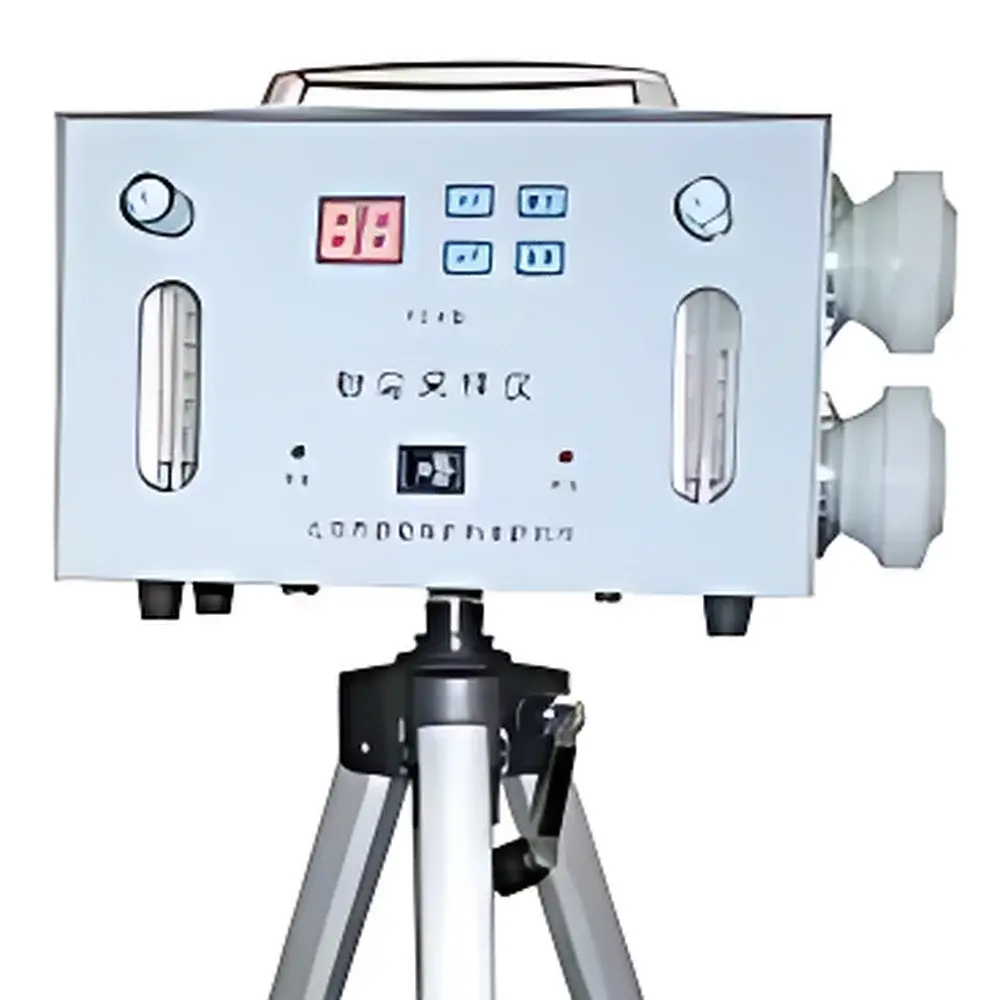
FC-4 Dust Sampler
| Origin | Jiangsu, China |
|---|---|
| Manufacturer Type | Authorized Distributor |
| Origin Category | Domestic (China) |
| Model | FC-4 |
| Pricing | Available Upon Request |
| Flow Range | 3–25 L/min (dual-channel, continuously adjustable) |
| Vacuum Pressure | >2500 Pa |
| Flowmeter Accuracy | Class 2.5 |
| Timer Range | 0–99 min (timing error ≤0.1%) |
| Battery Runtime | >3 hours (continuous operation) |
| Operating Temperature | 0–40 °C |
| Relative Humidity | <95% RH |
| Power Supply | 9.6 V / 4.5 Ah Ni-Cd rechargeable battery |
| Operating Current | <1.2 A |
| Dimensions (H×W×D) | 230 × 140 × 140 mm |
| Standard Kit Includes | 1× main unit, 2× sampling heads, 2× filter cassettes, 2× boxes of standard 37-mm or 25-mm membrane filters (e.g., PVC, mixed cellulose ester), 1× AC adapter cable, 1× tripod mount, 1× user manual, 1× certificate of conformity, 1× aluminum carrying case |
Overview
The FC-4 Dust Sampler is a dual-channel, portable gravimetric sampling instrument engineered for quantitative collection of airborne particulate matter (PM) in occupational and environmental monitoring applications. It operates on the principle of constant-flow aspiration through standardized filter media—typically 37-mm or 25-mm diameter membranes—enabling mass concentration determination (mg/m³) following gravimetric analysis per ISO 7708, EN 481, and OSHA Method ID-142. Its dual independent pump architecture supports simultaneous sampling at two distinct flow rates or parallel collection of identical samples for analytical redundancy and quality assurance. Designed for field deployment, the FC-4 integrates robust mechanical construction with precise electronic timing and stable flow control under variable backpressure conditions typical of loaded filter cassettes.
Key Features
- Dual independent diaphragm pumps delivering consistent flow across the full 3–25 L/min range, optimized for respirable and total dust fraction collection using cyclones or IOM samplers.
- High-efficiency vacuum generation (>2500 Pa) ensures reliable performance even with high-resistance filter media or extended sampling durations.
- Class 2.5 precision flowmeters calibrated traceably to national standards, supporting compliance with ISO 13137 and NIOSH Manual of Analytical Methods (NMAM) Chapter 2.
- Microprocessor-based timer with ±0.1% accuracy over 0–99 minute intervals, enabling repeatable exposure assessment protocols aligned with OEL (Occupational Exposure Limit) sampling strategies.
- Integrated low-voltage warning circuitry and energy-efficient electronics extend operational time beyond 3 hours on a single Ni-Cd battery charge (9.6 V / 4.5 Ah).
- Compact, shock-resistant aluminum enclosure (230 × 140 × 140 mm) with ergonomic handling and tripod-mount compatibility for both personal and area monitoring configurations.
Sample Compatibility & Compliance
The FC-4 accommodates standard 37-mm or 25-mm filter cassettes—including PVC, mixed cellulose ester (MCE), polycarbonate, and quartz fiber—used in accordance with ISO 8518 (coal dust), EN 689 (workplace aerosol assessment), and ACGIH TLV® guidelines. Its dual-channel design supports paired sampling for laboratory verification, duplicate analysis, or split-stream configurations (e.g., respirable vs. inhalable fractions). The instrument meets electromagnetic compatibility (EMC) requirements per IEC 61326-1 and is suitable for use in non-hazardous environments classified under IEC 60079-0. While not intrinsically safe, it serves as a foundational platform for certified explosion-proof accessory integration (e.g., external spark-proof housings) where required by local mining or chemical processing regulations.
Software & Data Management
The FC-4 operates as a standalone hardware system without embedded firmware-based data logging; however, its timer and flow stability support GLP-compliant manual recordkeeping. Users may integrate the device into broader digital workflows via external logging tools—such as barcode-scanned sample ID assignment or spreadsheet-based exposure tracking aligned with ISO/IEC 17025 documentation requirements. All calibration records, maintenance logs, and filter lot traceability data can be archived to satisfy internal QA/QC audits and regulatory submissions under OSHA 1910.1200 or EU REACH Annex XVII reporting frameworks.
Applications
- Occupational hygiene surveys in metallurgy, coal mining, foundries, cement production, and power generation facilities.
- Industrial hygiene baseline studies for respirable crystalline silica (RCS), asbestos fibers, welding fume, and metal oxide particulates.
- Environmental compliance monitoring near construction sites, quarries, and bulk material handling terminals.
- Educational and research laboratories conducting aerosol physics experiments, filter efficiency testing, and method validation studies.
- Public health investigations assessing indoor air quality in schools, hospitals, and municipal buildings.
FAQ
What filter types are compatible with the FC-4 Dust Sampler?
Standard 37-mm or 25-mm membrane filters—including PVC, mixed cellulose ester (MCE), polycarbonate, and quartz fiber—are fully supported for gravimetric analysis per ISO 7708 and NMAM methods.
Can the FC-4 operate continuously for an 8-hour shift?
No—the built-in Ni-Cd battery supports >3 hours of continuous operation; for full-shift sampling, users must employ external DC power supplies or implement timed sequential sampling protocols.
Is the FC-4 suitable for explosive atmospheres?
Not out-of-the-box; it is rated for general-purpose industrial use only. Explosion-proof variants require third-party certification and mechanical housing modifications compliant with ATEX or IECEx directives.
Does the FC-4 include flow calibration traceability documentation?
Yes—each unit ships with a factory calibration certificate referencing national metrology institute standards; annual recalibration is recommended per ISO/IEC 17025 and manufacturer guidelines.
How is flow rate verified during field use?
Users should perform pre- and post-sampling calibrations using a primary standard (e.g., bubble flowmeter or electronic calibrator) per ISO 13137 Section 6.3 to ensure measurement integrity throughout the sampling event.







