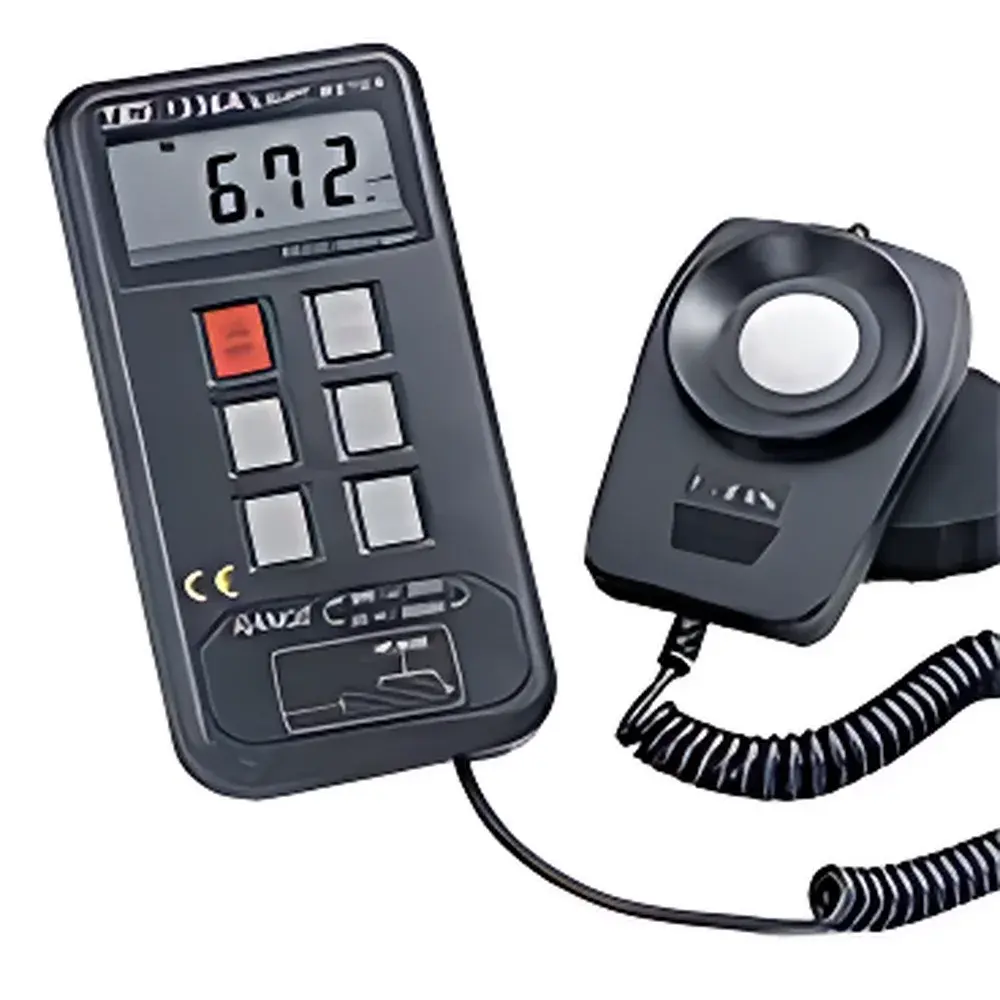
TES-1336A Digital Illuminance Meter
| Origin | Jiangsu, China |
|---|---|
| Manufacturer Type | Authorized Distributor |
| Origin Classification | Domestic (PRC) |
| Model | TES-1336A |
| Price | Upon Request |
| Measurement Range | 0–20,000 Lux / ft-cd (1 ft-cd = 10.76 Lux) |
| Display | 3½-digit LCD |
| Ranges | 20 / 200 / 2,000 / 20,000 Lux/ft-cd |
| Overload Indication | "OL" |
| Resolution | 0.01 Lux (0.01 ft-cd) |
| Accuracy | ±(3% of reading + 5 digits) |
| Repeatability | ±2% |
| Temperature Coefficient | ±0.1%/°C |
| Sampling Rate | 2.5 readings/sec |
| Sensor | Silicon photodiode |
| Data Logging Capacity | Up to 255 groups, 16,000 total records |
| RS-232 Interface | 9600 bps, includes 9-pin to 25-pin adapter |
| Operating Conditions | 0–40°C, 10–80% RH |
| Storage Conditions | −10–60°C, 10–70% RH |
| Power Supply | 9V alkaline battery (IEC 6F22 / NEDA 1604 / 006P) |
| Battery Life | Approx. 50 hours continuous use |
| Detector Cable Length | 150 cm |
| Detector Dimensions | 87.5 × 60 × 29 mm (L×W×H) |
| Meter Dimensions | 146 × 70 × 39 mm (L×W×H) |
| Weight | 300 g |
| Standard Accessories | Instruction manual, protective holster, 9V battery, RS-232 cable, 9-pin-to-25-pin adapter, calibration rod, software disk |
Overview
The TES-1336A Digital Illuminance Meter is a precision handheld instrument engineered for reliable, traceable measurement of visible light intensity in photometric units—specifically lux (lx) and foot-candles (ft-cd). Based on silicon photodiode detection with cosine-corrected angular response, the device adheres to CIE photopic luminosity function V(λ) standards to ensure spectral weighting fidelity across the 400–700 nm visible spectrum. Its dual-unit capability (lux/ft-cd) and calibrated linearity over four decades (0.01–20,000 lx) support applications ranging from workplace lighting compliance audits to architectural daylighting validation and industrial hygiene assessments. Designed for field portability and laboratory-grade repeatability, the TES-1336A delivers stable photometric performance under ambient conditions per IEC 60825-1 and ISO/CIE 19476:2014 guidelines for illuminance meter classification.
Key Features
- Four auto-ranging measurement scales (20 / 200 / 2,000 / 20,000 lux), eliminating manual range selection errors
- High-resolution 3½-digit LCD with overload indication (“OL”) and real-time sampling at 2.5 Hz
- Integrated data logging system storing up to 255 grouped sessions (16,000 total readings), timestamped and retrievable via serial interface
- RS-232 communication port (9600 bps) with included 9-pin to 25-pin adapter and dedicated PC software for export to CSV or Excel-compatible formats
- Cosine-corrected photodiode sensor mounted on 150 cm flexible cable, enabling remote probe placement while minimizing shadowing and operator-induced irradiance perturbation
- Calibration traceable to national standards; accuracy specified as ±(3% rdg + 5 digits) with temperature compensation of ±0.1%/°C
- Robust mechanical design: lightweight (300 g), IP54-rated enclosure for dust and splash resistance during routine field deployment
Sample Compatibility & Compliance
The TES-1336A is optimized for steady-state or slowly varying broadband visible light sources—including LED, fluorescent, incandescent, and metal halide fixtures—without requiring spectral correction factors when used within its specified spectral response range. It complies with international photometric practice requirements outlined in ISO 8995-1 (Lighting of work places), EN 12464-1 (Lighting of workplaces – Indoor), and IESNA RP-1 (Recommended Practice for Lighting for Offices). While not certified for Class I explosion-proof environments, its non-intrusive operation and low-power design make it suitable for general industrial, commercial, educational, and healthcare facility surveys. All firmware and hardware configurations meet electromagnetic compatibility (EMC) requirements per EN 61326-1 and safety standards per EN 61010-1.
Software & Data Management
The bundled Windows-compatible software enables full configuration of logging parameters (sampling interval, group naming, auto-start triggers), real-time graphing of illuminance trends, and batch export of datasets with metadata (date, time, unit, range). Audit-ready data files include embedded instrument ID, firmware version, and user-defined location tags. The software supports basic statistical analysis (min/max/mean/stdev) and generates PDF reports compliant with internal QA documentation protocols. Though not validated for 21 CFR Part 11 environments, the system supports GLP-aligned workflows through manual electronic signature integration and revision-controlled report templates.
Applications
- Workplace lighting verification per OSHA 1910.303 and EU Directive 2002/44/EC on artificial optical radiation
- Daylight harvesting system commissioning and seasonal performance monitoring in green building projects
- Photobiological safety screening for LED lighting installations (IEC TR 62778)
- Educational physics laboratories for inverse-square law experiments and spectral response characterization
- Architectural lighting design validation against LEED EQ Credit 8.1 (Daylight and Views)
- Factory floor illumination mapping for ISO 9001 clause 7.1.4 (Process environment)
FAQ
What is the spectral response range of the TES-1336A sensor?
The integrated silicon photodiode conforms to the CIE V(λ) photopic luminosity curve between 400 nm and 700 nm, with peak sensitivity near 555 nm.
Can the device measure pulsed or rapidly modulated light sources?
No—the 2.5 Hz sampling rate and analog signal conditioning are optimized for quasi-steady illumination; high-frequency flicker analysis requires dedicated flickermeters (e.g., IEEE 1789-compliant instruments).
Is calibration certificate included with purchase?
A factory calibration report is supplied; NIST-traceable recalibration services are available through authorized service centers every 12 months or after physical impact.
Does the RS-232 interface support USB adapters?
Yes—standard USB-to-RS-232 converters (FTDI chipset-based) are fully compatible when configured for 9600 bps, 8N1, no flow control.
How is cosine error minimized in field measurements?
The detector features a diffuser-coated aperture and optimized housing geometry to achieve <±3% cosine error at 60° incidence angle, meeting ISO/CIE 19476:2014 Class L requirements.