
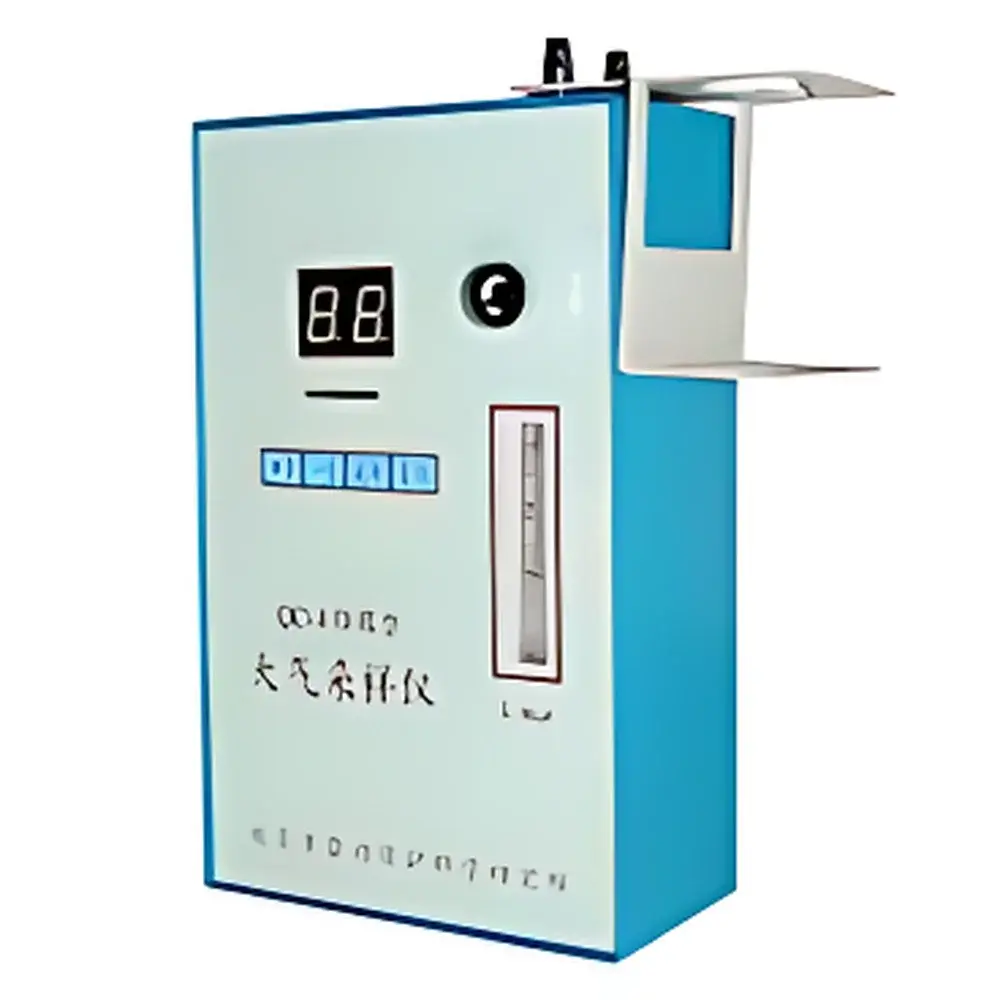
Yinghe QC-4 Intrinsically Safe Ambient Air Sampler
| Origin | Jiangsu, China |
|---|---|
| Manufacturer Type | Authorized Distributor |
| Origin Category | Domestic (China) |
| Model | QC-4 |
| Pricing | Available Upon Request |
| Load Capacity | ≥2 L/min at 4000 Pa |
| Flow Range | 0.1–1.5 L/min |
| Flow Stability | ≤5% |
| Flow Accuracy | ≤5% |
| Timer Range | 1–99 min |
| Timer Accuracy | <0.1% |
| Operating Temperature | −10 to +45 °C |
| Battery Runtime | ≥5 h (continuous) |
| Dimensions (W×H×D) | 115 × 190 × 60 mm |
| Weight (incl. battery) | 700 g |
Overview
The Yinghe QC-4 Intrinsically Safe Ambient Air Sampler is a certified portable gas sampling instrument engineered for reliable operation in hazardous locations where flammable gases, vapors, or combustible dusts may be present. Designed in strict compliance with Chinese explosion-protection standards (GB 3836.1–2010 and GB 3836.4–2010), the device employs intrinsic safety (Ex ib IIB T4 Gb) design principles—limiting electrical and thermal energy to levels incapable of igniting surrounding atmospheres. Its core sampling mechanism relies on a high-efficiency diaphragm pump, delivering stable volumetric flow under variable backpressure conditions. The instrument integrates a microprocessor-controlled timing circuit, digital LCD display, and precision analog flow regulation, enabling repeatable, time-weighted average (TWA) air sample collection for subsequent laboratory analysis (e.g., GC, HPLC, or gravimetric determination of airborne contaminants). It is not a real-time detector but a quantitative, gravimetric, or sorbent-based sampling platform intended for occupational hygiene, environmental compliance, and process safety monitoring.
Key Features
- Intrinsically safe construction certified to Ex ib IIB T4 Gb per GB 3836.1/4–2010—suitable for Zone 1 and Zone 2 hazardous areas
- High-torque, low-noise diaphragm pump with ≥2 L/min flow capacity at 4000 Pa backpressure—ensuring consistent aspiration through adsorbent tubes, impingers, or filter media
- Digital LCD timer with adjustable 1–99 minute intervals and <0.1% timing accuracy—supporting OSHA, NIOSH, and GBZ 159–2004 sampling protocols
- Compact ergonomic housing (115 × 190 × 60 mm) and lightweight design (700 g with battery)—optimized for personal (belt-mounted) and fixed-point deployment
- Flow stability ≤5% and flow accuracy ≤5% across full 0.1–1.5 L/min range—validated using traceable primary flow standards
- Extended battery runtime ≥5 hours on rechargeable Ni-MH pack—enabling full-shift TWA sampling without interruption
- Integrated over-pressure protection via built-in safety buffer bottle—preventing liquid carryover into pump chamber during impinger use
Sample Compatibility & Compliance
The QC-4 supports standardized sampling media including 37-mm and 25-mm membrane filters (for total/particulate matter), glass fiber filters (for asbestos or metals), charcoal or silica gel tubes (for VOCs), and impinger solutions (e.g., formaldehyde or sulfur dioxide absorption). It meets functional requirements outlined in GBZ/T 160 series (Chinese occupational exposure standards), as well as alignment with ISO 16000-22 (indoor air—sampling strategies) and ASTM D1357 (standard practice for sampling ambient air). While not CE-marked or ATEX-certified, its intrinsic safety certification enables deployment in Class I, Division 2 (NEC) and Zone 1 (IEC) environments when used with approved accessories. Device calibration must be performed prior to each sampling campaign using a NIST-traceable dry calibrator or bubble meter.
Software & Data Management
The QC-4 operates as a standalone hardware system with no embedded firmware update capability or Bluetooth/Wi-Fi connectivity. All operational parameters—including start time, duration, and manual flow verification logs—are recorded manually by the user in field notebooks or electronic lab notebooks (ELNs). To support GLP/GMP-aligned workflows, laboratories are advised to maintain a controlled calibration log (per ISO/IEC 17025), including date, technician ID, calibrator serial number, pre- and post-calibration flows, and environmental conditions. The device’s timer accuracy (<0.1%) satisfies audit requirements for time-stamped exposure assessment under China’s Work Safety Law and GBZ 188–2014 (occupational health surveillance technical specification).
Applications
- Occupational hygiene monitoring in coal mines, petrochemical refineries, paint manufacturing, and solvent-handling facilities
- Fixed-location ambient air quality assessment near fenceline emission sources in compliance with GB 3095–2012 (ambient air quality standards)
- Personal exposure sampling for respirable crystalline silica (quartz), lead, manganese, or organic vapors per GBZ 2.1–2019
- Pre-commissioning verification of local exhaust ventilation (LEV) system performance
- Emergency response sampling during chemical release incidents in intrinsically safe zones
- Educational and research applications requiring portable, certified sampling in controlled hazardous labs
FAQ
Is the QC-4 certified for use in ATEX or IECEx zones?
No. The QC-4 holds GB 3836-series intrinsic safety certification (Ex ib IIB T4 Gb) for use in Chinese hazardous area classifications. It is not ATEX or IECEx certified; users operating in EU or international facilities must verify equivalency with local authority approval prior to deployment.
What battery chemistry does the QC-4 use, and how is it charged?
The unit employs a sealed 7.2 V Ni-MH rechargeable battery pack. Charging is performed via the included regulated AC adapter (input: 100–240 V AC; output: 8.4 V DC), with full charge achieved in ≤6 hours. Battery health should be verified monthly using load testing.
Can the QC-4 be used with conductive tubing in static-sensitive environments?
Yes. When sampling low-conductivity vapors (e.g., hydrocarbons), antistatic or carbon-impregnated sampling lines are recommended to prevent electrostatic discharge—consistent with NFPA 77 guidance on static electricity control.
Does the device support constant-flow mode across varying filter loading?
It features passive flow regulation only. For true constant-flow operation under increasing filter resistance, external electronic flow controllers (e.g., mass flow controllers with feedback loops) must be integrated upstream—a configuration not natively supported by the QC-4.
Related Products







