
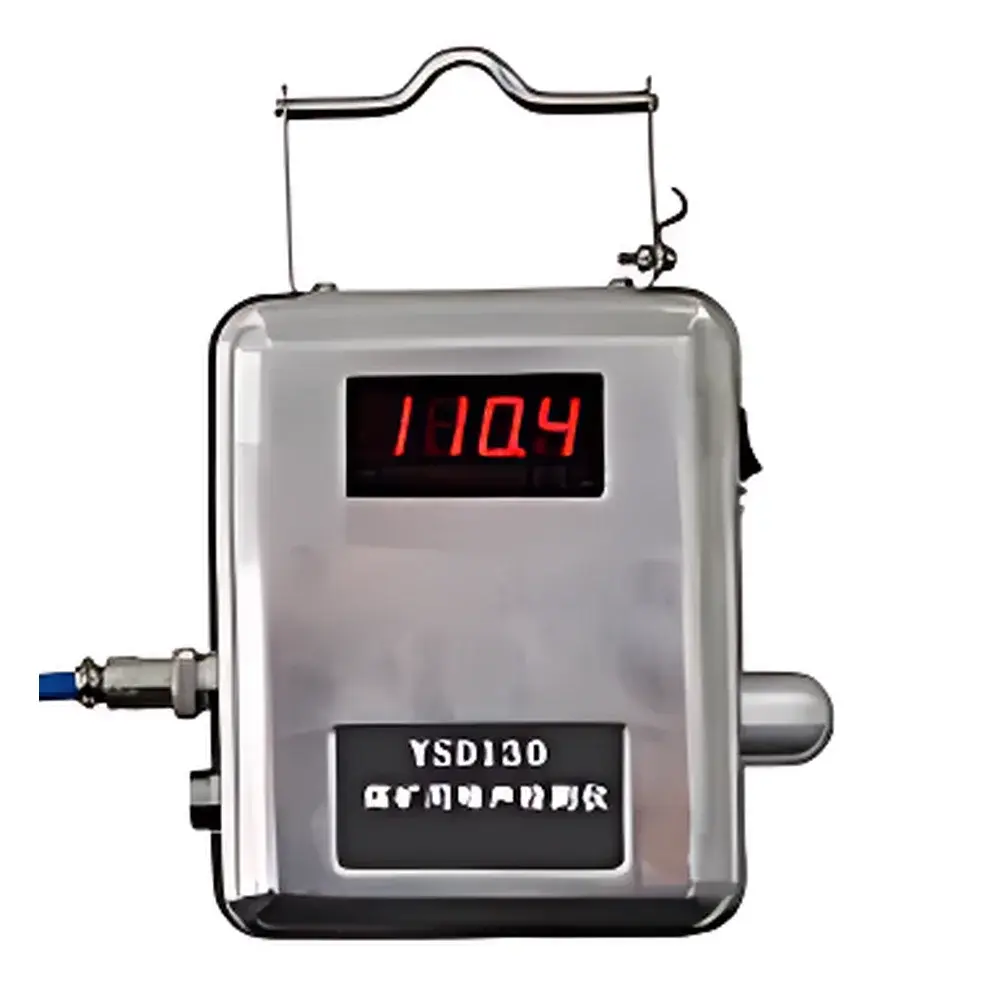
YSD-130 Mine-Use Intrinsically Safe Sound Level Meter
| Origin | Jiangsu, China |
|---|---|
| Manufacturer Type | Authorized Distributor |
| Origin Category | Domestic (PRC) |
| Model | YSD-130 |
| Pricing | Available Upon Request |
| Measurement Range | 40–130 dB(A) |
| Accuracy | ±2.5% |
| Operating Voltage | 7.5–12.5 V DC |
| Max Current Draw | ≤80 mA |
| Battery Life | ≥8 h |
| Output Interface | RS485 (2400 bps) |
| Dimensions | 220 × 140 × 40 mm |
| Weight | 1.0 kg |
| Intrinsic Safety Certification | Exib I |
| Environmental Operating Range | 0–40 °C, 80–110 kPa, ≤95% RH (non-condensing) |
| Compliance | GB 3836.1–2021, GB 3836.2–2021, GB 3836.4–2021, JJG 188–2017 (Class 2 Sound Level Meter) |
Overview
The YSD-130 Mine-Use Intrinsically Safe Sound Level Meter is a Class 2 precision acoustic measurement instrument engineered specifically for hazardous underground coal mine environments. Designed in strict compliance with the latest national metrological verification regulation JJG 188–2017 and the Chinese intrinsic safety standards GB 3836.1, GB 3836.2, and GB 3836.4, the device employs A-weighted frequency response (dB(A)) to quantify occupational noise exposure in accordance with ISO 1996-2 and IEC 61672-1 requirements. Its core architecture integrates a high-stability electret condenser microphone, analog-to-digital conversion with automatic ranging, and real-time signal processing optimized for low-SNR industrial settings. The instrument operates within a dynamic range of 40–130 dB(A), enabling reliable assessment of both ambient background noise and impulsive mining machinery emissions—critical for adherence to China’s Workplace Occupational Health Supervision Regulations and international best practices in hearing conservation programs.
Key Features
- Intrinsically safe design certified to Exib I marking—approved for use in methane- and coal-dust-laden atmospheres per GB 3836.4–2021;
- Integrated A-weighting network compliant with IEC 61672-1:2013 Class 2 performance specifications;
- Auto-ranging circuitry eliminates manual range selection, reducing operator error during rapid environmental transitions;
- RS485 serial interface (2400 bps) supports integration into centralized mine monitoring systems and SCADA networks;
- Onboard data storage enables time-stamped logging of up to 2,000 measurement records (Leq, Lmax, Lmin, Lpeak) without external power;
- Robust mechanical housing (220 × 140 × 40 mm, 1.0 kg) constructed from flame-retardant ABS with IP54-rated ingress protection;
- Extended operational autonomy: ≥8 hours continuous measurement on internal rechargeable Li-ion battery (7.5–12.5 V DC input compatible);
- Optimized thermal management for stable calibration drift ≤0.3 dB/°C across 0–40 °C ambient range.
Sample Compatibility & Compliance
The YSD-130 is validated for direct field deployment in Class I, Division 1 hazardous locations as defined under GB 3836. It is routinely deployed for noise mapping in underground conveyor zones, drilling faces, ventilation fan rooms, and crusher stations where combustible dust or explosive gas mixtures may be present. The instrument satisfies mandatory requirements for occupational noise monitoring under China’s Regulations on Prevention and Control of Occupational Diseases and aligns with supplementary guidance from the National Institute for Occupational Safety and Health (NIOSH) for underground mining noise surveys. All calibration procedures follow traceable protocols referenced to national primary acoustic standards maintained by the China National Institute of Metrology (CNIM). Device firmware and hardware configurations are locked to prevent unauthorized modification—ensuring ongoing conformance with intrinsic safety boundaries specified in GB 3836.4.
Software & Data Management
Data retrieval is performed via standardized RS485 communication using ASCII-based command protocol. A dedicated Windows-compatible configuration and analysis utility (provided on secure USB drive) supports batch download, spectral histogram generation, daily/weekly Leq reporting, and export to CSV or PDF formats compliant with GLP documentation requirements. Audit trails record all configuration changes, calibration events, and user logins with timestamp and operator ID. While the YSD-130 does not implement FDA 21 CFR Part 11 electronic signature functionality, its data integrity safeguards—including write-protected memory sectors and cyclic redundancy check (CRC) validation on all stored records—meet baseline requirements for regulatory review in occupational health audits.
Applications
- Ongoing noise exposure assessment for coal mine personnel under China’s occupational exposure limit (OEL) of 85 dB(A) over an 8-hour TWA;
- Pre-commissioning acoustic validation of newly installed ventilation systems and belt conveyors;
- Periodic verification of engineering controls (e.g., mufflers, enclosures) in accordance with ISO 9612:2009;
- Baseline noise mapping for hazard classification and zoning per AQ/T 9006–2010 (Safety Production Standardization Basic Specification);
- Field verification of personal protective equipment (PPE) effectiveness in conjunction with dosimeter measurements;
- Acoustic emission screening during maintenance of hydraulic roof supports and shearer loaders.
FAQ
Is the YSD-130 certified for use in gassy coal mines?
Yes—the device carries full Exib I certification per GB 3836.4–2021 and is approved for operation in environments with methane concentrations up to 100% LEL and respirable coal dust layers.
Does it support real-time data streaming to a central control room?
Yes—via RS485 at 2400 bps, the meter transmits instantaneous sound pressure level (SPL) and statistical metrics (Leq, Lmax) in ASCII format compatible with Modbus RTU gateways.
What is the recommended calibration interval?
Annual traceable calibration against a national standard sound calibrator (e.g., B&K 4231) is required; field verification with a Class 1 pistonphone (e.g., G.R.A.S. 42AB) is advised before each shift.
Can measurement data be exported for regulatory reporting?
Yes—CSV exports include date/time stamps, measurement mode, location ID, and full statistical parameters, supporting submission to provincial Work Safety Bureaus in standardized formats.
Is firmware upgrade capability available?
Firmware updates are performed exclusively by authorized service centers using encrypted firmware packages; end-user modification is physically prohibited by hardware write-protection fuses.







