
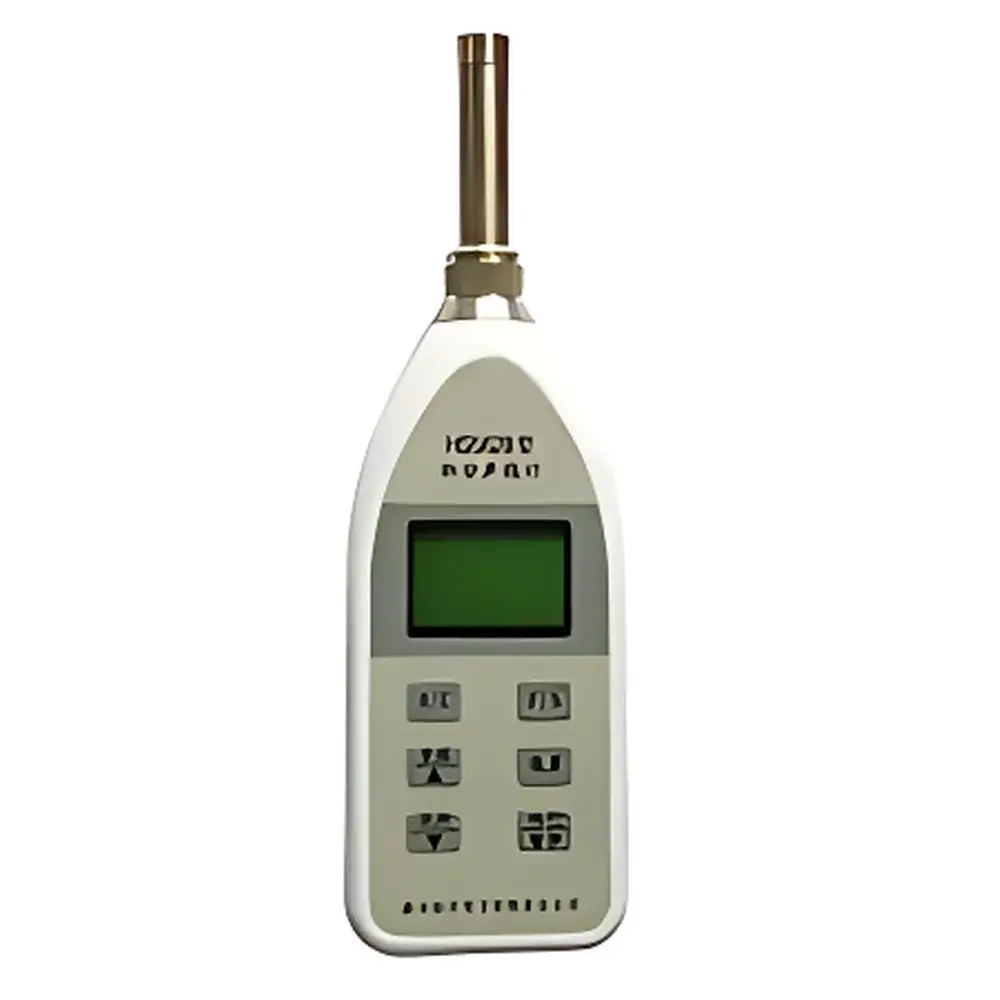
HS5628 Integrated Sound Level Meter
| Origin | Jiangsu, China |
|---|---|
| Manufacturer Type | Distributor |
| Origin Category | Domestic (China) |
| Model | HS5628 |
| Pricing | Upon Request |
| Microphone | 1/2″ (Φ12.7 mm) Electret Condenser |
| Measurement Range | 35 dB to 130 dB |
| Frequency Range | 20 Hz – 10 kHz |
| Frequency Weighting | A, C |
| Time Weighting | Fast (F), Slow (S) |
| Detector | Digital True RMS with Peak Factor ≥ 3 |
| Range Selection | High / Medium / Low (≥60 dB linear range per range) |
| Measurement Durations | 10 s, 1 min, 5 min, 10 min, 15 min, 20 min, 30 min, 1 h, 8 h, 24 h, Manual |
| Metrics | L<sub>p</sub>, L<sub>eq</sub>, L<sub>AE</sub>, SD, L<sub>max</sub>, L<sub>min</sub>, E |
| Display | 8×2 Dot-Matrix LCD |
| AC Output | Yes |
| Power Supply | Two AA batteries |
| Dimensions (L×W×H) | 200 × 62 × 30 mm |
| Mass | 200 g (including batteries) |
| Operating Temperature | −10 °C to +50 °C |
| Relative Humidity | 20% – 90% RH |
Overview
The HS5628 Integrated Sound Level Meter is a compact, handheld instrument engineered for precision environmental and occupational noise assessment in accordance with internationally recognized metrological standards. It operates on the principle of electroacoustic transduction using a calibrated electret condenser microphone, followed by digital signal processing to compute time-integrated acoustic parameters. Designed to meet IEC 61672-1:2013 Class 2 requirements—and fully compliant with GB/T 3785.1–2010 (equivalent to IEC 651)—the device delivers traceable, repeatable measurements suitable for regulatory monitoring, workplace health & safety evaluations, and industrial noise source characterization. Its true RMS detection architecture ensures accurate representation of complex, non-sinusoidal noise waveforms, including impulsive and fluctuating signals commonly encountered in manufacturing, transportation, and urban environments.
Key Features
- Class 2-compliant performance per IEC 61672-1:2013 and GB/T 3785.1–2010, validated for field-deployable accuracy
- Dual-frequency weighting networks (A and C) enabling compliance evaluation against occupational exposure limits (e.g., OSHA 1910.95, ISO 1999) and environmental criteria (e.g., EU Environmental Noise Directive 2002/49/EC)
- Three manually selectable input ranges (High/Medium/Low), each offering ≥60 dB linear dynamic range—optimized for minimizing overload risk across diverse sound pressure levels
- Programmable measurement durations from 10 seconds to 24 hours, supporting standardized metrics including equivalent continuous sound pressure level (Leq), sound exposure level (LAE), statistical percentiles (Lmax, Lmin), standard deviation (SD), and total energy (E)
- Digital true RMS detector with peak factor ≥3, ensuring fidelity in capturing transient events without clipping or averaging artifacts
- Low-power design powered by two standard AA cells, delivering up to 20 hours of continuous operation under typical usage conditions
- Compact form factor (200 × 62 × 30 mm; 200 g with batteries) optimized for handheld survey work, personal dosimetry support, and extended field deployment
Sample Compatibility & Compliance
The HS5628 is intended for use with free-field or diffuse-field acoustic environments where incident sound pressure levels fall within its specified operating range (35–130 dB re 20 µPa). It accommodates standard 1/2″ microphone calibrators (e.g., pistonphones per IEC 60942) for on-site verification. The instrument satisfies technical requirements for routine environmental noise monitoring per national implementation guidelines of ISO 1996-1 and ISO 1996-2. While not certified for explosion-proof use, it is suitable for general industrial settings meeting IP54-equivalent ingress protection when operated within its specified temperature (−10 °C to +50 °C) and humidity (20–90% RH, non-condensing) limits. Calibration certificates traceable to national metrology institutes (e.g., NIM, China) may be provided upon request to support GLP-aligned data integrity protocols.
Software & Data Management
The HS5628 supports analog AC output for real-time connection to external data loggers, oscilloscopes, or spectrum analyzers—enabling synchronized multi-parameter acquisition. Although it does not feature built-in Bluetooth or USB storage, its measurement results are displayed directly on the 8×2 dot-matrix LCD and can be manually recorded for subsequent entry into laboratory information management systems (LIMS) or Excel-based reporting templates. For organizations requiring audit-ready documentation, the device’s manual timing mode and fixed-duration presets facilitate structured data collection aligned with ISO/IEC 17025 clause 7.7 (reporting of results) and support basic traceability in QA/QC workflows. No proprietary software is required; however, third-party tools compatible with analog voltage outputs may be used for waveform capture and post-processing.
Applications
- Environmental noise mapping near roadways, railways, airports, and construction sites per ISO 1996-2
- Workplace noise exposure assessment for compliance with national occupational hygiene standards (e.g., GBZ 2.2–2007 in China, OSHA PELs in the US)
- Industrial machinery noise diagnostics—including rotating equipment, HVAC systems, compressors, and power tools
- Educational acoustics laboratories for student experiments on sound propagation, attenuation, and frequency analysis
- Municipal noise ordinance enforcement and community complaint investigations
- Pre-commissioning and commissioning verification of noise control measures (e.g., enclosures, barriers, silencers)
FAQ
Is the HS5628 suitable for legal metrology or court-admissible noise evidence?
The HS5628 meets IEC 61672-1 Class 2 specifications, making it appropriate for routine monitoring and preliminary assessments—but not for legally binding measurements requiring Class 1 instrumentation or accredited calibration under ISO/IEC 17025.
Can the device perform octave or 1/3-octave band analysis?
No. The HS5628 is a broadband integrating sound level meter and does not incorporate real-time spectral decomposition capabilities.
What is the recommended calibration interval?
Annual calibration against an accredited acoustic calibrator (e.g., 1 kHz, 94 dB or 114 dB reference) is recommended; field verification before and after each measurement session is advised per ISO 9612.
Does the HS5628 support data logging with timestamps?
No internal memory or timestamping functionality is included; measurements must be manually logged or captured externally via AC output.
Is the microphone pre-polarized and field-replaceable?
Yes—the 1/2″ electret condenser microphone is permanently polarized and mechanically compatible with standard IEC 61094-4 mounts, allowing for replacement or recalibration by authorized service centers.
Related Products







