
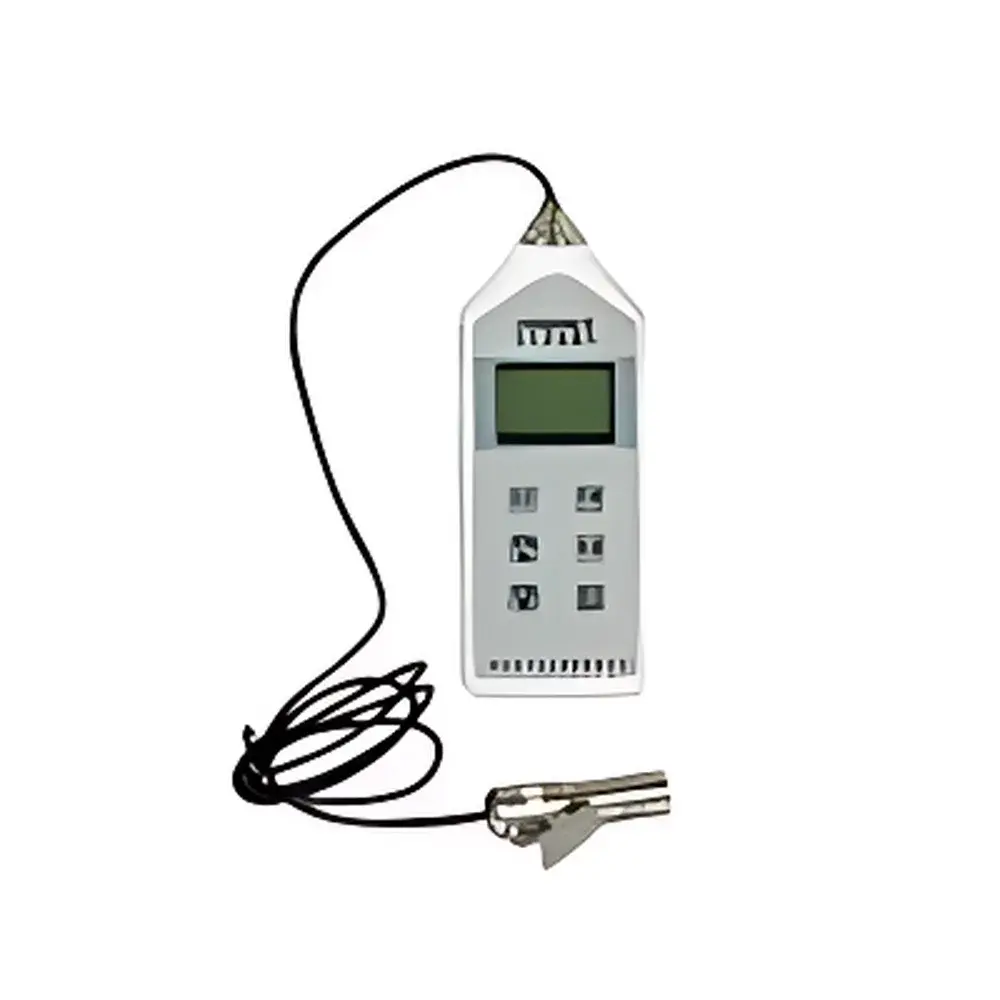
HS5628B Personal Sound Exposure Meter
| Origin | Jiangsu, China |
|---|---|
| Manufacturer Type | Distributor |
| Origin Category | Domestic (China) |
| Model | HS5628B |
| Price | Upon Request |
| Microphone | 1/2″ (Φ12.7 mm) electret condenser |
| Measurement Range | 35–130 dB(A), 40–130 dB(C) |
| Frequency Range | 20 Hz – 10 kHz |
| Frequency Weighting | A, C |
| Time Weighting | Fast (F), Slow (S) |
| Detector | Digital detection with peak factor ≥3 |
| Dynamic Range per Range | ≥60 dB |
| Range Settings | High (70–130 dB), Medium (50–110 dB), Low (35–90 dB) |
| Measurement Modes | Mode 1 (integrated metrics: L<sub>p</sub>, L<sub>eq</sub>, L<sub>AE</sub>, L<sub>max</sub>, L<sub>min</sub>, E |
| duration options | 10 s, 1, 5, 10, 20, 30 min, 1 h, 8 h, 24 h, or manual) |
| Mode 2 (continuous L<sub>eq</sub> with user-defined interval | 1–10 s) |
| Display | 8×2 dot-matrix LCD |
| Data Storage | 500 measurement sets |
| Interface | RS-232 serial port |
| Power Supply | 3 V (2 × AA batteries) |
| Dimensions (L×W×H) | 160 × 52 × 25 mm |
| Mass | 200 g (including batteries) |
| Operating Temperature | −10 °C to +50 °C |
| Relative Humidity | 20–90 % RH |
Overview
The HS5628B Personal Sound Exposure Meter is a compact, battery-powered occupational noise monitoring instrument engineered for compliance with international sound exposure assessment protocols, including ISO 9612:2009 and ANSI S1.25-1991. It employs digital signal processing-based detection to deliver stable, repeatable acoustic measurements across a wide dynamic range. Designed for personal dosimetry applications, the device captures time-integrated noise exposure metrics—including equivalent continuous sound pressure level (Leq), sound exposure level (LAE), maximum/minimum sound pressure levels (Lmax/Lmin), instantaneous pressure level (Lp), and total sound exposure (E)—in accordance with IEC 61672-1:2013 Class 2 performance requirements. Its lightweight form factor (200 g) and ergonomic design support extended wear during full-shift monitoring in industrial, construction, and municipal environments.
Key Features
- Dual operational modes: Mode 1 supports standardized integrated exposure assessments (e.g., 8-hour Leq, LAE, E) with configurable durations from 10 seconds to 24 hours; Mode 2 enables high-resolution continuous Leq logging at user-selectable intervals (1–10 s).
- Three manually switchable measurement ranges (Low: 35–90 dB, Medium: 50–110 dB, High: 70–130 dB), each offering ≥60 dB linear dynamic range and automatic overload/under-range indication.
- IEC 61672-compliant frequency weighting (A and C) and time weighting (Fast and Slow) ensure regulatory alignment for occupational health reporting.
- Digital detector architecture with peak factor ≥3 guarantees accurate capture of impulsive and transient noise events without analog clipping artifacts.
- Integrated real-time clock with date/time stamping for all stored records—critical for audit-ready documentation under OSHA 29 CFR 1910.95 and EU Directive 2003/10/EC.
- Onboard storage capacity for up to 500 complete measurement datasets, retained independently of power state.
- RS-232 serial interface compliant with TIA/EIA-232-F standards, enabling direct data export to PC-based analysis software or legacy thermal printers in field or laboratory settings.
Sample Compatibility & Compliance
The HS5628B is calibrated using a 1/2″ electret condenser microphone (Φ12.7 mm) meeting IEC 61094-4 specifications for free-field response. Its 20 Hz–10 kHz frequency range covers the full audible spectrum relevant to human hearing damage assessment. The instrument satisfies Class 2 accuracy requirements per IEC 61672-1:2013 for sound level meters and is suitable for workplace noise surveys conducted under ISO 9612 (field measurement strategy), ISO 1999 (hearing loss prediction), and national frameworks such as China’s GB/T 3785.1–2010. It does not meet Class 1 metrological specifications and is therefore not intended for primary calibration laboratories or reference-grade metrology. Environmental operation is validated between −10 °C and +50 °C at 20–90% RH, making it appropriate for indoor facilities, outdoor infrastructure sites, and mobile industrial platforms.
Software & Data Management
Data acquired by the HS5628B is structured in ASCII-encoded records compatible with standard spreadsheet and statistical analysis tools (e.g., Microsoft Excel, MATLAB, Python pandas). Each record includes timestamp, measurement mode, weighting configuration, range setting, and all computed metrics (Leq, Lmax, E, etc.). The RS-232 interface supports baud rates up to 9600 bps and requires no proprietary drivers—standard COM port communication suffices. While the meter itself does not feature USB or Bluetooth connectivity, third-party serial-to-USB adapters enable integration into modern Windows/macOS/Linux systems. All stored data retains full traceability for GLP-aligned reporting; however, the device lacks built-in electronic signature, audit trail, or 21 CFR Part 11 compliance features—users requiring regulated data integrity must implement external validation protocols and controlled file-handling procedures.
Applications
- Occupational hygiene assessments for compliance with national noise exposure limits (e.g., 85 dBA TWA over 8 hours).
- Task-based noise mapping in manufacturing, mining, transportation, and energy sectors.
- Verification of hearing protection effectiveness via before-and-after dosimetry.
- Baseline noise characterization during facility commissioning or retrofit projects.
- Educational demonstrations of acoustical principles and exposure modeling in university engineering labs.
- Field validation of noise control interventions (e.g., enclosure performance, damping treatments).
FAQ
What standards does the HS5628B comply with?
It meets IEC 61672-1:2013 Class 2 requirements for sound level meters and supports measurement methodologies defined in ISO 9612 and ANSI S1.25.
Can the HS5628B be used for legal noise enforcement?
No—it is designated for occupational health screening and preliminary assessment, not evidentiary-grade environmental enforcement where Class 1 instrumentation is mandated.
How long do the AA batteries last under typical use?
Approximately 100 hours of continuous operation in Mode 1 (8-hour measurement cycle), depending on backlight usage and ambient temperature.
Is calibration certificate included with purchase?
Factory calibration is performed prior to shipment; however, a formal NIST-traceable calibration certificate requires optional third-party service and is not supplied by default.
Does the device support Leq averaging over non-standard durations (e.g., 4.5 hours)?
Yes—Mode 1 allows manual (Man) triggering, enabling user-defined start/stop control for custom integration periods outside preset intervals.
Related Products







