
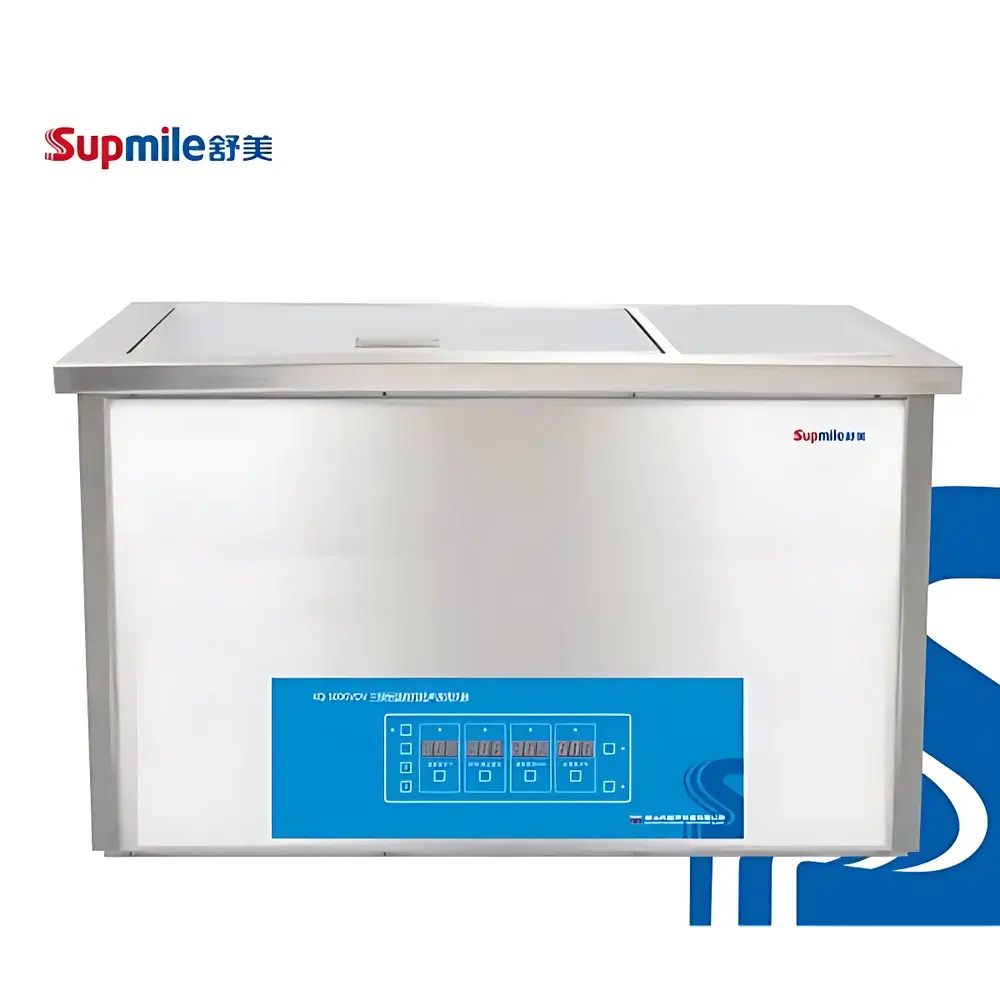
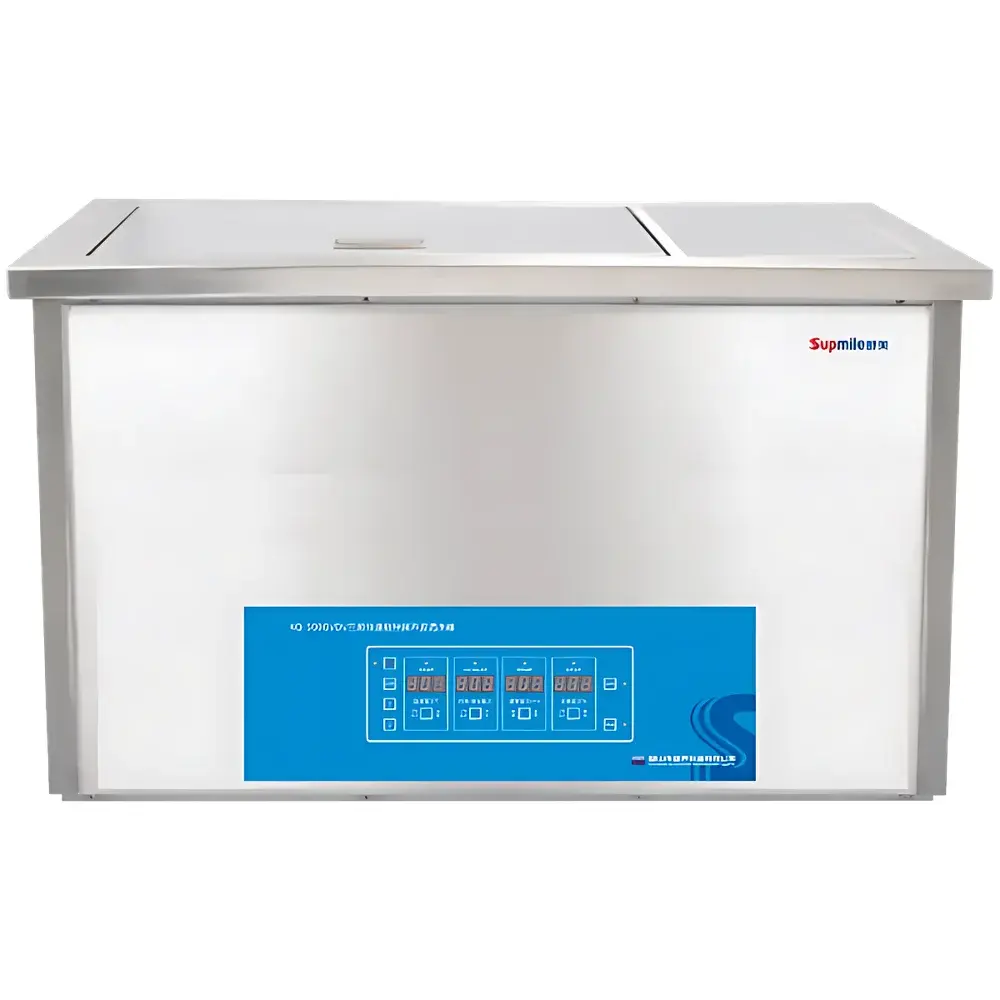
Shumei KQ-500GVDV Triple-Frequency Programmable Temperature-Controlled Ultrasonic Cleaner
| Brand | Shumei |
|---|---|
| Origin | Jiangsu, China |
| Manufacturer Type | Direct Manufacturer |
| Instrument Type | General-Purpose Ultrasonic Cleaner |
| Capacity | 27 L |
| Ultrasonic Frequencies | 45 / 80 / 100 kHz |
| Ultrasonic Power Output | 500 W (Adjustable 40–100%) |
| Heating Power | 800 W |
| Cooling Power | 350 W |
| Temperature Control Range | 0–80 °C (±2 °C accuracy) |
| Timer Range | 1–480 min |
| Noise Reduction Lid | Included |
| Automatic Fill/Drain | Electrically Controlled |
| Input Power | AC 220 V / 50 Hz |
| Internal Tank Dimensions | 500 × 300 × 180 mm |
| External Dimensions | 905 × 490 × 540 mm |
| Liquid Level Monitoring & Protection | Yes |
| Standard Accessories | Stainless Steel Mesh Basket, Stainless Steel Rack, Noise-Reduction Lid |
Overview
The Shumei KQ-500GVDV is a triple-frequency, microprocessor-controlled ultrasonic cleaner engineered for precision cleaning of delicate and complex laboratory components—including glassware, optical elements, semiconductor wafers, medical instruments, and analytical sample preparation vessels. It operates on the principle of cavitation-induced acoustic energy transfer, where high-frequency pressure waves generate transient microbubbles in the cleaning solution; their implosive collapse produces localized shear forces and micro-jets that dislodge particulate contaminants without mechanical abrasion. The instrument’s tri-band frequency capability (45 kHz, 80 kHz, and 100 kHz) enables selective optimization for diverse sample geometries and contaminant types: lower frequencies deliver higher cavitation intensity for robust particulate removal from macro-scale surfaces, while higher frequencies provide finer resolution for micro-contaminants and sensitive substrates such as MEMS devices or coated optics.
Key Features
- Triple-frequency ultrasonic generation with independent programmable switching between 45 kHz, 80 kHz, and 100 kHz—frequency transition time adjustable from 0 to 999 seconds for multi-stage cleaning protocols.
- Programmable temperature control (0–80 °C) with real-time digital display and ±2 °C thermal stability, supported by 800 W heating and 350 W active cooling circuits to maintain bath homogeneity during extended operation.
- 500 W total ultrasonic power output, continuously adjustable from 40% to 100% via digital interface—enabling fine-tuned energy delivery for fragile samples or viscous media.
- Integrated liquid level monitoring system with automatic low-level cutoff and visual/audible alert to prevent transducer dry-run damage and ensure consistent acoustic coupling.
- Full-digital microcontroller architecture with non-volatile memory for storing up to 10 user-defined cleaning programs—including time, temperature, frequency, and power settings—with recall functionality and parameter lockout for GLP-compliant workflows.
- Robust 304 stainless steel tank (500 × 300 × 180 mm internal) and chassis construction; DV-series sealed enclosure design minimizes airborne noise (<65 dB(A) at 1 m) and reduces thermal loss for energy-efficient operation.
Sample Compatibility & Compliance
The KQ-500GVDV accommodates a broad range of sample formats—from standard volumetric flasks and HPLC vials to irregularly shaped surgical tools and multi-layered microfluidic chips—via its 27 L capacity and included stainless steel mesh basket and support rack. Its frequency versatility supports ASTM D2603 (ultrasonic cleaning validation), ISO 13485 (medical device cleaning process verification), and USP (cleaning validation for pharmaceutical equipment). The unit complies with IEC 61000-6-3 (EMC emissions) and IEC 61010-1 (safety requirements for laboratory electrical equipment). Optional audit trail logging (via RS232/USB interface) supports FDA 21 CFR Part 11 compliance when integrated with validated laboratory information management systems (LIMS).
Software & Data Management
The embedded firmware provides real-time digital readouts of actual vs. setpoint values for temperature, elapsed time, ultrasonic power, and liquid level. All operational parameters—including start/stop timestamps, frequency transitions, and thermal deviation events—are timestamped and stored in internal memory for post-process review. Data export is supported via USB mass storage mode (CSV format) or serial communication (ASCII protocol), enabling traceability for QA/QC documentation and periodic equipment performance verification per ISO/IEC 17025 requirements. No proprietary software installation is required for basic operation; advanced scheduling and remote monitoring may be implemented using third-party SCADA-compatible drivers.
Applications
- Pre-analytical sample preparation in clinical and environmental labs: removal of organic residues from GC/MS autosampler vials, ICP-MS nebulizer cones, and filtration membranes.
- Cleaning of precision optics and metrology components prior to interferometric inspection or coating deposition.
- Decontamination of reusable surgical instruments in hospital central sterile supply departments (CSSD), meeting AAMI ST79 process validation benchmarks.
- Removal of photoresist residues and etch byproducts from silicon wafers in semiconductor R&D cleanrooms.
- Extraction support for solid-phase microextraction (SPME) and QuEChERS sample prep workflows where solvent compatibility and thermal stability are critical.
FAQ
What materials are compatible with the KQ-500GVDV’s ultrasonic field?
Stainless steel, borosilicate glass, titanium, and most thermoplastics (e.g., PTFE, PP, PC) are suitable. Avoid aluminum, zinc, or soft soldered assemblies unless validated for specific frequency/power combinations.
Can the unit operate continuously for >24 hours?
Yes—thermal management and duty-cycle monitoring allow unattended operation within the specified temperature and time limits; however, periodic maintenance (transducer inspection, solution replacement) is required per ISO 15877.
Is the cooling function mandatory for temperature control?
No—the 350 W cooling circuit is optional and only activated when ambient or process heat exceeds the setpoint; passive heat dissipation suffices below ~45 °C in well-ventilated environments.
How is calibration verified for temperature and time accuracy?
Built-in NTC sensors are factory-calibrated against NIST-traceable references; users may perform in-situ verification using Class A PT100 probes and stopwatch-grade timers per ISO/IEC 17025 Clause 6.5.
Does the unit support external trigger inputs for synchronized operation?
Yes—dry-contact TTL-compatible input terminals enable integration with robotic arms, automated liquid handlers, or PLC-based lab automation platforms.



