
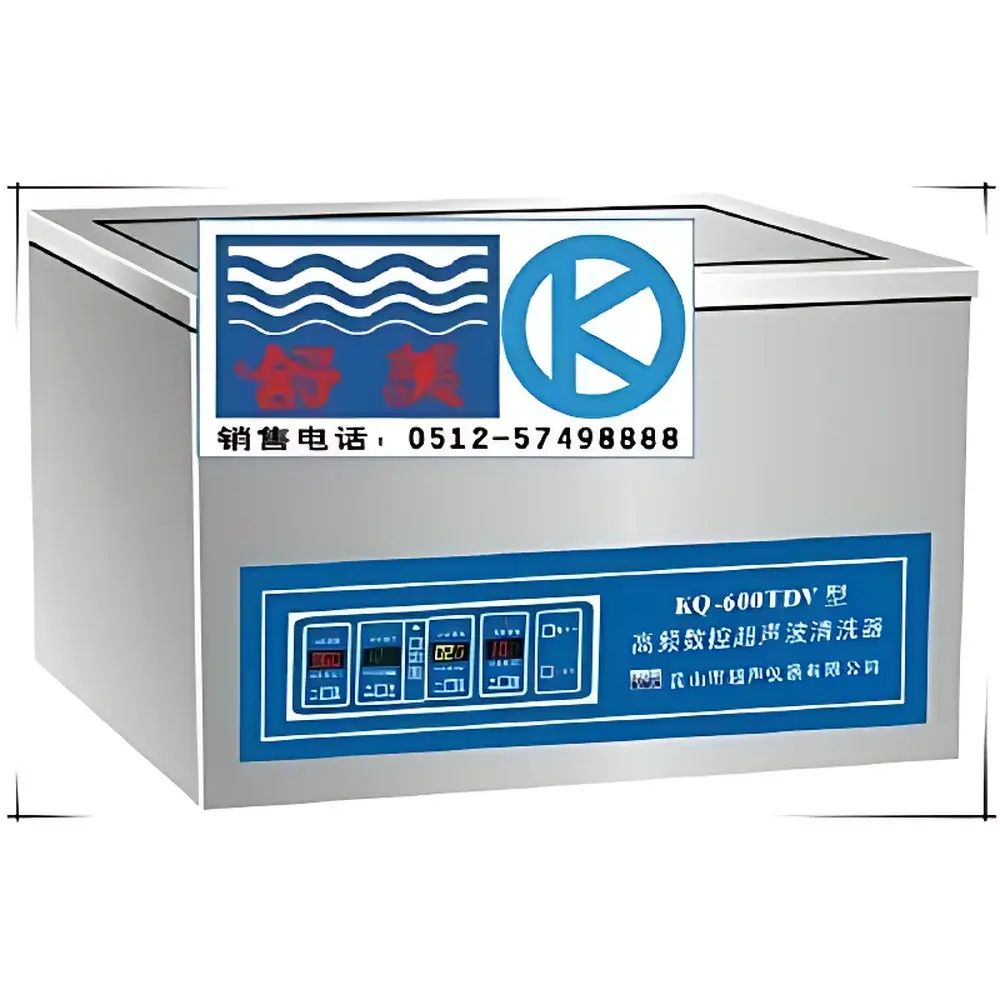
Shumei KQ-600TDV Desktop High-Frequency Digital Ultrasonic Cleaner
| Brand | Shumei |
|---|---|
| Origin | Jiangsu, China |
| Manufacturer Type | Direct Manufacturer |
| Country of Origin | China |
| Model | KQ-600TDV |
| Dimensions (W×D×H) | 610×410×380 mm |
| Inner Tank Dimensions | 500×300×180 mm |
| Capacity | 27 L |
| Ultrasonic Frequency | 80 kHz |
| Ultrasonic Power Output | 600 W |
| Power Adjustment Range | 40–100 % |
| Heating Power | 1000 W |
| Temperature Control Range | 10–80 °C |
| Timer Range | 1–480 min |
| Cumulative Operating Time Counter | Up to 999,999 h |
| Water Level Sensing Range | 1–140 mm |
| Construction | Stainless Steel Tank & Housing |
| Features | Automatic Vapor Recovery, Motorized Fill/Drain Control, Acoustic Damping Lid |
| Frequency Options Available | 50 / 60 / 70 / 80 / 100 kHz |
Overview
The Shumei KQ-600TDV is a desktop high-frequency digital ultrasonic cleaner engineered for laboratories requiring precision cleaning, degassing, emulsification, homogenization, solvent exchange, extraction, and cell disruption. Unlike conventional low- or medium-frequency units (typically 25–40 kHz), the KQ-600TDV operates at 80 kHz—enabling finer cavitation bubble collapse dynamics, reduced surface erosion, and superior removal of sub-micron particulates and tightly adhered organic residues. Its integrated transducer-and-tank architecture eliminates coupling losses common in external generator systems, ensuring consistent energy delivery across the entire bath volume. Designed for environments where reproducibility, traceability, and process control are critical—including analytical QC labs, pharmaceutical R&D, academic research facilities, and microelectronics prototyping—the unit complies with fundamental mechanical safety standards (IEC 61010-1) and supports GLP-aligned operational documentation through its embedded digital logging system.
Key Features
- High-resolution digital display showing real-time and setpoint values for ultrasonic duration, power level (%), liquid temperature, actual water level (mm), and cumulative operational hours (up to 999,999 h)
- Microcontroller-based control system enabling programmable sequences with independent parameter memory for time, temperature, power, and fill level
- Stainless steel tank (304 grade) formed via deep-drawing process for structural integrity and corrosion resistance; outer housing and acoustic damping lid also constructed from brushed stainless steel
- Integrated vapor recovery system minimizing solvent loss and operator exposure during heated operation with volatile aqueous or organic solutions
- Motor-driven automatic water filling and draining function, activated via level sensor feedback and programmable thresholds
- Multi-stage safety protection including over-temperature cutoff, over-current detection, low-water-level lockout, and dry-run prevention
- Selectable ultrasonic frequencies (50 / 60 / 70 / 80 / 100 kHz) via firmware configuration—facilitating method optimization across diverse sample matrices and contamination types
Sample Compatibility & Compliance
The KQ-600TDV accommodates a broad range of sample formats: glassware (vials, cuvettes, pipette tips), metal components (surgical instruments, MEMS substrates), ceramic filters, polymer microplates, and biological tissue specimens. Its 27 L capacity and 500 × 300 × 180 mm tank geometry support immersion of large or irregularly shaped items without compromising field uniformity. The unit meets essential electrical safety requirements per IEC 61010-1 and incorporates design elements aligned with ISO/IEC 17025 clause 6.4 (equipment verification) and USP guidance on analytical instrument qualification. While not certified for sterile processing under ISO 13485 or FDA 21 CFR Part 820, it serves as a validated cleaning step within GMP-compliant workflows when paired with documented SOPs and periodic performance verification (e.g., aluminum foil erosion test per ASTM D2603).
Software & Data Management
All operational parameters—including start/stop timestamps, temperature profiles, power modulation history, and cumulative runtime—are stored in non-volatile memory. Data export is supported via RS-232 serial interface (optional USB-to-serial adapter) for integration into laboratory information management systems (LIMS) or electronic lab notebooks (ELN). The embedded firmware supports audit-trail-enabling features: user-access logs, parameter-change timestamps, and error-event recording with diagnostic codes. Though no proprietary PC software is bundled, ASCII-formatted output enables parsing by third-party scripting tools (Python, LabVIEW) for automated reporting and trend analysis—critical for long-term equipment reliability monitoring and preventive maintenance scheduling.
Applications
- Pre-analytical cleaning of HPLC vials, GC liners, and ICP-MS sample introduction components to eliminate carryover and background interference
- Removal of photoresist residues and metal oxides from semiconductor wafers prior to metrology or thin-film deposition
- Cell lysis and organelle isolation in molecular biology protocols requiring minimal thermal denaturation
- Accelerated solvent extraction of plant metabolites or environmental contaminants from solid matrices
- Degassing of viscous solvents (e.g., glycerol, ethylene glycol) prior to viscosity or rheology measurements
- Ultrasonic-assisted cleaning of optical components (lenses, prisms) without micro-scratching risks associated with lower frequencies
FAQ
What is the maximum recommended operating temperature for aqueous solutions?
The heating system is rated for continuous operation up to 80 °C; however, for extended stability and reduced evaporation rates, 55–65 °C is optimal for most cleaning applications.
Can the unit be operated without heating enabled?
Yes—temperature control is fully decoupled from ultrasonic activation, allowing cold sonication for thermally sensitive samples.
Is calibration of the temperature or level sensors required by the user?
No field calibration is needed; factory-trimmed sensors maintain ±1.5 °C accuracy and ±2 mm level resolution over the specified operating range.
How often should the stainless steel tank be passivated?
Passivation is recommended after initial installation and annually thereafter using citric acid-based formulations per ASTM A967, especially following use with chloride-containing solutions.
Does the unit support remote start/stop via external TTL or relay signal?
Not natively—but the RS-232 interface allows command-line control (e.g., “START”, “STOP”, “QUERY_TEMP”) using standard terminal emulation software or custom automation scripts.



