
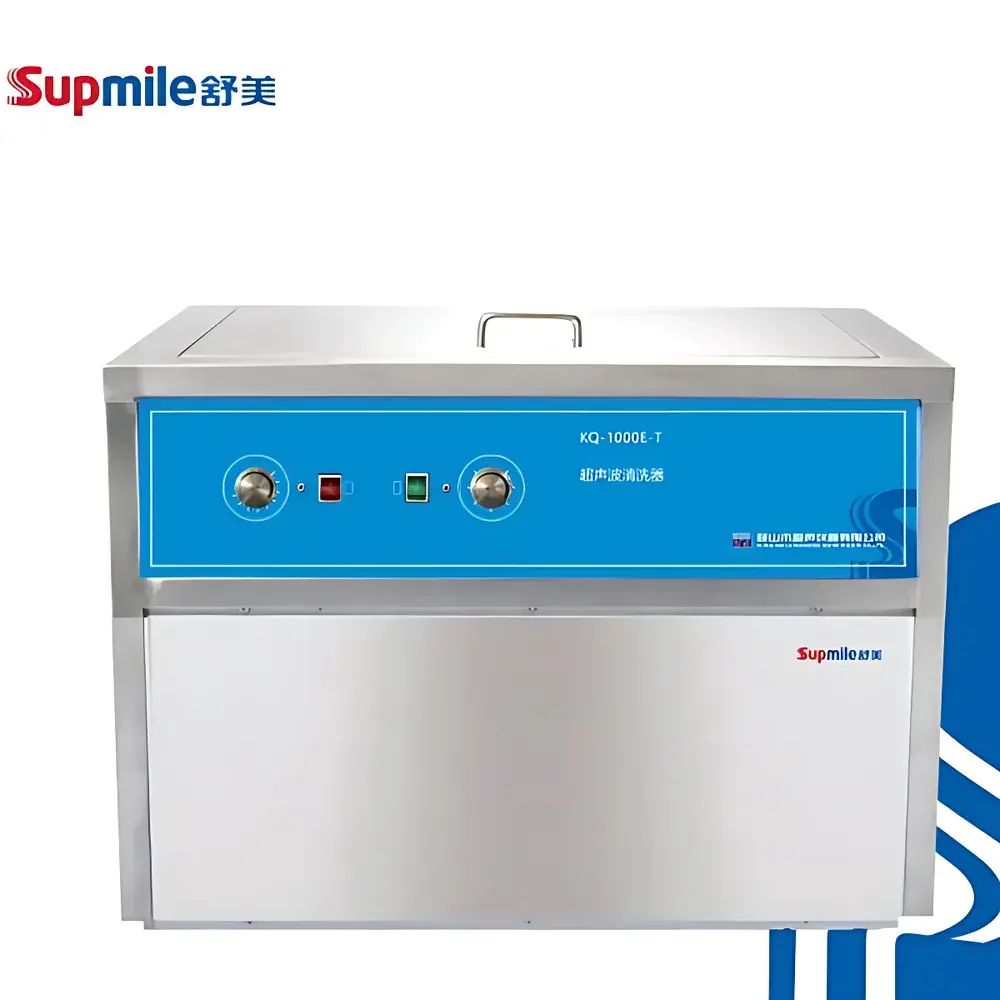
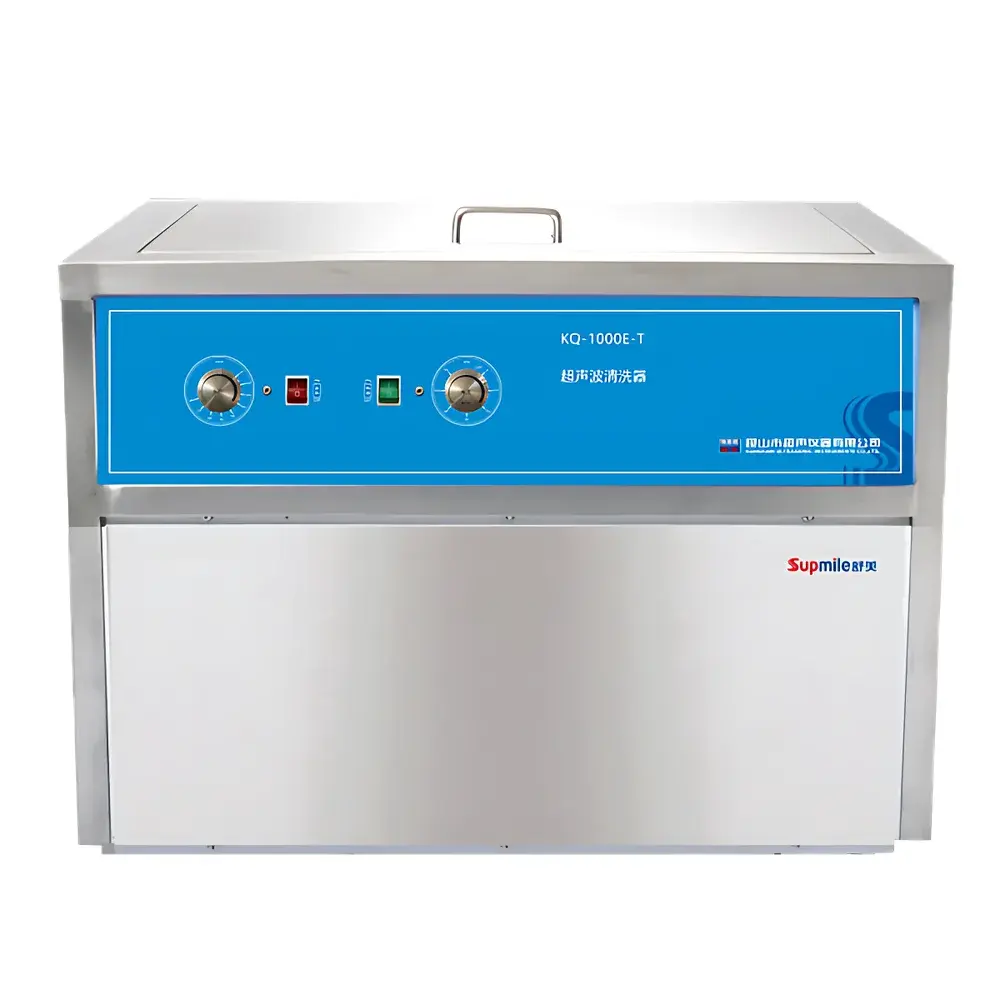
Supmile KQ-1000E-T Ultrasonic Cleaner
| Brand | Supmile |
|---|---|
| Origin | Jiangsu, China |
| Manufacturer Type | Direct Manufacturer |
| Region of Origin | Domestic (China) |
| Model | KQ-1000E-T |
| Instrument Type | General-Purpose |
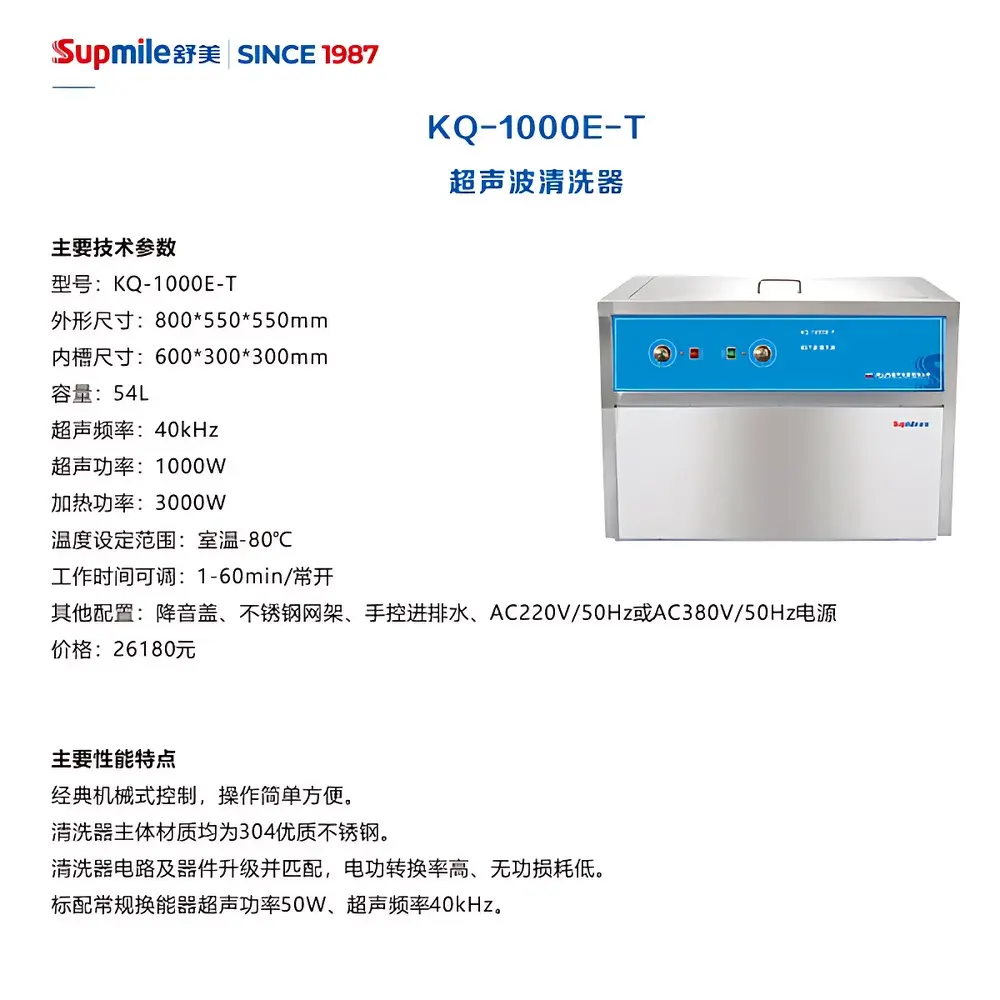
| Tank Capacity | 54 L |
| Ultrasonic Frequency | 40 kHz |
| Ultrasonic Power Output | 1000 W |
| Heating Power | 3000 W |
| Temperature Range | Ambient to 80 °C |
| Timer Range | 1–60 min or Continuous Operation |
| Sound-Dampening Lid | Yes |
| Drain/Inlet Control | Manual |
| Power Supply | AC 220 V / 50 Hz or AC 380 V / 50 Hz |
| Tank Dimensions (L×W×H) | 600 × 300 × 300 mm |
| Overall Dimensions (L×W×H) | 800 × 550 × 550 mm |
| Construction Material | 304 Stainless Steel |
| Control Interface | Mechanical Knob-Based System |
| Standard Accessories | Stainless Steel Mesh Basket, Sound-Dampening Lid, Manual Drain/Inlet Valves |
Overview
The Supmile KQ-1000E-T Ultrasonic Cleaner is a general-purpose, benchtop-to-floor-standing laboratory cleaning system engineered for consistent, non-destructive removal of particulate, organic, and inorganic contaminants from precision components, glassware, metal parts, and instrumentation. It operates on the principle of ultrasonic cavitation: high-frequency sound waves (40 kHz) generate microscopic vacuum bubbles in the cleaning solution; their rapid collapse produces localized high-pressure shockwaves and microstreaming that dislodge adherent soils without mechanical abrasion. Designed for routine laboratory, QC, and maintenance workflows, the unit delivers reproducible cleaning performance across diverse sample geometries and material sensitivities. Its robust 304 stainless steel tank—measuring 600 × 300 × 300 mm (L×W×H)—provides a 54-liter working volume suitable for large batches or oversized items such as chromatography columns, filter housings, or surgical instrument trays.
Key Features
- High-power ultrasonic transduction: 1000 W nominal output at 40 kHz, optimized for uniform energy distribution across the full tank volume using industrial-grade piezoelectric transducers mounted on the tank bottom.
- Integrated heating system: 3000 W resistive heater enables precise temperature control from ambient up to 80 °C, enhancing detergent efficacy and accelerating soil solubilization for stubborn residues.
- Mechanical control architecture: Dedicated rotary knobs for time (1–60 min or continuous mode) and temperature adjustment ensure intuitive, reliable operation with minimal electronic complexity—reducing failure points and facilitating long-term serviceability.
- Acoustic containment: Removable sound-dampening lid significantly reduces operational noise levels (<65 dB(A) at 1 m), improving ergonomic conditions in shared lab environments while minimizing airborne cavitation byproducts.
- Durable construction: Entire tank and housing fabricated from electropolished 304 stainless steel, resistant to corrosion from aqueous detergents, mild acids, and alkaline solutions commonly used in laboratory cleaning protocols.
- Manual fluid management: Front-mounted ball valves allow controlled fill and drain operations without requiring permanent plumbing—ideal for labs with variable water access or mobile deployment requirements.
Sample Compatibility & Compliance
The KQ-1000E-T accommodates a broad range of substrates including borosilicate glass, fused silica, titanium alloys, stainless steel, anodized aluminum, and polymer-based components (e.g., PTFE, polypropylene, polycarbonate), provided compatible cleaning chemistries are selected per material compatibility charts. The unit complies with IEC 61000-6-3 (EMC emission standards) and IEC 61000-6-2 (immunity). While not certified to ISO 13485 or FDA 21 CFR Part 11, its mechanical controls and traceable operating parameters (time, temperature) support GLP-aligned documentation when integrated into validated cleaning SOPs. Users must validate cleaning efficacy per ASTM F3127 (Standard Guide for Validation of Cleaning Processes for Reusable Medical Devices) or internal quality requirements.
Software & Data Management
This model does not incorporate digital controllers, data logging, or network connectivity. All operational parameters are set and monitored manually via analog dials and visual indicators. This design prioritizes reliability, ease of calibration verification, and immunity to firmware-related failures—making it suitable for regulated environments where audit trails rely on procedural documentation rather than electronic records. For laboratories requiring electronic data capture, external USB or RS-232 data loggers may be interfaced with temperature and timer outputs (where available via optional analog signal taps).
Applications
- Cleaning of HPLC/GC sample vials, autosampler needles, and flow cells prior to analysis.
- Preparation of optical components (lenses, mirrors, cuvettes) for spectroscopic or interferometric measurements.
- Removal of machining oils, flux residues, and oxide layers from metal calibration standards and reference samples.
- Decontamination of reusable pipette tips, centrifuge rotors, and electrophoresis apparatus before reuse.
- Supporting ISO 17025-accredited testing labs in maintaining equipment cleanliness as part of measurement uncertainty control.
- Pharmaceutical QC labs performing visual inspection prep for parenteral container integrity testing.
FAQ
Is the KQ-1000E-T suitable for cleaning delicate MEMS devices or semiconductor wafers?
It is not recommended for sub-micron feature cleaning without process validation; cavitation intensity at 40 kHz may exceed safe thresholds for fragile microstructures. Lower-frequency units (e.g., 80–130 kHz) or megasonic systems are preferred for such applications.
Can this unit be operated with deionized water alone, without detergent?
Yes, but cleaning efficiency will be substantially reduced for organic or hydrophobic residues; use of low-foaming, non-corrosive ultrasonic detergents (e.g., Alconox-type formulations) is strongly advised for reproducible results.
What is the expected service life of the transducers under continuous daily use?
With proper maintenance—including regular degassing, avoidance of dry operation, and adherence to manufacturer-recommended duty cycles—transducer assemblies typically maintain >90% power output for 5,000+ operating hours.
Does the unit include overtemperature or overfill protection?
Yes: built-in thermal cut-off switch prevents heater activation above 85 °C; no automatic overfill detection is included—operators must observe maximum fill line marked on the tank interior.
Is CE marking applicable to this model?
The KQ-1000E-T meets essential requirements of the EU Machinery Directive 2006/42/EC and Electromagnetic Compatibility Directive 2014/30/EU; CE marking is applied upon completion of EU-based conformity assessment and technical file submission by authorized representatives.



