
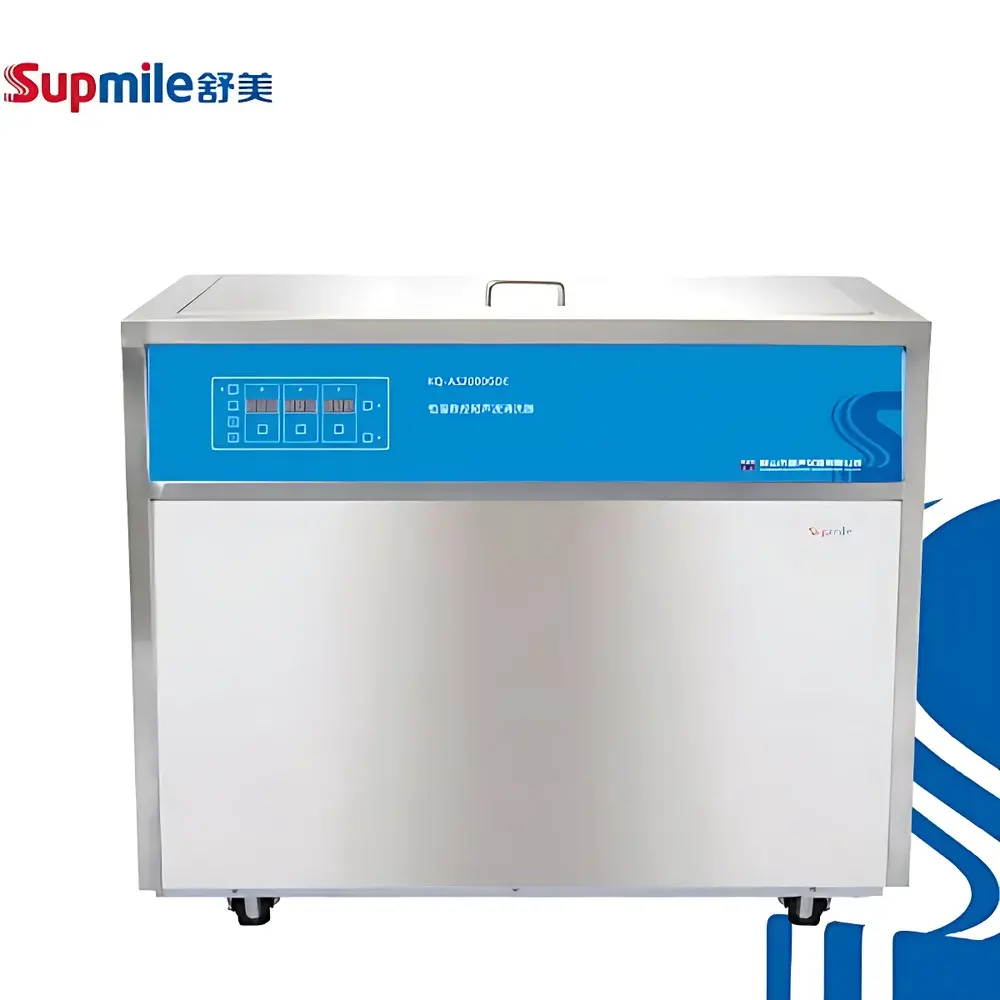
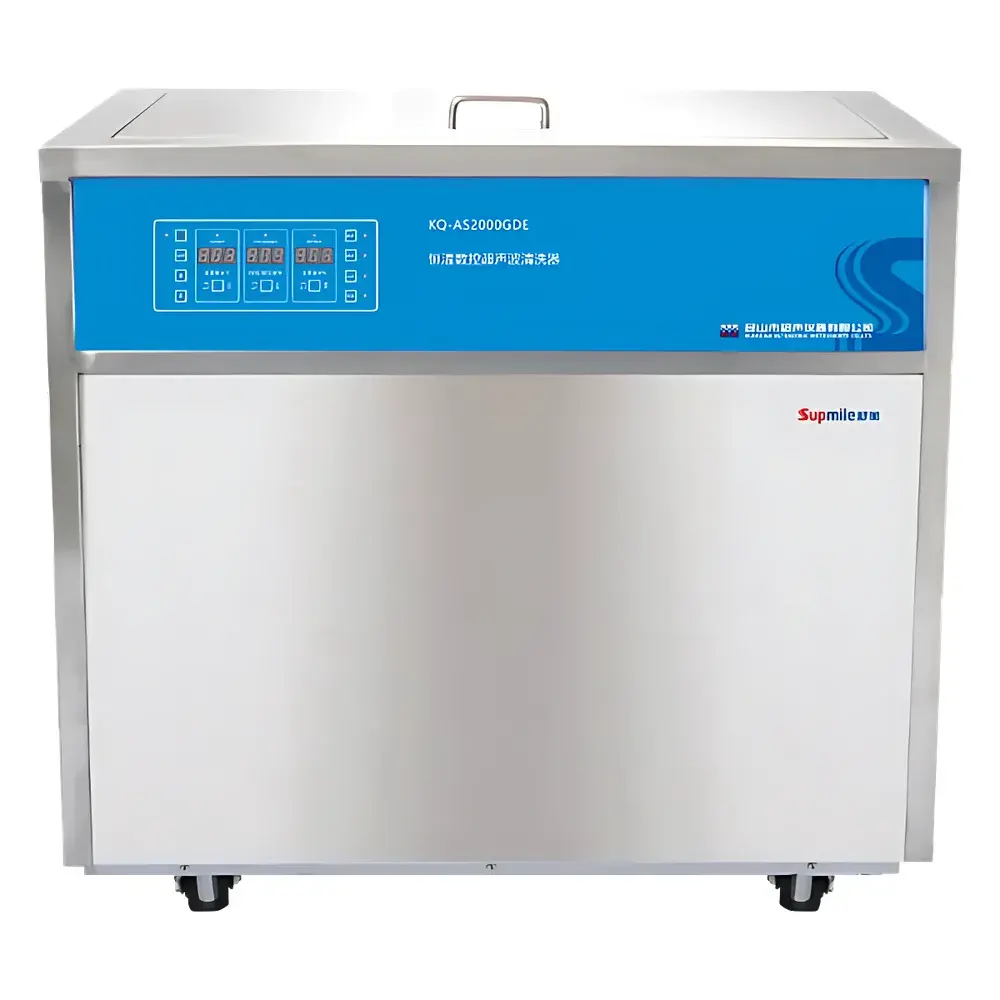
Shumei KQ-AS2000GDE Temperature-Controlled Digital Ultrasonic Cleaner
| Brand | Shumei |
|---|---|
| Origin | Jiangsu, China |
| Manufacturer Type | Direct Manufacturer |
| Product Category | Domestic |
| Model | KQ-AS2000GDE |
| Instrument Type | General-Purpose |
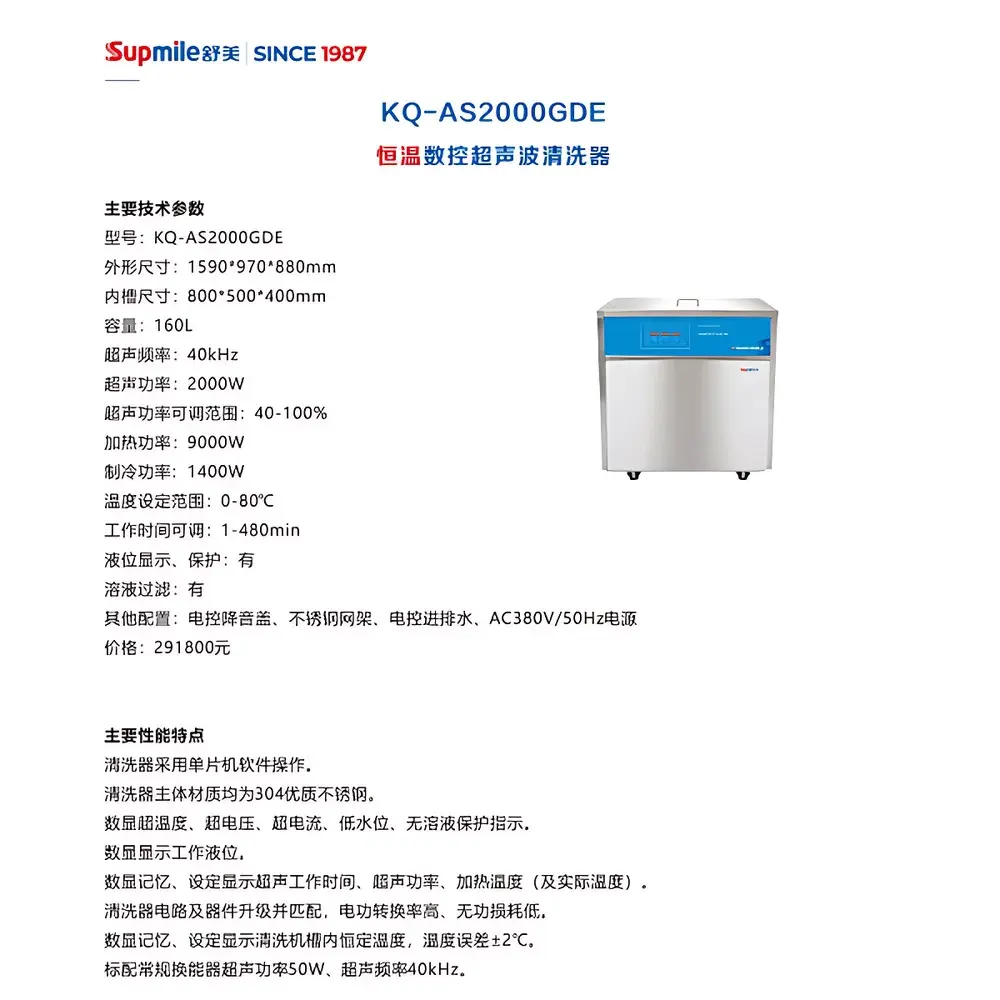
| Capacity | 160 L |
| Ultrasonic Frequency | 40 kHz |
| Ultrasonic Power Output | 2000 W |
| Power Adjustment Range | 40–100% |
| Temperature Control Range | 0–80 °C |
| Heating Power | 9000 W |
| Cooling Power | 1400 W |
| Timer Range | 1–480 min |
| Lid Type | Electrically Actuated Noise-Reduction Cover |
| Drain/Inlet | Electrically Controlled |
| Tank Dimensions (L×W×H) | 800 × 500 × 400 mm |
| External Dimensions (L×W×H) | 1590 × 970 × 880 mm |
| Power Supply | AC 380 V / 50 Hz |
| Safety Features | Low-Level Liquid Detection, Over-Temperature/Over-Voltage/Over-Current Protection, Solution Filtration System |
| Display | Digital LED with Real-Time Parameter Monitoring |
| Construction Material | 304 Stainless Steel |
| Temperature Accuracy | ±2 °C |
Overview
The Shumei KQ-AS2000GDE is a high-capacity, temperature-regulated digital ultrasonic cleaner engineered for demanding laboratory, pharmaceutical, and precision manufacturing environments. It operates on the principle of cavitation-induced acoustic energy transfer—where high-frequency mechanical vibrations (40 kHz) generate transient microbubbles in the cleaning medium that collapse with localized energy release, enabling effective removal of particulate contaminants, organic residues, and biofilms from complex geometries. Unlike basic benchtop units, the KQ-AS2000GDE integrates active heating (up to 9 kW) and cooling (1.4 kW) subsystems to maintain precise thermal stability across extended cleaning cycles—critical for temperature-sensitive substrates such as optical lenses, semiconductor wafers, surgical instruments, and chromatographic columns. Its 160 L stainless steel tank (800 × 500 × 400 mm internal volume) supports large-volume batch processing while maintaining uniform ultrasonic field distribution through optimized transducer array placement and impedance-matched power delivery.
Key Features
- Microprocessor-controlled operation with real-time digital display of ultrasonic power (40–100% adjustable), temperature setpoint and actual value (0–80 °C, ±2 °C accuracy), and timer (1–480 min)
- Robust 304 stainless steel construction for corrosion resistance, structural integrity, and compliance with ISO 13485 cleanroom-compatible material standards
- Electrically actuated noise-reduction lid with integrated safety interlock—automatically deactivates ultrasonics when opened
- Intelligent liquid level monitoring with low-level cutoff and visual/audible alerts to prevent dry-run damage
- Dual-mode thermal management: rapid heating via 9 kW resistive elements and active cooling via 1.4 kW refrigeration circuit for stable isothermal operation
- Integrated solution filtration system with replaceable cartridge to extend bath life and reduce particulate redeposition
- Electrically controlled inlet and drain valves for automated fluid handling—compatible with centralized lab utility networks
- Comprehensive electronic protection suite: over-voltage, over-current, over-temperature, and no-solution detection with fault logging capability
Sample Compatibility & Compliance
The KQ-AS2000GDE accommodates a broad range of sample types—including glassware, metal components, ceramic substrates, polymer assemblies, and delicate instrumentation parts—without compromising surface integrity. Its programmable power ramping and temperature stabilization ensure compatibility with thermolabile materials, including coated optics and calibration standards. The unit meets general electrical safety requirements per IEC 61010-1 and incorporates design features aligned with GLP and GMP documentation practices, including non-volatile parameter memory (retains settings after power loss) and timestamped operational logs. While not certified for sterile processing under ISO 17664 or EN 13060, it serves as a validated pre-sterilization cleaning stage in workflows compliant with USP , ASTM D4295, and ISO 15883-1 for reusable medical device reprocessing.
Software & Data Management
The embedded control firmware supports full parameter traceability: all user-defined settings (power %, temperature setpoint, duration), real-time sensor readings (actual bath temperature, current draw, liquid level status), and event timestamps are stored in internal non-volatile memory. Optional RS-485 or Ethernet interface modules enable integration into LabVantage, STARLIMS, or custom SCADA systems for centralized audit trail generation. Data export is supported via USB flash drive in CSV format, facilitating compliance with FDA 21 CFR Part 11 requirements when paired with institutional electronic signature policies. No cloud connectivity or proprietary software installation is required for core functionality.
Applications
- Precision cleaning of HPLC/GC autosampler vials, injection ports, and column fittings
- Decontamination of surgical tools and endoscopic components prior to autoclaving
- Removal of photoresist residue and etch byproducts from silicon wafers and MEMS devices
- Preparation of reference standards and volumetric glassware in metrology labs
- Restoration of antique optical components and museum artifacts using low-power, temperature-controlled protocols
- Bulk cleaning of filter housings, heat exchanger plates, and fluidic manifolds in biopharma facilities
FAQ
What is the maximum recommended operating temperature for aqueous solutions in this unit?
The system is rated for continuous operation at up to 80 °C with water-based cleaning agents; higher temperatures require solvent-rated accessories and additional ventilation.
Does the unit support external temperature probe input for independent bath validation?
No—the built-in PT100 sensor is fixed and calibrated; external probe integration requires third-party data acquisition hardware.
Can the ultrasonic transducers be replaced individually without tank disassembly?
Yes—modular transducer mounting allows field replacement using standard torque tools and OEM spare kits.
Is the filtration system compatible with organic solvents such as acetone or isopropanol?
Only with optional fluoropolymer-filter housing; standard cellulose cartridges are incompatible with aggressive organics.
What maintenance intervals are specified for the refrigeration subsystem?
Compressor oil and refrigerant charge verification are recommended every 24 months under continuous operation; service must be performed by certified HVAC-R technicians.



