
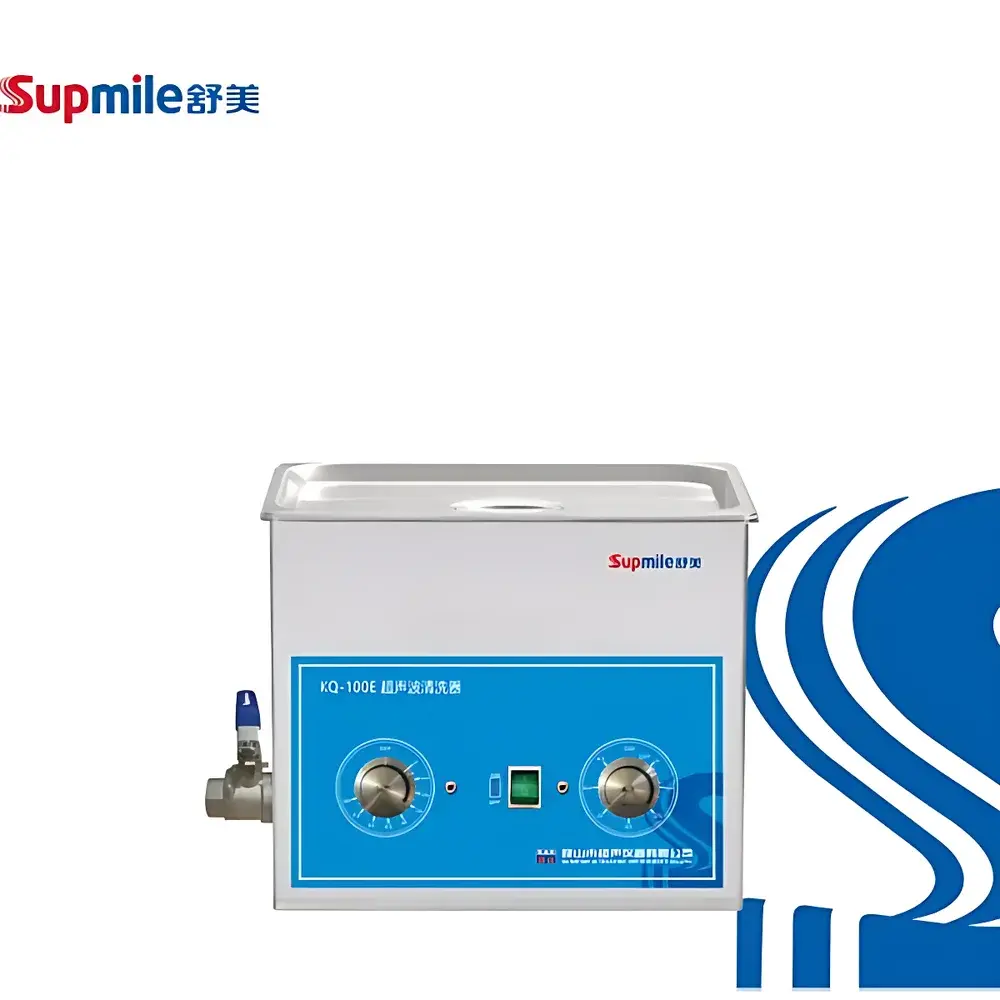
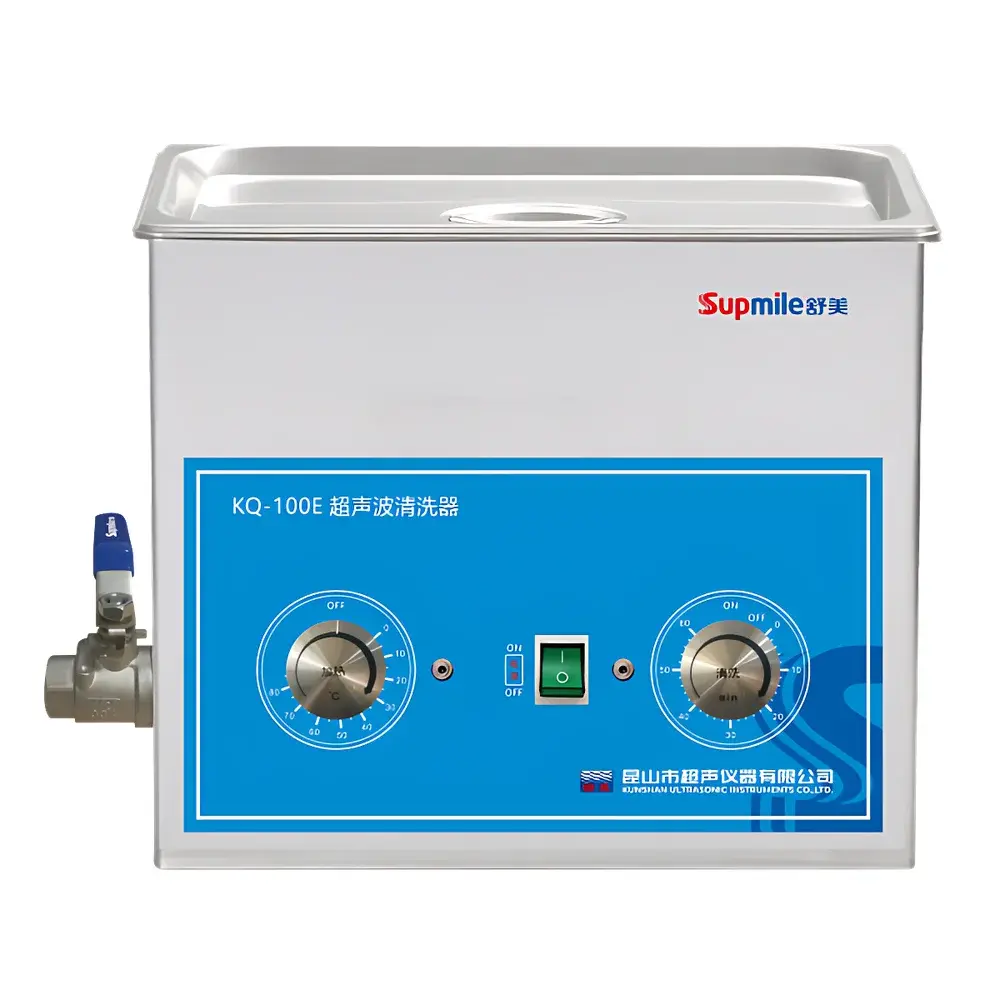
Supmile KQ-100E Benchtop Ultrasonic Cleaner
| Brand | Supmile |
|---|---|
| Origin | Jiangsu, China |
| Manufacturer Type | Direct Manufacturer |
| Equipment Type | General-Purpose Ultrasonic Cleaner |
| Model | KQ-100E |
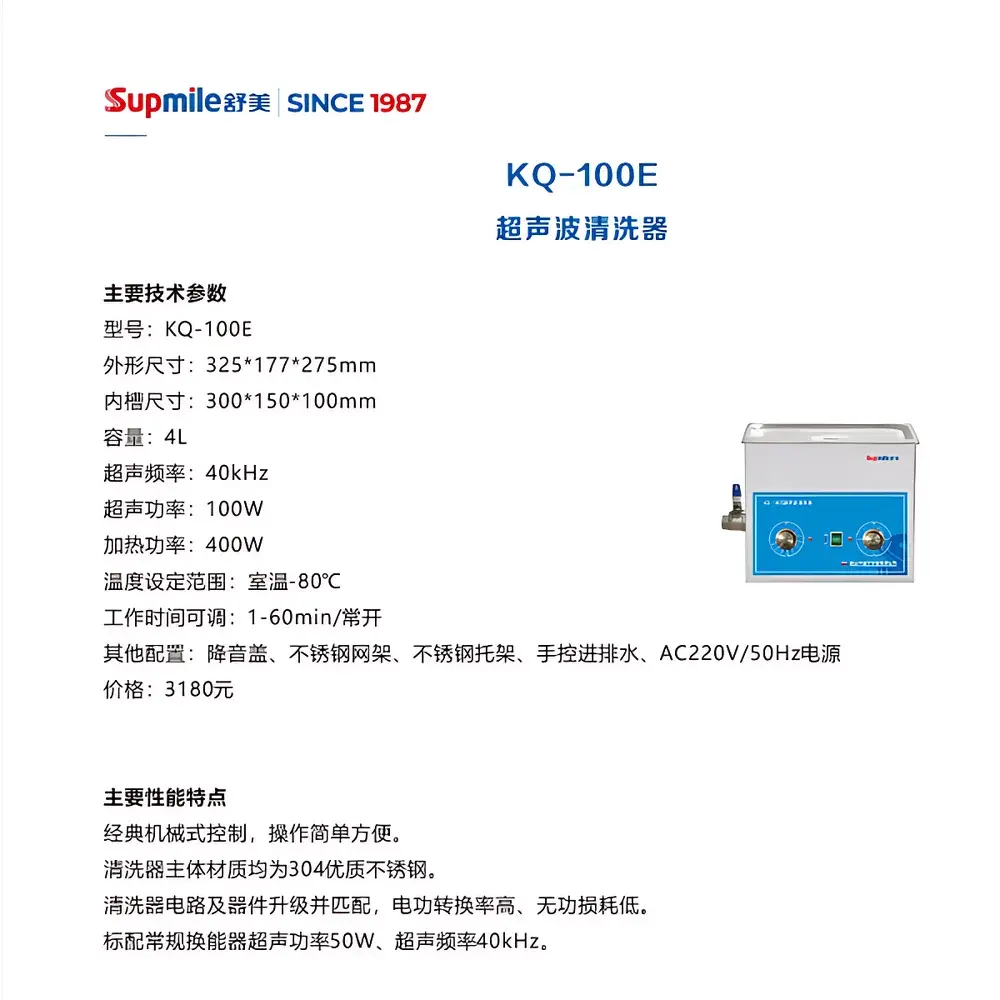
| Capacity | 4 L |
| Ultrasonic Frequency | 40 kHz |
| Ultrasonic Power Output | 100 W |
| Heating Power | 400 W |
| Temperature Range | Ambient to 80 °C (adjustable) |
| Timer Range | 1–60 min or Continuous Operation |
| Sound-Dampening Lid | Included |
| Drain/Inlet | Manual Valve Control |
| Power Supply | AC 220 V, 50 Hz |
| Internal Tank Dimensions | 300 × 150 × 100 mm |
| External Dimensions | 325 × 177 × 275 mm |
| Construction Material | 304 Stainless Steel |
Overview
The Supmile KQ-100E is a compact, general-purpose benchtop ultrasonic cleaner engineered for routine laboratory cleaning, degreasing, and particle removal from delicate instrumentation, glassware, precision components, and small-volume samples. It operates on the principle of cavitation—high-frequency sound waves (40 kHz) generate microscopic vacuum bubbles in the cleaning solution; their rapid collapse produces localized high-pressure shockwaves that dislodge contaminants from surfaces without mechanical abrasion. Designed for reliability and ease of use in QC labs, academic research facilities, and maintenance workshops, the KQ-100E delivers consistent acoustic energy distribution across its 4 L stainless steel tank, ensuring reproducible cleaning efficacy under standardized conditions.
Key Features
- Robust 304 stainless steel construction for corrosion resistance, structural integrity, and long-term compatibility with aqueous and mild solvent-based cleaning media.
- Adjustable digital timer (1–60 minutes) with continuous operation mode, enabling precise control over exposure duration to optimize cleaning efficiency while minimizing sample degradation risk.
- Integrated heating system (400 W) with thermostatic control spanning ambient temperature to 80 °C—facilitating accelerated dissolution of organic residues and improved detergent activation in low-surface-tension formulations.
- Dedicated sound-dampening lid reduces operational noise to <55 dB(A) at 1 m distance, supporting compliance with occupational health guidelines in shared lab environments.
- Manual inlet and drain valves allow safe, controlled fluid exchange—eliminating splash hazards and enabling solvent recovery or waste segregation per institutional EHS protocols.
- Mechanical control interface ensures electromagnetic immunity and operational stability in electromagnetically noisy environments (e.g., near centrifuges, RF equipment, or power supplies).
Sample Compatibility & Compliance
The KQ-100E accommodates standard laboratory items including volumetric flasks, pipette tips, syringe filters, watch glasses, crucibles, and small metal or ceramic parts. Its 300 × 150 × 100 mm internal tank volume supports immersion of multiple items simultaneously without compromising ultrasonic field uniformity. The unit complies with IEC 61000-6-3 (EMC emission limits) and IEC 61000-6-2 (immunity requirements), and its stainless steel wetted surfaces meet ISO 8573-1 Class 4 purity standards for non-contaminating contact surfaces. While not certified for sterile processing per ISO 13485 or FDA 21 CFR Part 820, it is routinely deployed as a pre-sterilization cleaning step aligned with ISO 15883-1 and AAMI ST79 guidance for reusable medical device reprocessing workflows.
Software & Data Management
As a mechanically controlled instrument, the KQ-100E does not incorporate embedded firmware, network connectivity, or data logging capabilities. All operational parameters—including time, temperature, and power activation—are set manually via front-panel dials and switches. This architecture eliminates cybersecurity vulnerabilities, avoids software validation burdens under GLP/GMP frameworks, and ensures deterministic behavior during audit inspections. For laboratories requiring traceability, users may document operating conditions using external logbooks or LIMS-integrated manual entry protocols compliant with ISO/IEC 17025 clause 7.5.2 (control of equipment records).
Applications
- Removal of particulate matter, oils, and biofilms from HPLC vials, autosampler needles, and flow cell components prior to analytical reuse.
- Preparation of substrates for SEM/TEM sample mounting by eliminating electrostatic dust and hydrocarbon contamination.
- Cleaning of optical lenses, diffraction gratings, and quartz cuvettes without surface scratching or coating damage.
- Supporting ASTM D2624 and ASTM D4057 procedures for residual fuel contaminant extraction from sampling hardware.
- Decontamination of reusable PPE components (e.g., face shield frames, respirator valve assemblies) in biosafety level 2 (BSL-2) support labs.
FAQ
Is the KQ-100E suitable for cleaning delicate electronic components?
Yes—its 40 kHz frequency provides balanced cavitation intensity suitable for PCBs, connectors, and MEMS devices when used with low-volatility, non-corrosive cleaning solutions and appropriate dwell times.
Can deionized water be used as the cleaning medium?
Deionized water alone offers limited cleaning efficacy; it is recommended to combine it with a validated, non-ionic surfactant formulation compatible with your substrate material and downstream application.
Does the unit include temperature calibration documentation?
No factory calibration certificate is supplied; users should perform periodic verification using a NIST-traceable thermometer per ISO/IEC 17025 clause 6.5.2 before critical cleaning cycles.
What maintenance is required for long-term performance?
Routine inspection of transducer adhesion integrity, periodic descaling of the tank interior using dilute citric acid (if hard water is used), and verification of lid seal compression are advised every 500 operating hours.



