
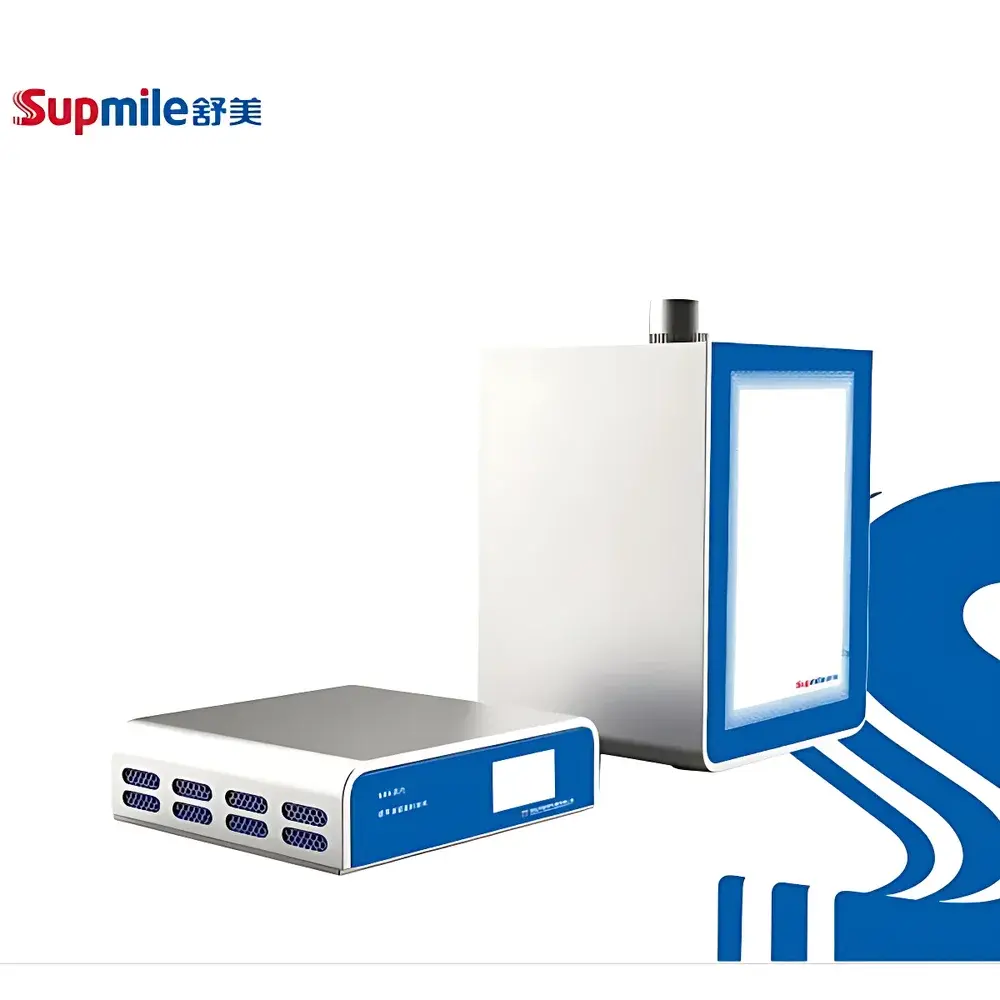
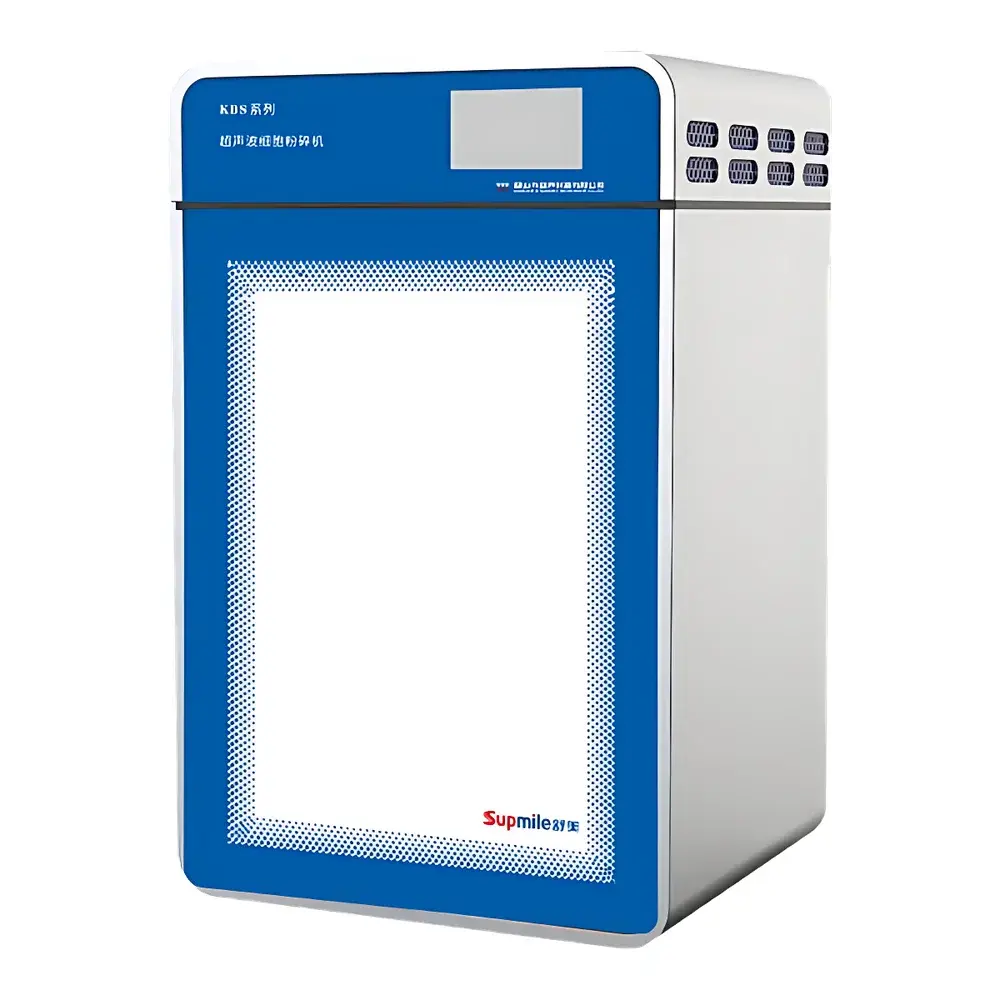
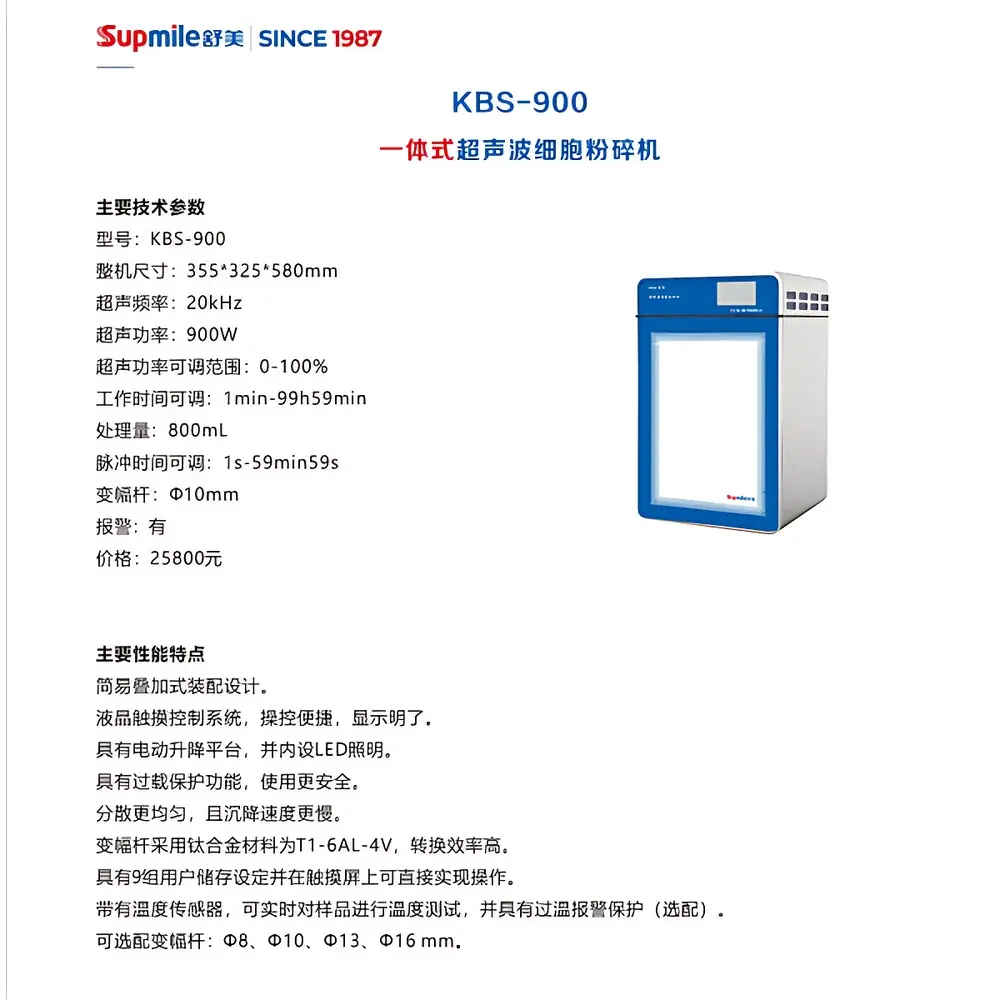
Shumei KBS-900 Integrated Ultrasonic Cell Disruptor
| Brand | Shumei |
|---|---|
| Origin | Jiangsu, China |
| Manufacturer Type | Direct Manufacturer |
| Instrument Category | Domestic |
| Model | KBS-900 |
| Quotation | ¥25,800 |
| Instrument Type | Ultrasonic Cell Disruptor |
| Operating Frequency | 20 kHz |
| Ultrasonic Power Output | 900 W |
| Adjustable Power Range | 0–100% |
| Time Setting Range | 1 min – 99 h 59 min |
| Pulse Duration Adjustment | 1 s – 59 min 59 s |
| Maximum Sample Volume | 800 mL |
| Probe Diameter Options | Φ8, Φ10 (standard), Φ13, Φ16 mm |
| Probe Material | Ti-6Al-4V Titanium Alloy |
| Safety Features | Overload Protection, Overtemperature Alarm (optional), Real-time Temperature Monitoring (optional) |
| User Memory Slots | 9 |
| Display | LCD Touchscreen Interface |
| Dimensions (W×D×H) | 355 × 325 × 580 mm |
Overview
The Shumei KBS-900 Integrated Ultrasonic Cell Disruptor is an engineered solution for mechanical lysis of biological cells, subcellular organelles, and microbial aggregates using high-intensity focused ultrasound. Based on the principle of acoustic cavitation—where rapid pressure fluctuations generate transient microbubbles that collapse violently near cellular structures—the system delivers controlled energy transfer to disrupt membranes while preserving intracellular biomolecules such as proteins, nucleic acids, and enzymes. Designed for benchtop deployment in molecular biology laboratories, bioprocessing R&D facilities, and academic core facilities, the KBS-900 integrates transducer, generator, and ergonomic handling components into a single compact chassis. Its 20 kHz operating frequency ensures optimal energy coupling across aqueous suspensions, while the 900 W nominal output provides scalable disruption capacity for volumes up to 800 mL per batch. The device complies with IEC 61000-6-3 (EMC emission standards) and meets general safety requirements outlined in IEC 61010-1 for laboratory electrical equipment.
Key Features
- Integrated motorized vertical stage with precise probe positioning and built-in LED illumination for real-time visual monitoring of sample homogeneity and cavitation activity.
- Full-touch LCD interface supporting intuitive parameter entry, real-time feedback, and nine programmable user protocols for reproducible method recall.
- Ti-6Al-4V titanium alloy ultrasonic probe (standard Φ10 mm) offering superior acoustic impedance matching, corrosion resistance, and thermal stability under prolonged duty cycles.
- Adjustable pulse mode (1 s – 59 min 59 s) enabling duty-cycle control to minimize thermal accumulation during sensitive applications such as protein extraction or chromatin shearing.
- Comprehensive safety architecture including automatic overload shutdown, hardware-based current limiting, and optional real-time temperature sensing with configurable overtemperature alarm thresholds.
- Modular probe compatibility supporting interchangeable tips (Φ8, Φ10, Φ13, Φ16 mm) to match sample viscosity, container geometry, and desired shear intensity profile.
Sample Compatibility & Compliance
The KBS-900 accommodates a broad range of biological matrices—including bacterial cultures (E. coli, Bacillus spp.), yeast (S. cerevisiae), mammalian cell lines (HEK293, CHO), plant tissues, and soft animal tissues—when suspended in aqueous buffers or low-viscosity solvents. It supports both continuous and pulsed sonication modes suitable for applications requiring minimal thermal denaturation or fragmentation control. While not certified for GMP manufacturing environments, the instrument’s design aligns with GLP documentation practices through timestamped protocol logging (when paired with optional data export functionality). All electrical and mechanical subsystems conform to CE marking directives applicable to laboratory instrumentation sold within the European Economic Area.
Software & Data Management
The embedded firmware enables local storage of operational logs—including date/time stamps, power settings, duration, pulse configuration, and probe ID—for audit trail generation. Though no external PC software is bundled, the system supports USB export of CSV-formatted session records for integration into LIMS or electronic lab notebook (ELN) platforms. Optional RS-232 or Ethernet connectivity modules (available upon request) facilitate remote command execution and centralized monitoring in multi-instrument labs. All stored parameters are retained during power cycling, and firmware updates can be applied via USB drive without service intervention.
Applications
- Nucleic acid isolation workflows requiring efficient nuclear membrane rupture without excessive DNA shearing.
- Preparation of soluble protein extracts from inclusion bodies or membrane-bound complexes.
- Homogenization of tissue lysates prior to Western blotting or mass spectrometry analysis.
- Disruption of biofilms and microbial aggregates for viability assessment or antimicrobial susceptibility testing.
- Dispersion of nanomaterials or liposomes in aqueous suspension for pharmaceutical formulation development.
- Cell lysis optimization studies where comparative evaluation of probe geometry, amplitude, and pulsing regime is required.
FAQ
What is the maximum recommended sample volume for consistent disruption efficiency?
For uniform energy distribution and reproducible lysis, the KBS-900 is optimized for volumes between 50 mL and 500 mL using the standard Φ10 mm probe; volumes up to 800 mL are supported but may require extended treatment time or probe repositioning.
Is temperature control integrated into the base unit?
A temperature sensor port is provided for optional external PT100 or thermistor probes; real-time monitoring and overtemperature cutoff are available only when this accessory is installed.
Can the KBS-900 be used with corrosive solvents or high-salinity buffers?
The titanium probe and stainless-steel housing resist degradation in common biological buffers (e.g., Tris-HCl, PBS, RIPA); however, prolonged exposure to strong acids, halogenated solvents, or >1 M NaCl solutions is not advised without protective sleeve consultation.
Does the system support FDA 21 CFR Part 11-compliant electronic signatures?
No—this model does not include role-based access control, audit trail encryption, or electronic signature functionality required for regulated environments; it is intended for research-use-only (RUO) applications.
What maintenance intervals are recommended for sustained performance?
Probe tip inspection every 200 hours of operation; ultrasonic stack recalibration every 12 months or after physical impact; routine cleaning of transducer coupling surfaces with isopropyl alcohol before each use.
Related Products




