
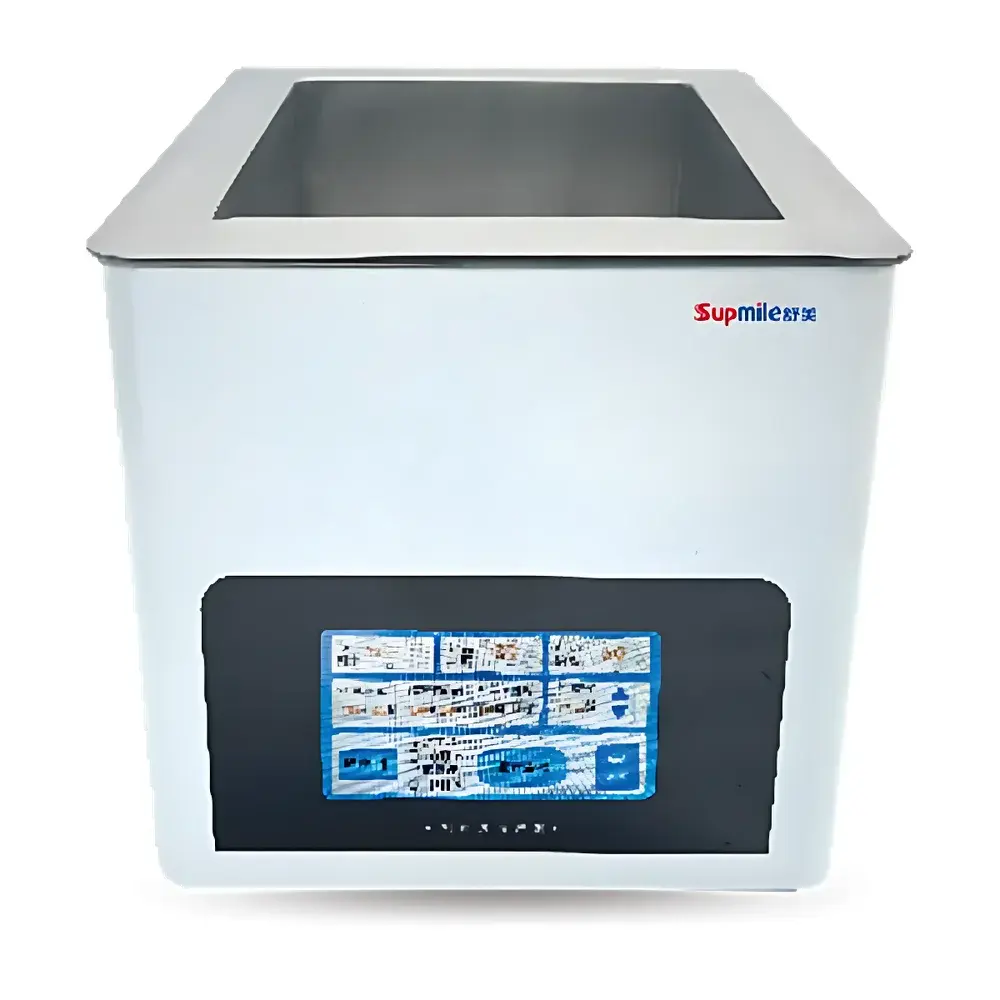
SHUMEI KQ-400CE Desktop IoT-Enabled Ultrasonic Cleaner
| Brand | SHUMEI |
|---|---|
| Origin | Jiangsu, China |
| Manufacturer Type | Direct Manufacturer |
| Instrument Type | General-Purpose |
| Capacity | 15 L |
| Ultrasonic Frequency | 40 ± 1 kHz |
| Ultrasonic Power | 360 W |
| Power Adjustment Range | 0–100% |
| Temperature Control Range | Ambient to 80 °C |
| Timer Range | 1 min – 99 h 59 min |
| Drain Valve | Equipped |
Overview
The SHUMEI KQ-400CE Desktop IoT-Enabled Ultrasonic Cleaner is an industrial-grade, network-connected cleaning system engineered for precision, traceability, and operational flexibility in regulated laboratory environments. It operates on the principle of piezoelectric ultrasonic cavitation—generating high-frequency mechanical oscillations (40 ± 1 kHz) within a liquid medium to produce transient microbubbles that collapse with localized energy release, effectively dislodging particulate contaminants, organic residues, and biofilms from delicate substrates. Unlike conventional analog cleaners, the KQ-400CE integrates dual-mode control architecture (local touchscreen + cloud-based remote interface), enabling real-time monitoring and audit-compliant data logging without physical presence. Its design meets fundamental requirements for cleanroom-compatible operation (ISO 14644-1 Class 7/8 environments), low-noise static ultrasonication (<55 dB(A)), and stable thermal management—critical for sensitive samples such as optical lenses, semiconductor wafers, microfluidic devices, and analytical calibration standards.
Key Features
- 7-inch capacitive TFT touchscreen interface with intuitive icon-driven navigation and 9 programmable user protocols stored locally
- Dual-control architecture: local operation via touchscreen or remote command via web portal, WeChat Mini Program, or Windows-based PC client over Ethernet/Wi-Fi/4G/RS485
- Real-time telemetry acquisition: continuous logging of ultrasonic power output (W), RMS current draw (A), operating frequency deviation (Hz), and bath temperature (°C)
- Japanese-origin piezoceramic transducers (Honda OEM specification) mounted on reinforced stainless-steel tank base for uniform energy distribution and long-term resonance stability
- Multi-layer protection circuitry: digital over-temperature, over-voltage, and over-current detection with automatic shutdown and visual alarm indicators
- High-efficiency power conversion topology minimizing reactive power loss; >85% electroacoustic efficiency under nominal load
- Electropolished 304 stainless-steel tank (320 × 320 × 150 mm) housed in corrosion-resistant powder-coated steel chassis
- Integrated degassing mode with adjustable pulse intervals to remove dissolved gases prior to critical cleaning cycles
- Manual drain valve with PTFE-sealed brass fitting for controlled effluent disposal and rapid tank emptying
Sample Compatibility & Compliance
The KQ-400CE supports cleaning of diverse sample types including glassware (volumetric flasks, cuvettes), metal components (stainless steel fixtures, surgical instruments), ceramic substrates (chromatography columns, sensor housings), and polymer-based devices (microplates, filtration membranes). Its ambient-to-80 °C digitally regulated heating function enables optimized solvent activation for aqueous and mild detergent-based formulations. The system complies with general safety requirements per IEC 61010-1 (Electrical Safety for Laboratory Equipment) and electromagnetic compatibility per EN 61326-1. While not certified for sterile processing per ISO 17664 or FDA 21 CFR Part 820, its data logging capability—including timestamped parameter records and operator ID tagging—supports GLP/GMP-aligned documentation practices when integrated into validated lab workflows.
Software & Data Management
The embedded Linux-based controller runs SHUMEI CloudLink firmware (v3.2+), supporting secure TLS 1.2 encrypted communication with on-premise or AWS-hosted data repositories. All operational events—including program start/stop, parameter modifications, fault triggers, and manual overrides—are recorded with millisecond-level timestamps and exported in CSV or SQLite format. Audit trail functionality satisfies basic ALCOA+ principles (Attributable, Legible, Contemporaneous, Original, Accurate) for internal quality review. Remote access requires role-based authentication (admin/operator/guest tiers); no data is transmitted to third-party cloud services by default. Firmware updates are delivered via signed OTA packages with SHA-256 verification.
Applications
- Precision cleaning of HPLC/GC autosampler vials, syringe filters, and column frits prior to chromatographic analysis
- Removal of photoresist residues and etch byproducts from silicon wafers in R&D cleanrooms
- Decontamination of reusable pipette tips, electrophoresis combs, and PCR tube racks in molecular biology labs
- Surface preparation of metallic coupons for corrosion testing (ASTM G1–21)
- Pre-analytical cleaning of environmental sampling filters and air particulate collectors
- Supporting ISO 13485-certified medical device reprocessing validation studies through repeatable parameter scripting
FAQ
Does the KQ-400CE support FDA 21 CFR Part 11 compliance?
No—while it provides timestamped, operator-attributed data logs, it does not include electronic signature enforcement, audit trail immutability locks, or identity verification modules required for full Part 11 compliance.
Can the ultrasonic frequency be manually adjusted outside the 40 kHz nominal range?
No—the transducer is fixed-tuned to 40 ± 1 kHz for optimal cavitation efficiency and mechanical longevity; variable-frequency operation is not supported.
Is the drain valve compatible with standard laboratory floor drain connections?
Yes—the 1/2-inch NPT outlet accepts common flexible PVC or silicone tubing (ID 12 mm) and may be routed to sink traps or waste neutralization systems.
What is the maximum permissible liquid height for stable operation?
Fill level must remain between 50 mm and 130 mm above the tank bottom to ensure consistent acoustic coupling and avoid transducer overheating.
How frequently should the transducer array be inspected for performance drift?
We recommend quarterly verification using a calibrated hydrophone or acoustic intensity meter per ASTM E1002; field recalibration is not user-serviceable.



