
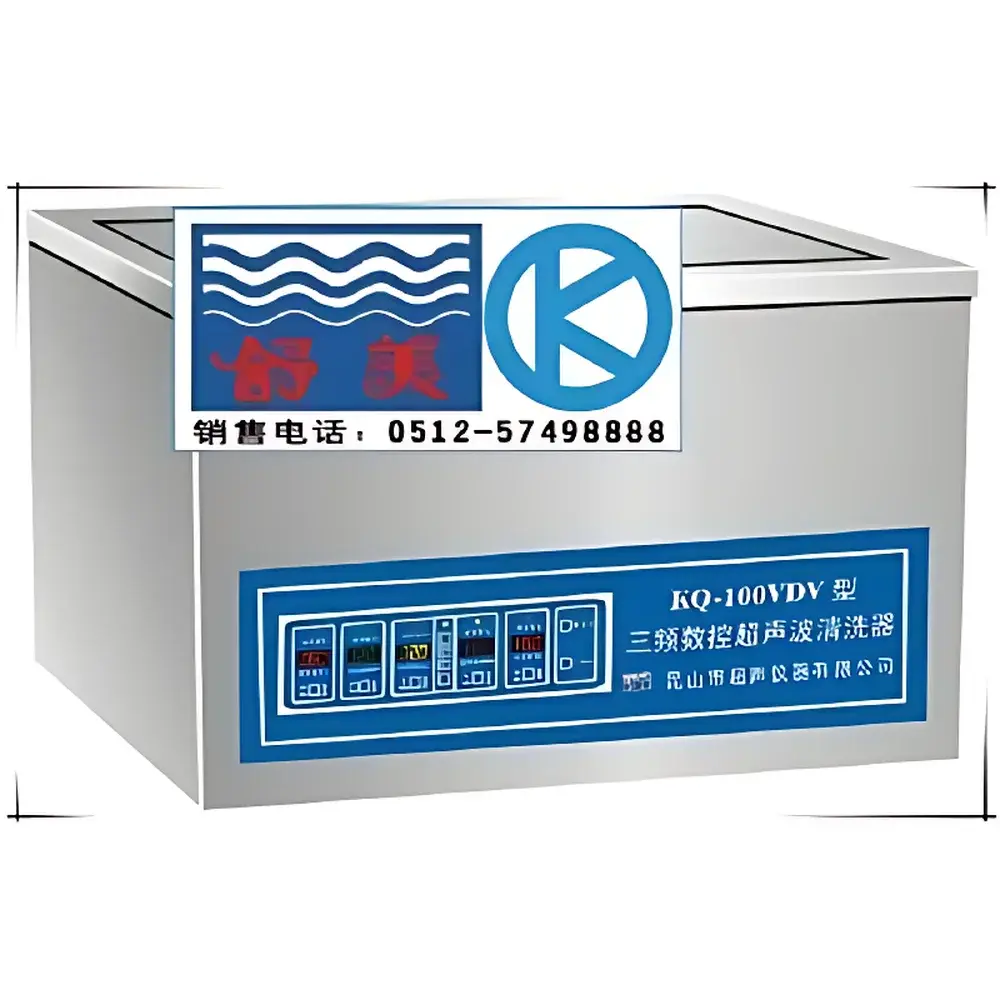
Shumei KQ-100VDV Desktop Tri-Frequency Digital Ultrasonic Cleaner
| Brand | Shumei |
|---|---|
| Origin | Jiangsu, China |
| Manufacturer Type | Direct Manufacturer |
| Country of Origin | China |
| Model | KQ-100VDV |
| Price | Upon Request |
| Dimensions (W×D×H) | 340 × 250 × 330 mm |
| Inner Tank Dimensions | 230 × 140 × 130 mm |
| Capacity | 4 L |
| Ultrasonic Frequencies | 45 kHz, 80 kHz, 100 kHz |
| Frequency Switching Interval | 1–999 s |
| Ultrasonic Power Output | 100 W (Adjustable: 40–100% in 10% increments) |
| Heating Power | 400 W |
| Temperature Range | 10–80 °C |
| Timer Range | 1–480 min |
| Cumulative Operating Time Counter | Up to 999,999 h |
| Water Level Detection Range | 1–70 mm |
| Tank Material | 304 Stainless Steel |
| Lid & Housing Material | 304 Stainless Steel |
| Standard Rack | Polypropylene (PP) |
| Safety Features | Overvoltage/Overcurrent Indication, Low-Liquid-Level Protection, Real-Time Liquid Temperature Monitoring, Auto-Shutoff on Dry Run |
| Optional Frequency Sets | 20/40/60 kHz, 28/45/100 kHz, or 45/80/100 kHz |
| Integrated Features | Vapor Recovery System, Acoustic Damping & Thermal Insulation Lid |
Overview
The Shumei KQ-100VDV is a desktop tri-frequency digital ultrasonic cleaner engineered for laboratories requiring high-fidelity, multi-stage cleaning protocols across diverse sample types. Unlike conventional single-frequency ultrasonic systems—whose cavitation energy distribution is constrained by fixed resonance—it employs synchronized switching among three discrete frequencies (45 kHz, 80 kHz, and 100 kHz), enabling sequential coarse, intermediate, and fine cleaning phases within a single tank. This frequency-hopping architecture leverages the physical principle that lower frequencies generate larger, more energetic cavitation bubbles suited for macroscopic particulate removal, while higher frequencies produce denser, smaller bubbles ideal for dislodging sub-micron contaminants and accessing geometrically complex surfaces—including blind holes, microchannels, and porous substrates. The system’s integrated transducer array and stainless-steel tank (304 grade) are acoustically tuned to maintain consistent energy coupling across all three bands, minimizing standing-wave dead zones and ensuring uniform cleaning efficacy—validated under ISO 13485-aligned internal process controls.
Key Features
- Tri-frequency programmable operation with user-selectable sets: 45/80/100 kHz (standard), or optional 20/40/60 kHz and 28/45/100 kHz configurations for specialized applications.
- Digital microcontroller-based interface with real-time, simultaneous display of liquid level (1–70 mm), actual bath temperature, set temperature (10–80 °C), ultrasonic frequency, elapsed time (1–480 min), power output (%), and cumulative operational hours (up to 999,999 h).
- Intelligent frequency auto-switching: configurable interval from 1 to 999 seconds per band, supporting both timed sequential and adaptive cleaning strategies.
- Integrated vapor recovery system mitigates solvent evaporation losses and reduces ambient VOC exposure—critical for chlorinated or alcohol-based cleaning media used in precision optics and semiconductor pre-processing.
- Acoustically damped, thermally insulated stainless-steel lid minimizes airborne noise (<55 dB(A) at 1 m) and surface heat loss, enhancing operator safety and thermal stability during extended heating cycles.
- Comprehensive electronic protection suite: dry-run detection, overtemperature cutoff, overvoltage/overcurrent monitoring, and real-time fault logging with on-screen diagnostic codes.
- 304 stainless-steel tank formed via deep-drawn stamping—free of weld seams in the cavity—to prevent crevice corrosion and ensure long-term chemical compatibility with aqueous, alkaline, acidic, and mild organic solvents.
Sample Compatibility & Compliance
The KQ-100VDV accommodates a broad spectrum of labware and components: glassware (vials, cuvettes, pipette tips), metal parts (surgical instruments, watch components), ceramic substrates, silicon wafers, printed circuit boards (PCBs), and biological carriers (cell culture inserts, microfluidic chips). Its frequency agility ensures effective decontamination of biofilms, protein residues, polishing compounds, flux residues, and oxide layers without mechanical abrasion. While not certified for sterile processing per ISO 13485 or FDA 21 CFR Part 820, the unit supports GLP-compliant workflows through traceable parameter logging, non-volatile memory retention of user-defined protocols, and audit-ready operational history. It meets CE marking requirements for electromagnetic compatibility (EN 61326-1) and low-voltage safety (EN 61010-1), and its stainless-steel construction complies with ASTM A240 for corrosion resistance in laboratory environments.
Software & Data Management
Operation is governed by an embedded 8-bit microcontroller running proprietary firmware—no external PC or software installation required. All parameters (frequency sequence, dwell time per band, power level, temperature setpoint, and fill-level threshold) are stored in non-volatile EEPROM and persist after power cycling. The system records cumulative runtime and fault events (e.g., “Low Liquid Alert #7”) with timestamps, accessible via the front-panel display. For integration into automated lab environments, optional RS-232 serial output (available upon request) enables remote parameter interrogation and basic command triggering (start/stop/pause) using ASCII protocol—compatible with LabVIEW, Python pySerial, or custom SCADA interfaces. Data export requires manual transcription; no cloud connectivity or proprietary software dependency is introduced.
Applications
- Pre-analytical sample preparation: removal of residual buffers, salts, and cellular debris from HPLC vials, autosampler needles, and electrophoresis combs.
- Materials science: degassing of nanoparticle suspensions prior to TEM grid deposition; cleaning of sputter targets and vacuum chamber components.
- Life sciences: gentle dissociation of adherent cells from microcarrier beads; deagglomeration of liposomal formulations without sonolytic degradation.
- Quality control labs: validation of cleaning efficacy per ASTM F312-22 (Standard Test Methods for Cleaning Validation of Medical Devices) using surrogate soils (e.g., bovine serum albumin, hemoglobin).
- Electronics manufacturing: post-reflow flux residue removal from SMT assemblies prior to AOI inspection.
- Academic research: extraction of metabolites from plant tissues, homogenization of tissue lysates, and dispersion of carbon nanotubes in aqueous surfactant solutions.
FAQ
What frequency combination is factory-defaulted on the KQ-100VDV?
The unit ships preconfigured for 45 kHz / 80 kHz / 100 kHz—optimized for general-purpose laboratory cleaning across organic, inorganic, and biological contaminant classes.
Can the heater operate independently of ultrasonic activation?
Yes. Heating mode may be engaged without ultrasonic output, enabling controlled solvent warming for temperature-sensitive cleaning protocols.
Is the plastic rack autoclavable?
The standard polypropylene rack is rated for repeated steam sterilization at 121 °C for 20 minutes—verified per ISO 17665-1—but prolonged exposure above 100 °C may reduce structural integrity over time.
Does the unit support continuous ultrasonic operation beyond 480 minutes?
No. The maximum timer setting is 480 minutes; however, the cumulative hour counter continues tracking total operational life independent of session duration.
How is liquid level measured—and what happens if it falls below the minimum threshold?
Capacitive sensing detects solution height between 1–70 mm; if level drops below 1 mm, the system halts heating and ultrasonics, displays “LOW LIQ”, and activates audible alert until refilled.
Related Products



