
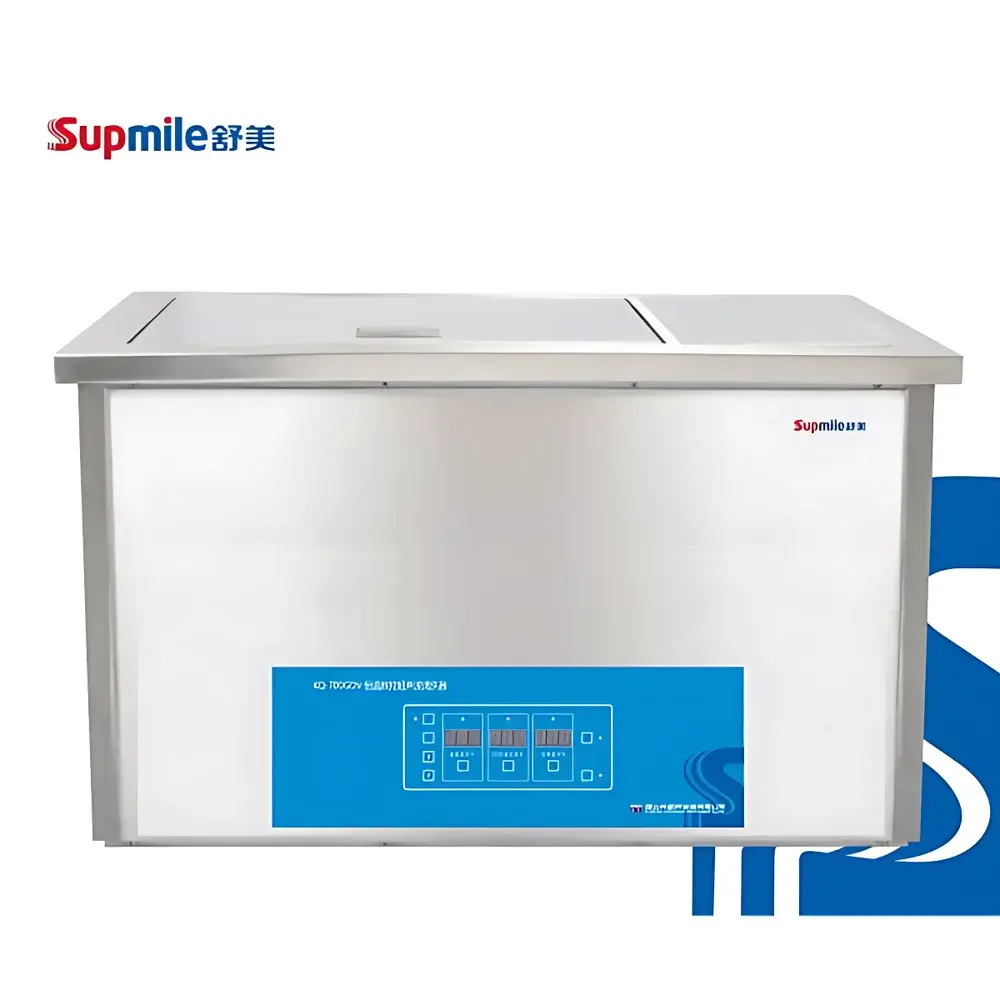
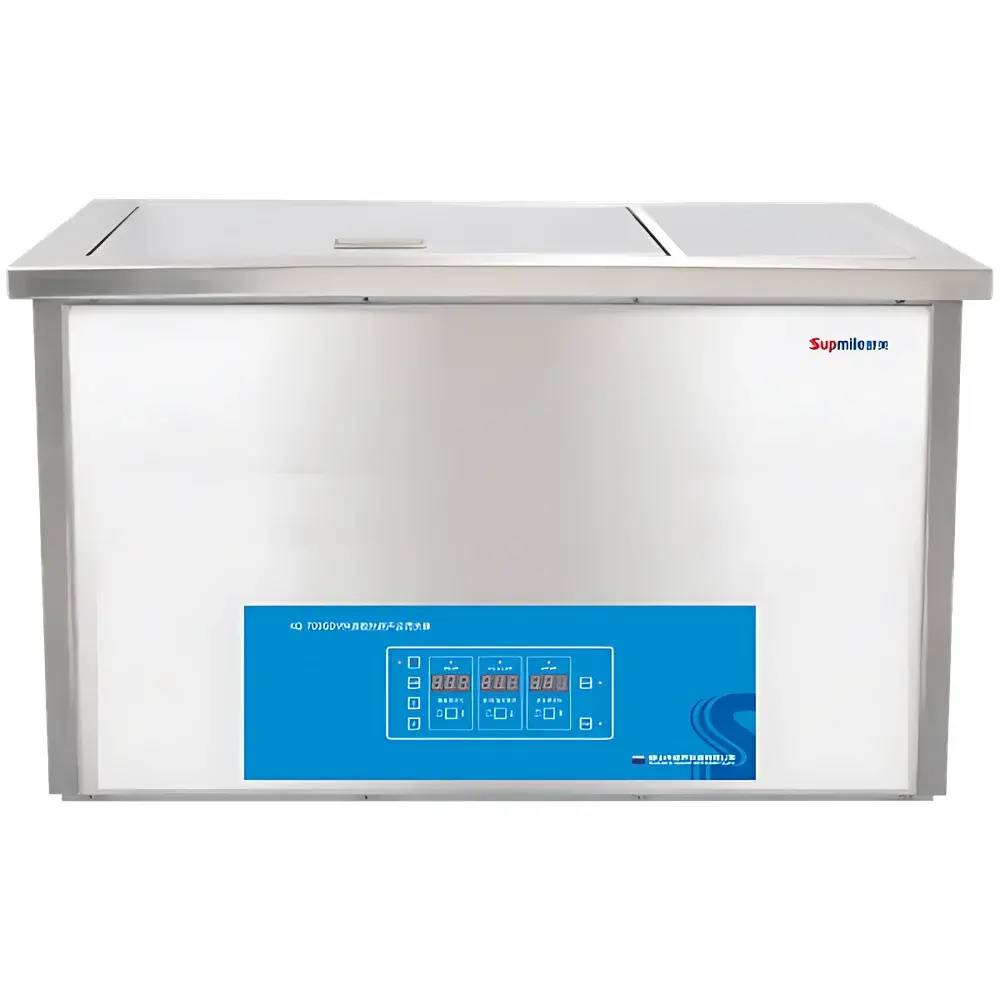
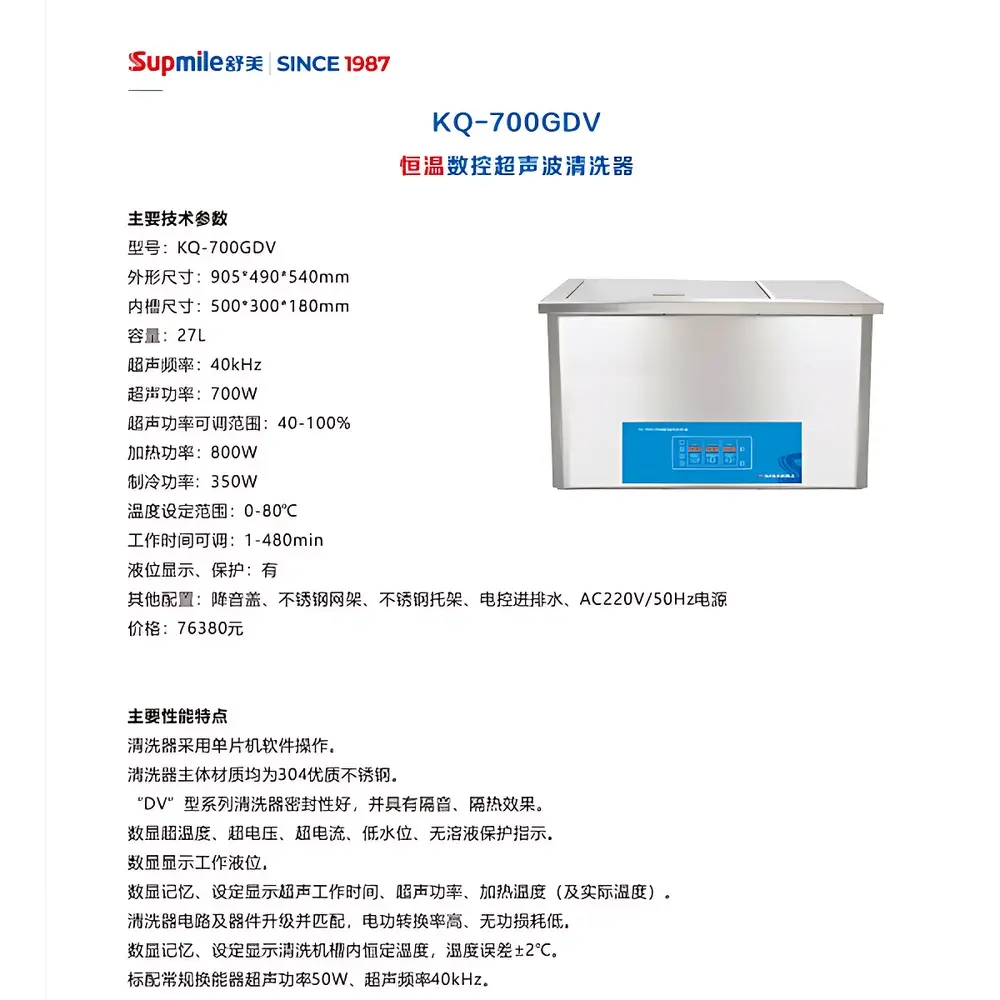
Shumei KQ-700GDV Benchtop Temperature-Controlled Digital Ultrasonic Cleaner
| Brand | Shumei |
|---|---|
| Origin | Jiangsu, China |
| Manufacturer Type | Direct Manufacturer |
| Instrument Type | General-Purpose Ultrasonic Cleaner |
| Capacity | 27 L |
| Ultrasonic Frequency | 40 kHz |
| Ultrasonic Power Output | 700 W (Adjustable 40–100%) |
| Heating Power | 800 W |
| Cooling Power | 350 W |
| Temperature Control Range | 0–80 °C (±2 °C accuracy) |
| Timer Range | 1–480 min |
| Sound-Dampening Lid | Included |
| Automatic Inlet/Drain | Electrically Controlled |
| Power Supply | AC 220 V / 50 Hz |
| Internal Tank Dimensions | 500 × 300 × 180 mm |
| External Dimensions | 905 × 490 × 540 mm |
| Construction Material | 304 Stainless Steel |
| Standard Accessories | Stainless Steel Mesh Basket, Support Rack, Liquid Level Sensor with Low-Level Protection |
Overview
The Shumei KQ-700GDV is a benchtop temperature-controlled digital ultrasonic cleaner engineered for reproducible, high-efficiency cleaning of precision components, laboratory glassware, optical elements, and small-volume instrumentation parts. It operates on the principle of cavitation—where high-frequency acoustic energy (40 kHz) generates transient microbubbles in liquid media that collapse violently near solid surfaces, dislodging particulate contaminants, organic residues, and loosely adhered biofilms. Unlike basic ultrasonic cleaners, the KQ-700GDV integrates active thermal regulation (0–80 °C), programmable power modulation, and real-time process monitoring—enabling controlled cleaning under optimized thermosonic conditions. Its 27 L stainless steel tank (304 grade) provides sufficient volume for batch processing of multiple samples or larger items such as chromatography columns, sensor housings, or semiconductor wafers while maintaining structural integrity and corrosion resistance in aqueous and mild solvent environments.
Key Features
- Microprocessor-based digital control system with intuitive interface for independent adjustment of ultrasonic power (40–100% of 700 W nominal output), heating setpoint (0–80 °C), and cleaning duration (1–480 minutes).
- Integrated temperature feedback loop with ±2 °C accuracy; dual-function heating (800 W) and cooling (350 W) modules ensure stable thermal equilibrium during extended operation.
- Acoustically insulated enclosure featuring a hinged sound-dampening lid to reduce ambient noise emissions below 65 dB(A) at 1 m distance—compliant with ISO 7779 and IEC 60704-1 for laboratory equipment noise classification.
- Comprehensive safety architecture: automatic shutdown triggered by low liquid level detection, over-temperature, over-current, and over-voltage conditions; visual LED indicators for all fault states.
- Electrically actuated inlet and drain valves enable repeatable, hands-free fluid handling—critical for GMP-aligned workflows where operator intervention must be minimized.
- Full 304 stainless steel construction—including tank, lid frame, mesh basket, and support rack—ensures compatibility with deionized water, ethanol, isopropanol, and alkaline detergent solutions without degradation.
Sample Compatibility & Compliance
The KQ-700GDV accommodates a wide range of sample geometries and material classes, including but not limited to borosilicate glassware (vials, cuvettes, pipette tips), metal calibration standards, ceramic substrates, and polymer-based microfluidic chips. Its uniform energy distribution—validated via ASTM E1729-22 mapping protocols—supports consistent cleaning efficacy across the entire tank volume. The unit complies with IEC 61000-6-3 (EMC emission limits) and IEC 61000-6-2 (immunity requirements), and its electrical safety design meets IEC 61010-1:2010 for laboratory equipment. While not certified for sterile processing per ISO 13485 or EN 13060, it serves as a validated pre-sterilization cleaning stage in ISO 15883-compliant washer-disinfector workflows.
Software & Data Management
The KQ-700GDV employs embedded firmware—not external PC software—to manage all operational parameters. All user-defined settings (power %, temperature setpoint, timer value) are retained in non-volatile memory following power cycling. Real-time display includes actual bath temperature, elapsed time, and instantaneous ultrasonic output status. Though lacking network connectivity or audit trail functionality, its deterministic behavior and hardware-enforced interlocks satisfy basic GLP documentation requirements when paired with manual logbook entries or external data acquisition systems recording analog outputs (e.g., 4–20 mA temperature signal).
Applications
- Pre-analytical preparation of HPLC/GC vials, syringe filters, and autosampler components to eliminate carryover contamination.
- Removal of photoresist residues and flux contaminants from PCBs and MEMS devices prior to metrology.
- Routine cleaning of reusable cell culture inserts, electrophoresis combs, and microcentrifuge tubes in academic and biotech labs.
- Decontamination of reusable surgical instruments and dental tools in low-risk clinical support settings (non-sterile reprocessing only).
- Surface activation of substrates prior to thin-film deposition or adhesive bonding in materials science laboratories.
FAQ
Is the KQ-700GDV suitable for use with flammable solvents?
No. The unit is rated exclusively for aqueous and polar non-flammable solutions (e.g., water, ethanol ≤30% v/v, sodium hydroxide solutions). Operation with acetone, hexane, or chlorinated solvents poses fire and explosion hazards and voids warranty.
Can the ultrasonic frequency be changed?
No. The transducer array is fixed at 40 kHz, optimized for general-purpose cleaning efficiency and cavitation density in aqueous media. Variable-frequency operation is not supported.
Does the unit support validation protocols for regulated environments?
It provides essential parameters for IQ/OQ execution (temperature stability, timer accuracy, power linearity), but lacks electronic signature, event logging, or 21 CFR Part 11 compliance features required for full PQ in FDA-regulated facilities.
What maintenance is required for long-term reliability?
Routine inspection of the stainless steel tank for pitting, verification of transducer adhesion integrity every 6 months, and periodic calibration of the PT100 temperature sensor using NIST-traceable reference standards are recommended.



