
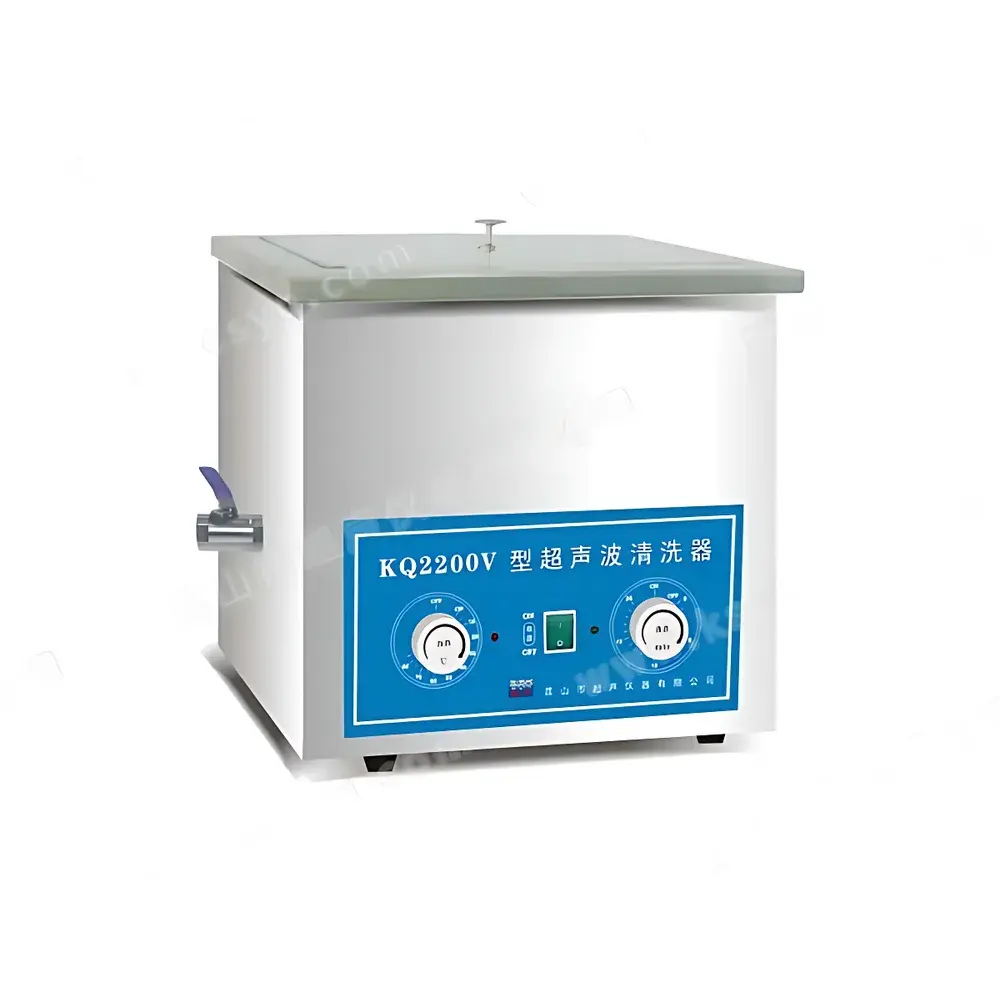
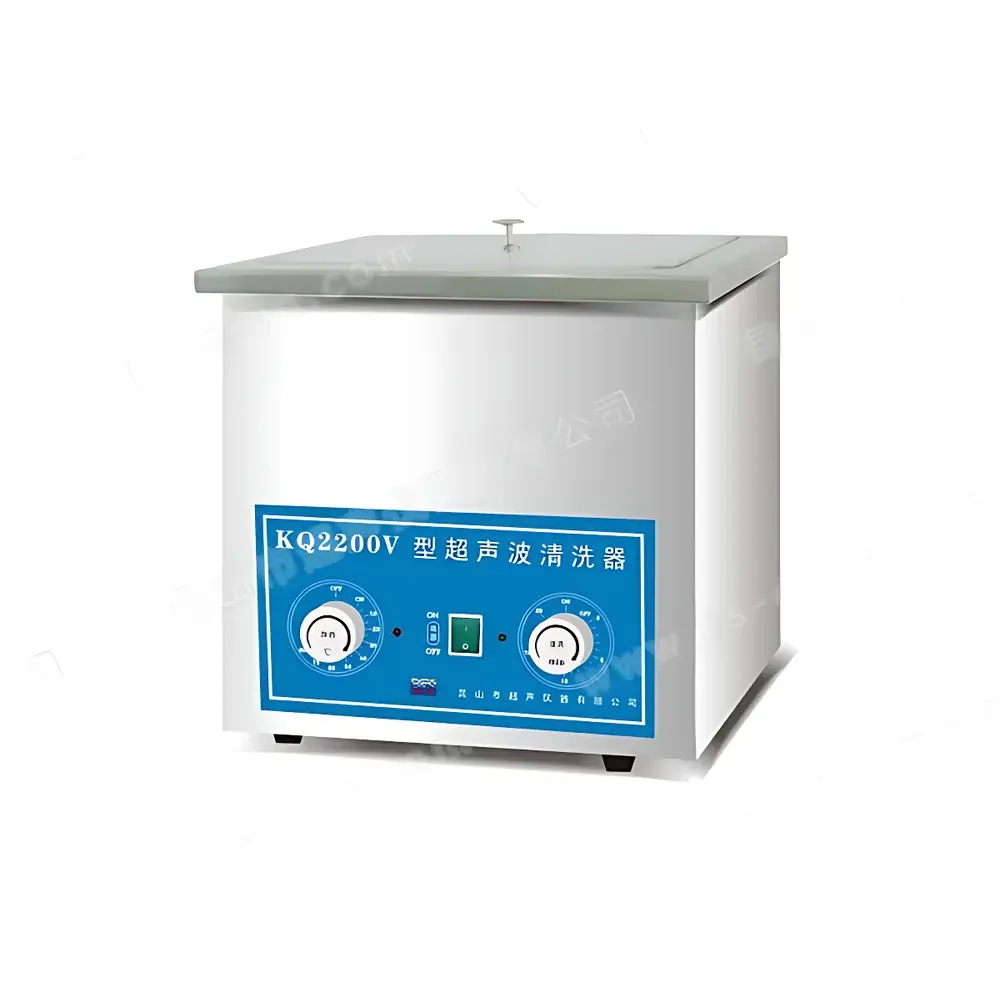
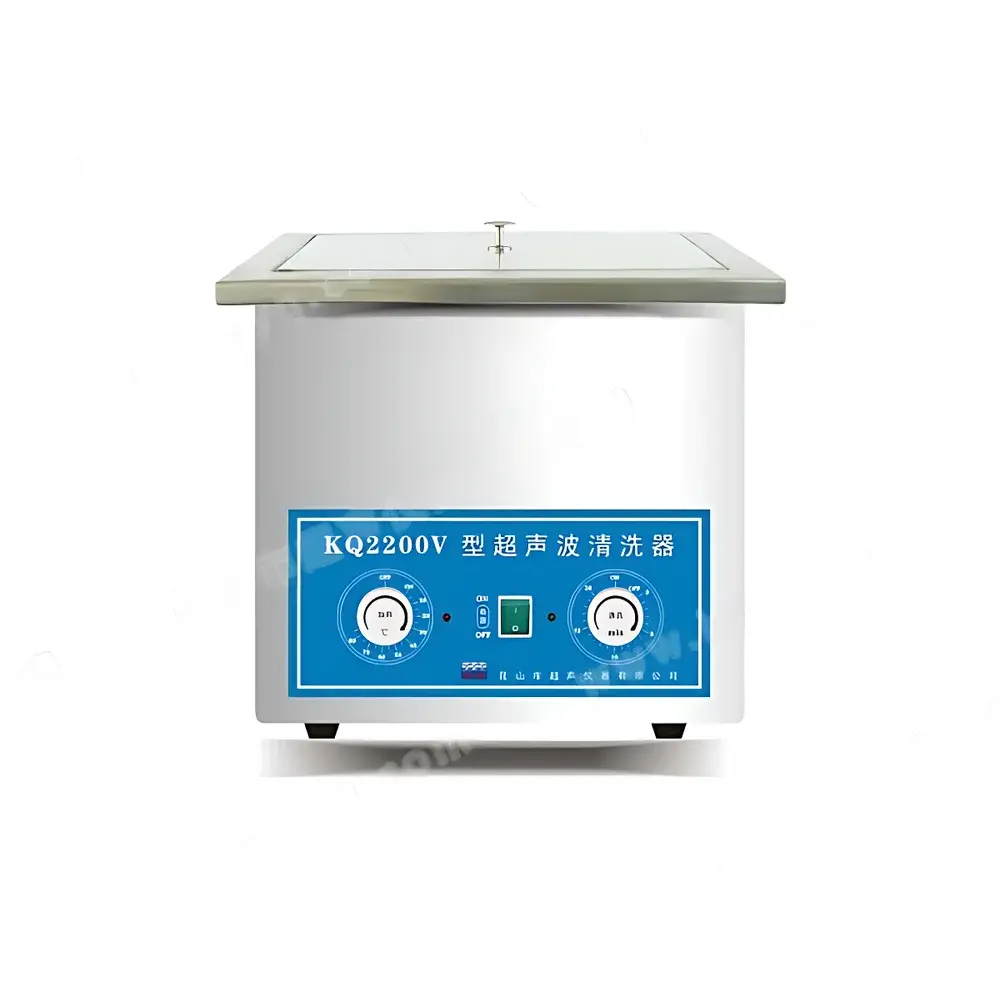
SHUMEI KQ2200V Benchtop Ultrasonic Cleaner
| Brand | SHUMEI |
|---|---|
| Origin | Jiangsu, China |
| Manufacturer Type | Direct Manufacturer |
| Equipment Type | General-Purpose Ultrasonic Cleaner |
| Capacity | 4 L |
| Ultrasonic Frequency | 40 kHz |
| Ultrasonic Power | 100 W |
| Adjustable Power | No |
| Temperature Range | 0–80 °C |
| Heating Power | 400 W |
| Timer Range | 1–20 min |
| Sound-Dampening Lid | Yes |
| Manual Fill/Drain | Yes |
| Internal Tank Dimensions | 230 × 140 × 130 mm |
| Overall Dimensions | 345 × 250 × 315 mm |
| Power Supply | 220 V / 50 Hz |
| Construction Material | 304 Stainless Steel |
| Heating Method | PTC Surface-Mount Heater |
| Auto-Frequency Sweeping | Yes |
| Standard Transducer Configuration | Dual 50 W, 40 kHz units |
Overview
The SHUMEI KQ2200V is a benchtop ultrasonic cleaner engineered for routine laboratory cleaning, degreasing, and particle removal from precision components, glassware, surgical instruments, and analytical sample preparation vessels. It operates on the principle of cavitation—generated by high-frequency (40 kHz) acoustic energy transmitted through a liquid medium—producing microscopic implosions that dislodge contaminants from surfaces without mechanical abrasion. Designed for reliability in QC labs, academic research facilities, and small-scale manufacturing environments, the KQ2200V features a fully welded 304 stainless steel tank with optimized geometry to ensure uniform energy distribution and minimal standing-wave interference. Its fixed-frequency architecture (non-sweeping by default, but equipped with auto-sweep circuitry to mitigate transducer fatigue and improve cleaning consistency over extended cycles) delivers stable output across its full operational temperature and time range.
Key Features
- Robust 304 stainless steel construction—including tank, lid, and basket—for corrosion resistance and long-term structural integrity under repeated thermal and ultrasonic stress.
- PTC surface-mount heating system enabling precise, uniform temperature control from ambient to 80 °C with low thermal inertia and inherent overtemperature protection.
- Dual 50 W piezoelectric transducers operating at 40 kHz, acoustically coupled to the tank base for optimal energy transfer and reproducible cleaning performance.
- Integrated auto-frequency sweeping circuitry that dynamically adjusts drive frequency within a narrow band around 40 kHz to maintain resonance as solution properties (e.g., temperature, viscosity, dissolved gas content) change during operation.
- Sound-dampening hinged lid with silicone gasket seal, reducing airborne noise to ≤55 dB(A) at 1 m distance and minimizing heat loss during heated cycles.
- Mechanical timer with 1-minute resolution (1–20 min), calibrated for repeatability and compatible with GLP documentation workflows when paired with external loggers.
- Manual fill-and-drain system with integrated drain valve and inlet port—designed for solvent compatibility and ease of maintenance without requiring plumbing integration.
Sample Compatibility & Compliance
The KQ2200V accommodates standard laboratory items including volumetric flasks, pipette tips, crucibles, HPLC vials, microscope slides, and small metal tools (up to 230 × 140 mm footprint). Its 130 mm tank depth supports immersion of tall or vertically oriented parts. The unit complies with IEC 61000-6-3 (EMC emission limits) and IEC 61000-6-2 (immunity requirements) for laboratory equipment. While not certified to ISO 13485 or FDA 21 CFR Part 11 out-of-the-box, its mechanical controls, non-networked architecture, and deterministic timer behavior support audit-ready operation in GxP-aligned environments when documented per internal SOPs. All wetted surfaces meet USP Class VI biocompatibility criteria for aqueous cleaning applications.
Software & Data Management
The KQ2200V is a standalone, microcontroller-based instrument with no embedded software stack, network interface, or data export capability—intentionally designed to eliminate cybersecurity risks and reduce validation burden in regulated settings. Operational parameters (time, temperature) are set via tactile rotary knobs and displayed on an LED segment display. For traceability, users may record cycle start/end times, bath temperature readings (via external calibrated thermometer), and visual inspection outcomes in paper or electronic lab notebooks. The absence of firmware updates or user-accessible configuration menus ensures consistent behavior across device lifetime—critical for method transfer and equipment qualification (IQ/OQ).
Applications
- Routine cleaning of GC/HPLC autosampler vials, syringe filters, and column frits prior to reuse or calibration.
- Removal of organic residues (e.g., oils, waxes, polymers) from metal substrates in materials science sample prep.
- Pre-analytical decontamination of microbiological culture plates and reusable pipette tips in teaching labs.
- Desorption of loosely bound particulates from MEMS devices and optical components prior to SEM imaging.
- Supporting ASTM D2247 (standard practice for testing water resistance of coatings) via controlled immersion cleaning steps.
- ISO 15528-compliant cleaning of reference standards before gravimetric or spectrophotometric analysis.
FAQ
Is the ultrasonic frequency adjustable?
No—the KQ2200V operates exclusively at 40 kHz. Frequency selection (e.g., 25 kHz or 33 kHz) is not supported; this model is optimized for general-purpose cleaning where high cavitation density outweighs low-frequency penetration depth.
Can this unit be used with solvents other than water?
Yes—provided the solvent is non-corrosive to 304 stainless steel and has flash point >60 °C. Acetone, isopropanol, and ethanol are commonly used; chlorinated or highly acidic solvents are prohibited.
Does it include a filtration system?
No—solution filtration is not integrated. Users must manually replace or filter bath fluid between batches per SOP-defined contamination thresholds.
What safety certifications does it carry?
It conforms to GB 4706.1 (Chinese national standard equivalent to IEC 60335-1) for household and similar electrical appliances, with additional factory-level dielectric strength and leakage current testing per ISO/IEC 17025-accredited protocols.
Is calibration required before use?
No formal calibration is mandated; however, periodic verification of timer accuracy (±1% tolerance) and temperature uniformity (±2 °C across tank volume) using NIST-traceable references is recommended for GLP compliance.



