
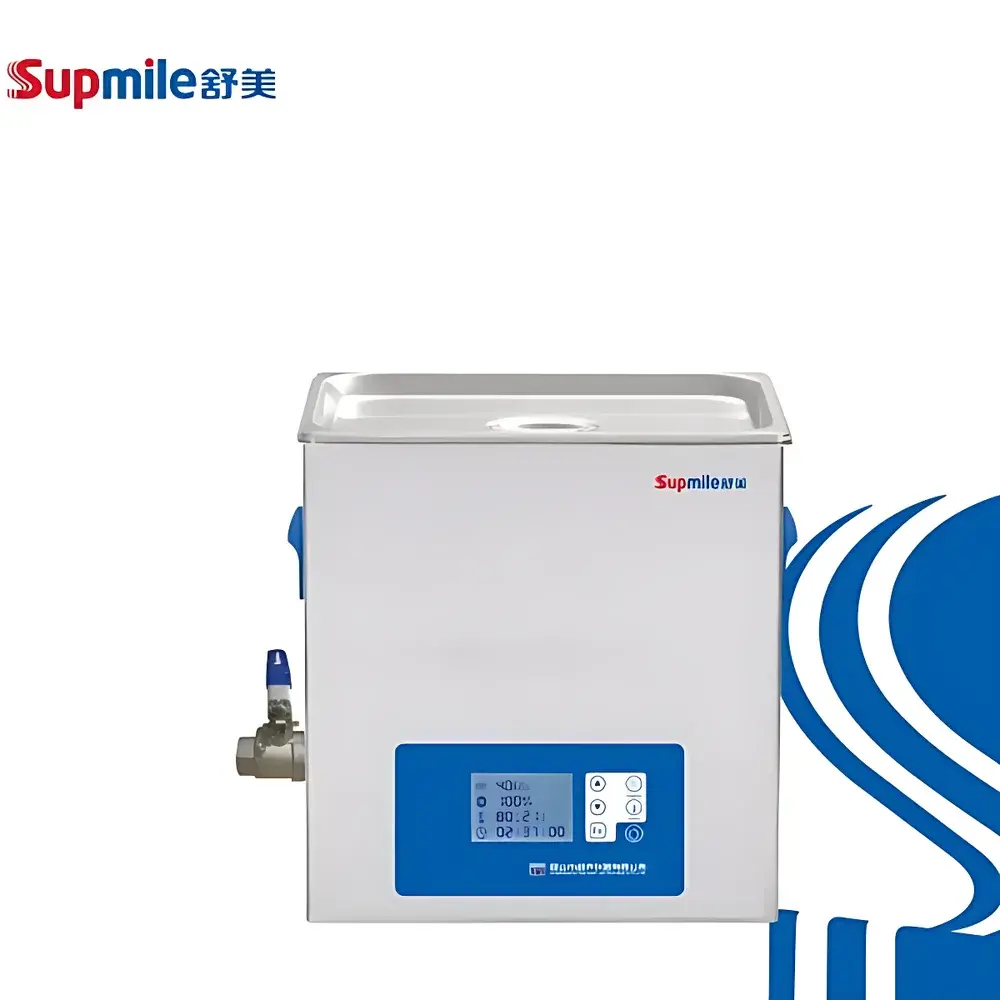
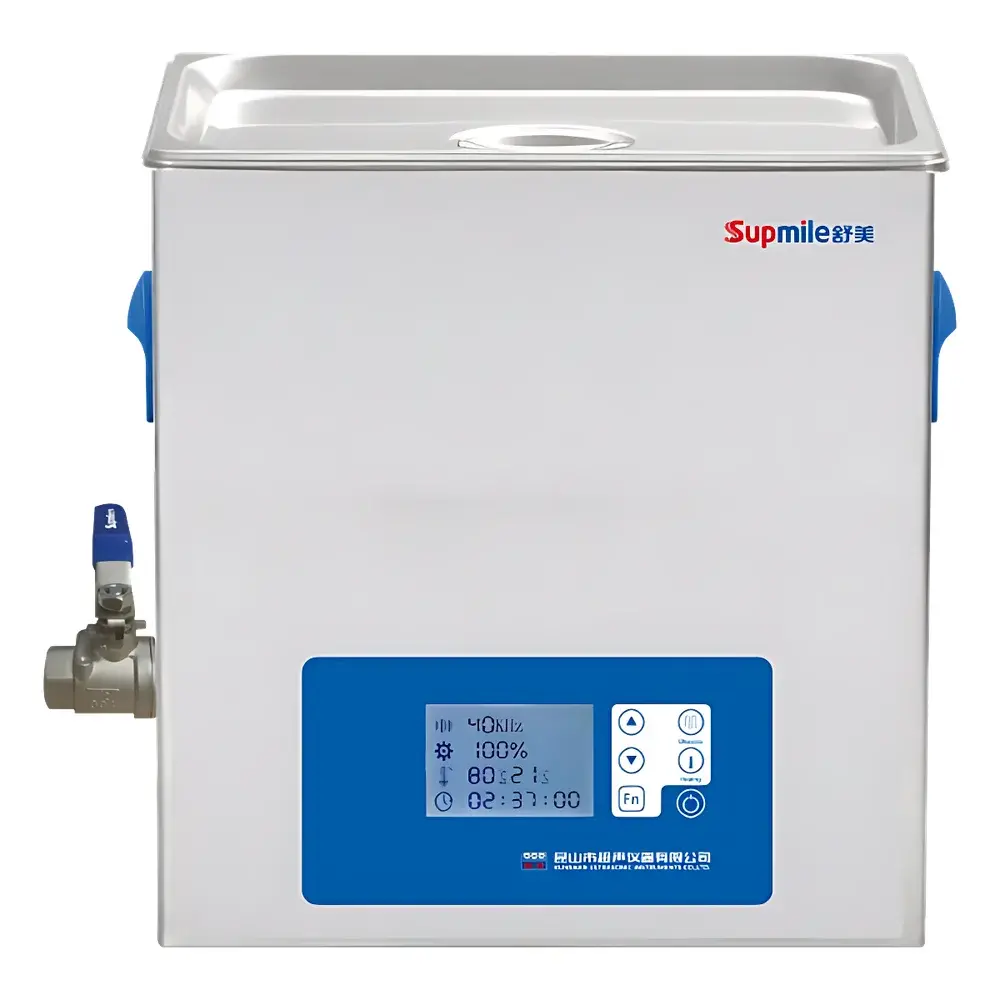
Shumei KQ3200DM Quiet-Operation Ultrasonic Cleaner
| Brand | Shumei |
|---|---|
| Origin | Jiangsu, China |
| Manufacturer Type | Direct Manufacturer |
| Instrument Type | General-Purpose Ultrasonic Cleaner |
| Capacity | 6 L |
| Ultrasonic Frequency | 40 kHz |
| Ultrasonic Power Output | 150 W (0–100% adjustable) |
| Heating Power | 400 W |
| Temperature Range | Ambient to 80 °C |
| Timer Range | 0–24 h |
| Noise Level | <60 dB(A) |
| Lid | Acoustic-Dampening Cover Included |
| Drain/Inlet | Manual Valve Control |
| Tank Material | 304 Stainless Steel (Deep-Drawn One-Piece Construction) |
| Power Supply | AC 220 V / 50 Hz |
| Safety Features | Liquid-Level Protection, Over-Temperature & Over-Current Protection |
| Standard Accessories | Stainless Steel Mesh Basket, Stainless Steel Rack, Acoustic Lid |
Overview
The Shumei KQ3200DM Quiet-Operation Ultrasonic Cleaner is an engineered solution for precision cleaning of delicate laboratory components, optical elements, precision instruments, and small-volume sample containers. It operates on the principle of ultrasonic cavitation—generating high-frequency mechanical oscillations at 40 kHz within a liquid medium to produce microscopic vacuum bubbles that collapse with localized energy release. This transient implosion disrupts particulate adhesion, organic residue, and biofilm without mechanical abrasion or thermal degradation. Designed specifically for environments where acoustic comfort and operational stability are critical—including analytical labs, quality control suites, and university teaching facilities—the KQ3200DM integrates noise-dampening architecture (<60 dB[A] during operation), a fully sealed 304 stainless steel tank (300 × 150 × 150 mm internal dimensions), and intelligent electronic controls to ensure repeatable, traceable cleaning cycles.
Key Features
- Acoustic optimization: Integrated sound-dampening lid and vibration-isolated transducer mounting reduce ambient noise to ≤60 dB(A), meeting ISO 1996-1:2016 requirements for low-noise laboratory equipment.
- Full-range power modulation: Ultrasonic output is continuously adjustable from 0% to 100% of nominal 150 W, enabling method development for sensitive substrates such as coated lenses, microfluidic chips, or MEMS devices.
- Thermal control system: Independent 400 W heating element supports temperature setpoints from ambient to 80 °C with ±2 °C accuracy, facilitating aqueous or solvent-based cleaning protocols compliant with ASTM D4784 and ISO 12100 standards.
- Robust construction: One-piece deep-drawn 304 stainless steel tank eliminates weld seams and crevices—critical for corrosion resistance and cleanability under repeated exposure to alkaline detergents or mild solvents.
- Enhanced safety architecture: Dual-protection circuitry provides real-time monitoring of liquid level, current draw, and thermal load; automatic shutdown occurs upon detection of dry-run, over-temperature (>85 °C), or over-current conditions.
- LCD touch interface: Intuitive 3.5-inch graphical display enables direct parameter entry for time (0–24 h), temperature (0–80 °C), and ultrasonic intensity (0–100%), with non-volatile memory retaining up to 10 user-defined cleaning programs.
Sample Compatibility & Compliance
The KQ3200DM accommodates a wide range of labware including volumetric flasks, cuvettes, pipette tips, HPLC vials, watch glasses, and semiconductor wafers (up to 150 mm diameter). Its 6 L working volume and modular stainless steel accessories—mesh basket and support rack—support both batch and selective immersion cleaning. The unit conforms to IEC 61000-6-3 (EMC emissions) and IEC 61000-6-2 (immunity), and its electrical insulation meets IEC 61010-1:2010 Class I safety requirements for laboratory equipment. While not certified for sterile processing per ISO 13485 or FDA 21 CFR Part 820, it is routinely deployed in GLP-compliant laboratories for pre-analytical cleaning steps preceding spectroscopic, chromatographic, or gravimetric analysis.
Software & Data Management
The KQ3200DM operates as a standalone instrument without proprietary software dependencies. All operational parameters are configured and logged locally via the embedded controller. Cycle records—including start time, duration, temperature setpoint, power level, and completion status—are stored in internal flash memory for up to 1,000 cycles and can be reviewed directly on-screen. For integration into validated workflows, the device supports manual documentation of cleaning parameters in electronic lab notebooks (ELNs) or LIMS systems. Optional RS-232 or USB-to-serial adapters (sold separately) enable basic ASCII command interfacing for external logging, though no native audit trail or 21 CFR Part 11 compliance features are implemented.
Applications
- Cleaning of glassware prior to trace metal analysis (e.g., ICP-MS sample introduction systems)
- Removal of flux residues from printed circuit boards and SMT components
- Preparation of quartz cuvettes for UV-Vis spectrophotometry to minimize scattering artifacts
- Decontamination of reusable surgical instruments in research animal facilities (non-sterile level)
- Surface preparation of substrates prior to thin-film deposition or contact angle measurement
- Routine maintenance of HPLC autosampler vials, filters, and inline frits
FAQ
Is the KQ3200DM suitable for cleaning plastic or polymer components?
Yes—when operated at reduced ultrasonic intensity (≤40%) and temperatures below 50 °C, it is compatible with common lab plastics including polypropylene, PTFE, and polycarbonate. Avoid prolonged exposure of ABS or PETG above 60 °C.
Does the unit include a degassing function?
No dedicated degas mode is provided; however, the 0–100% power adjustability allows users to initiate low-power cycling (e.g., 20% for 5 min) to assist in dissolved gas removal prior to full-intensity cleaning.
Can the drain valve be connected to a floor drain or waste collection system?
The manual drain valve is designed for gravity-fed discharge only; no threaded or quick-connect fittings are supplied. Custom hose adapters may be fabricated per local plumbing standards.
What maintenance is required for long-term reliability?
Monthly inspection of the acoustic lid seal, quarterly cleaning of the transducer mounting surface with isopropyl alcohol, and annual verification of temperature sensor calibration using a NIST-traceable thermometer are recommended.
Is the 304 stainless steel tank resistant to common cleaning solvents?
It exhibits excellent resistance to aqueous alkaline solutions, ethanol, and isopropanol. Avoid prolonged contact with hydrochloric acid, hypochlorite solutions, or chlorinated solvents, which may promote pitting corrosion.



