
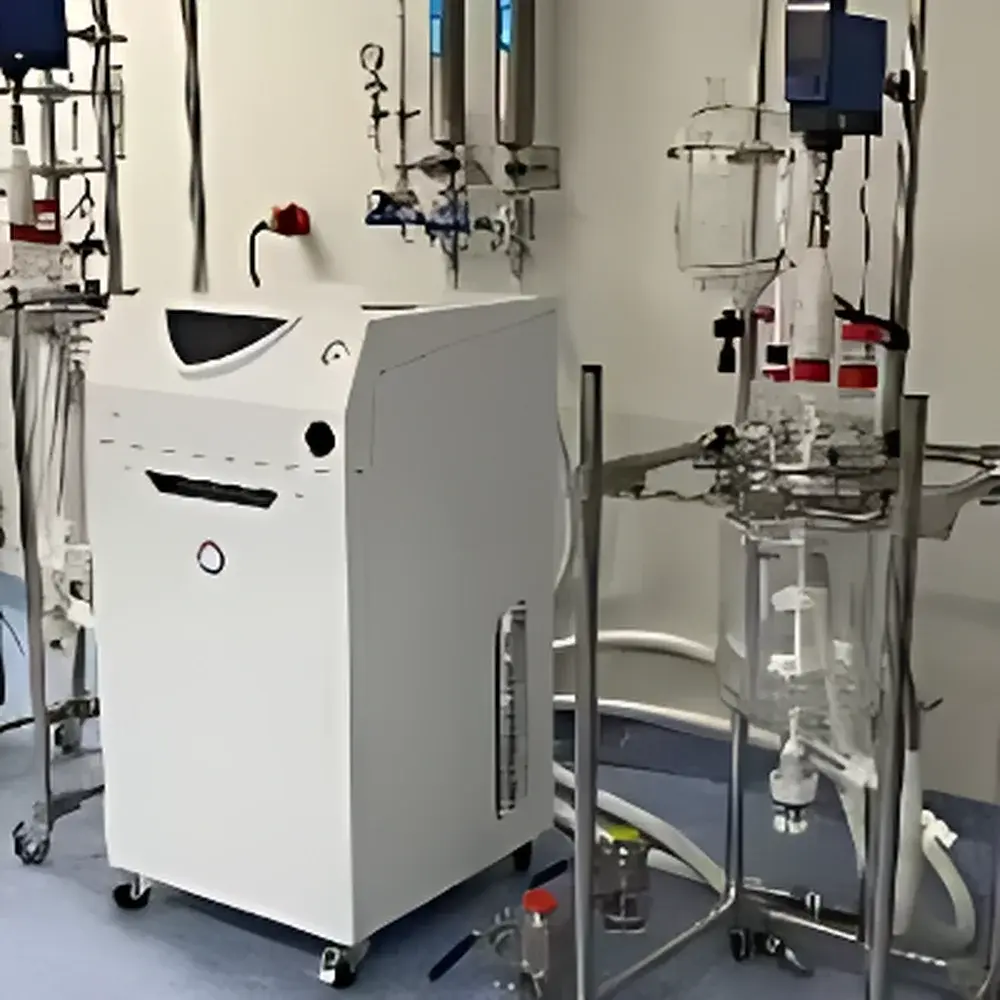
DIEHM DN200–DN500 Non-Explosion-Proof Pilot-Scale Glass Reactor
| Brand | DIEHM |
|---|---|
| Origin | Germany |
| Reactor Type | Jacketed Glass Reactor |
| Diameter Range | DN200–DN500 |
| Working Volume | 15 L to 150 L |
| Design Pressure | Low-Pressure (≤0.6 MPa gauge) |
| Vacuum Capability | ≤1 mbar (absolute) |
| Construction Material | Borosilicate Glass 3.3 (DIN ISO 3585) |
| Sealing | PTFE & EPDM Composite Gaskets |
| Agitator Options | PTFE-Coated or All-Glass Impeller |
| Frame | Modular Stainless Steel (AISI 304) Support Structure |
| Condenser Compatibility | Vertical or Horizontal, Interchangeable with Standard DIN/ISO Flange Interfaces |
| Feed Options | Elevated Dosing Vessel with Quick-Connect Fittings |
| Sampling Port | Integrated Sanitary Ball Valve (PTFE-sealed) |
| Compliance | Designed per AD 2000-Merkblatt W2 and DIN EN 13445-3 (Unfired Pressure Vessels – Part 3: Design) for Glass-Lined & Transparent Pressure Equipment |
Overview
The DIEHM DN200–DN500 Non-Explosion-Proof Pilot-Scale Glass Reactor is a fully jacketed, transparent process vessel engineered for controlled chemical synthesis, crystallization, solvent recovery, and multi-step reaction development in pilot laboratories and small-scale production environments. Constructed entirely from high-purity borosilicate glass 3.3 (compliant with DIN ISO 3585), the reactor enables real-time visual monitoring of phase separation, precipitate formation, emulsification, and mixing homogeneity—critical parameters inaccessible in opaque metal reactors. Its double-walled design integrates a thermally efficient jacket for precise temperature control via external heating/cooling circulators (e.g., LAUDA units), supporting operation across a typical range of −20 °C to +200 °C depending on thermal fluid and pressure conditions. The system operates under low-pressure and vacuum service (down to 1 mbar abs), making it suitable for distillation, reduced-pressure drying, and solvent stripping applications. As a non-explosion-proof configuration, it is intended for use in classified areas where flammable atmospheres are not present—or where supplemental engineering controls (e.g., inert gas purging, ventilation interlocks) are implemented per site-specific risk assessment.
Key Features
- Borosilicate glass 3.3 body and lid with calibrated volume markings (±1% accuracy) for reliable volumetric dosing and process repeatability
- Modular DN200–DN500 diameter platform accommodating working volumes from 15 L to 150 L, enabling direct scale-up correlation from lab to pilot scale
- Standardized DIN 28178/DIN 28179 flange interfaces (ISO-KF, ISO-F, or CG-10/15/20) on the reactor head—supporting up to five independently configurable ports for condensers, sensors, feed lines, and gas inlets
- Quick-release clamp system with corrosion-resistant stainless steel levers and PTFE/EPDM composite gaskets ensuring leak-tight sealing under thermal cycling
- Sanitary bottom discharge valve with full-bore PTFE seat and zero-dead-leg geometry, compliant with ASME BPE 2022 surface finish requirements (Ra ≤ 0.8 µm)
- Agitation system with interchangeable impellers: chemically inert PTFE-coated marine-style blades or all-glass anchor/paddle variants, compatible with standard G 1/2″ or G 3/4″ shaft couplings
- Stainless steel support frame (AISI 304) featuring tool-free height adjustment, integrated leveling feet, and load-rated casters for safe repositioning
Sample Compatibility & Compliance
The reactor demonstrates exceptional compatibility with aggressive reagents—including concentrated mineral acids (HCl, HNO₃, H₂SO₄), organic solvents (THF, DMF, chlorinated hydrocarbons), and strong alkalis (NaOH, KOH)—due to the intrinsic chemical resistance of borosilicate glass 3.3. It is routinely employed in API intermediate synthesis, fine chemical batch processing, and polymerization studies where trace metal contamination must be avoided. From a regulatory standpoint, the design adheres to the mechanical integrity requirements of DIN EN 13445-3 for transparent pressure equipment and references AD 2000-Merkblatt W2 for allowable stress evaluation of glass components under combined thermal and mechanical loading. While not certified for Zone 1/2 explosive atmospheres (IEC 60079-0), the reactor may be operated in accordance with local ATEX/IECEx risk mitigation protocols when integrated into ventilated enclosures or purged with nitrogen.
Software & Data Management
As a standalone hardware platform, the DIEHM glass reactor does not include embedded digital controllers or proprietary software. However, its mechanical and interface architecture is fully compatible with third-party process automation systems. Standard analog (4–20 mA) and digital (RS485 Modbus RTU, optional Profibus DP) signal outputs can be integrated with distributed control systems (DCS) or SCADA platforms for centralized logging of temperature (via Pt100 RTD wells), pressure (via DIN 16270-compatible transmitters), and agitation speed (via tachometer feedback). All instrumentation interfaces conform to GAMP 5 guidelines, supporting audit-trail-enabled data acquisition under FDA 21 CFR Part 11 when deployed with validated electronic record systems. Calibration documentation follows ISO/IEC 17025 principles, and as-built dimensional reports are provided with each unit.
Applications
- Multi-stage batch synthesis of pharmaceutical intermediates under reflux, distillation, or controlled addition protocols
- Catalytic hydrogenation screening using suspended noble-metal catalysts (Pd/C, PtO₂) with real-time observation of catalyst dispersion and gas evolution
- Crystallization kinetics studies—including supersaturation profiling, nucleation onset detection, and polymorph screening—leveraging optical clarity and precise thermal ramping
- Solvent exchange and azeotropic removal in peptide coupling or esterification reactions
- Process validation trials for technology transfer from R&D to manufacturing, utilizing identical geometry and heat/mass transfer characteristics across scale
- Teaching and demonstration of unit operations—including mixing efficiency, heat transfer coefficients, and vapor–liquid equilibrium—in university chemical engineering laboratories
FAQ
Is this reactor suitable for exothermic reactions requiring rapid cooling?
Yes—the double-jacket design supports high coolant flow rates and low thermal mass, enabling response times under 30 seconds for ΔT ≥ 10 °C when paired with a high-capacity chiller (e.g., LAUDA PROLINE series).
Can the reactor be supplied with pressure-rated sight glasses or reinforced viewports?
Standard configurations include full-circumference cylindrical viewing; optional fused quartz viewport inserts (up to DN100) are available for enhanced UV transparency or higher mechanical strength.
What certifications accompany the unit upon delivery?
Each reactor ships with a Manufacturer’s Declaration of Conformity, material test reports (MTRs) for glass and metal components, dimensional inspection records, and a hydrostatic test certificate at 1.5× maximum allowable working pressure (MAWP).
Do you offer custom port layouts or specialized condenser integration?
Yes—DIEHM provides engineering consultation and CAD-based customization for non-standard flange arrangements, integrated reflux dividers, or direct-coupled Vigreux-type condensers meeting client-defined thermal duty specifications.



