
Cowie PTFE-Coated Magnetic Stir Bar
| Brand | Cowie |
|---|---|
| Origin | United Kingdom |
| Product Type | PTFE-Coated Magnetic Stir Bar |
| Material Certification | FDA-Approved & USP Class VI Compliant |
| Temperature Range | –200 °C to +280 °C (short-term exposure up to +400 °C with thermal degradation onset, non-melting) |
| Sterilization Compatibility | Autoclave (121 °C, 20 min), dry heat, ethylene oxide, hydrogen peroxide plasma — not gamma irradiation |
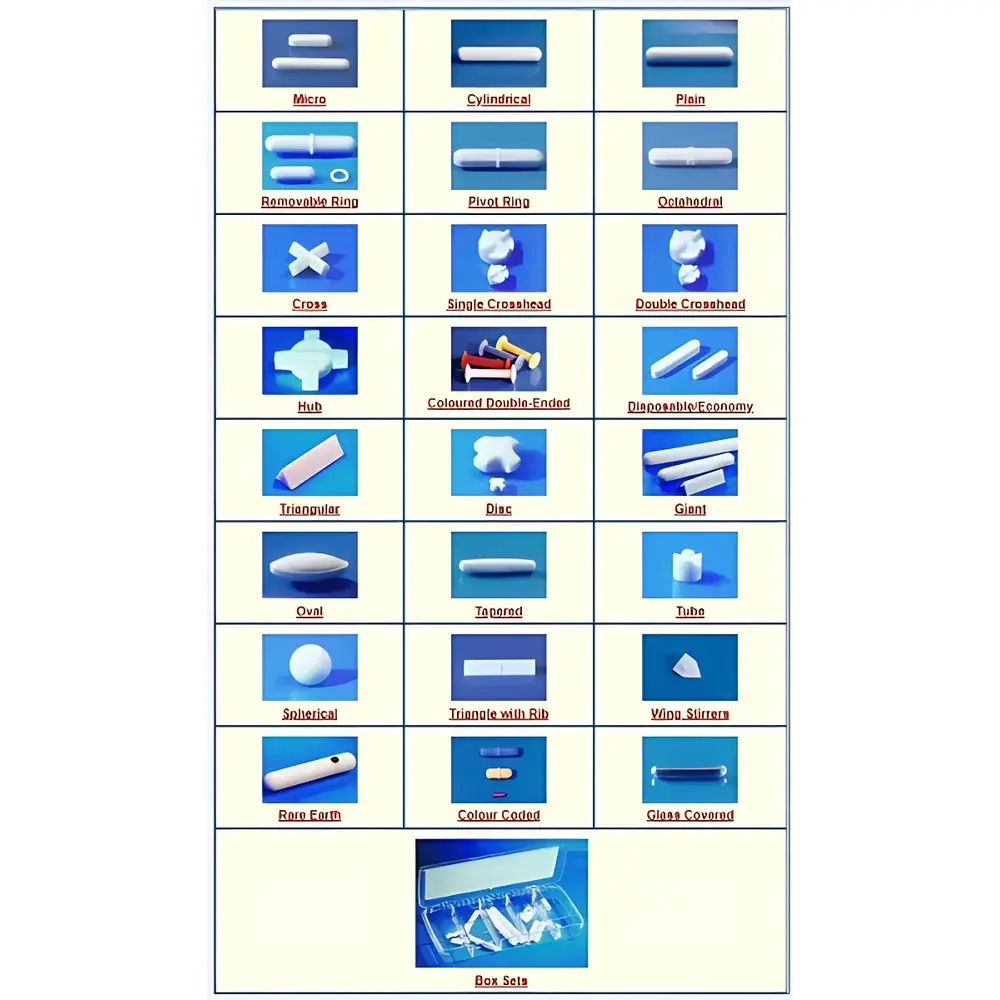
| Shape Options | Cylindrical, Oval, Cross-shaped |
| Surface | Fully PTFE-encapsulated, chemically inert, non-porous |
| Compliance | BS EN ISO 9001:2008 certified manufacturing |
Overview
The Cowie PTFE-Coated Magnetic Stir Bar is a precision-engineered laboratory component designed for reliable, contamination-free mixing in aggressive chemical, high-purity, and regulated environments. Constructed using magnetically responsive core material fully encapsulated in virgin polytetrafluoroethylene (PTFE), this stir bar operates on the principle of magnetic coupling—rotating synchronously with an external rotating magnetic field generated by a compatible magnetic stirrer base. Its fully fluorinated surface ensures zero leachables, eliminating metallic ion contamination critical in trace analysis, pharmaceutical synthesis, and semiconductor-grade reagent handling. Unlike stainless-steel or glass-coated alternatives, the Cowie stir bar maintains dimensional stability and mechanical integrity across extreme thermal gradients—from cryogenic storage at –200 °C to high-temperature reflux at +280 °C—without swelling, cracking, or surface delamination.
Key Features
- Fully PTFE-encapsulated construction with seamless overmolding—no exposed metal, no seams, no crevices for residue entrapment
- Chemical resistance validated against concentrated acids (e.g., HF, HNO₃, aqua regia), strong bases (e.g., 50% NaOH), organic solvents (e.g., THF, DMF, chlorinated hydrocarbons), and oxidizing agents
- Thermal stability certified from –200 °C to +280 °C continuous use; short-term tolerance to +400 °C with controlled thermal degradation (no melting, no dripping, no off-gassing of volatile fluorocarbons under inert atmosphere)
- FDA 21 CFR §177.1550 and USP Class VI biocompatibility certified—suitable for USP monograph-compliant dissolution testing and cell culture media preparation
- Available in standardized geometries (cylindrical, oval, cross-shaped) optimized for vortex control, low-shear suspension, and viscous medium engagement—each shape rigorously balanced for rotational symmetry and magnetic moment consistency
- Non-porous, hydrophobic surface prevents biofilm adhesion and enables rapid, residue-free cleaning via ultrasonic bath or solvent rinse
Sample Compatibility & Compliance
The Cowie PTFE stir bar is routinely deployed in applications requiring ISO/IEC 17025-compliant sample preparation, including EPA Method 3510C (acid digestion), ASTM D86 (distillation), and USP (dissolution apparatus calibration). Its inertness supports compatibility with Grade 1–3 ultrapure water systems, electrochemical cells (e.g., three-electrode setups), and halogen-sensitive organometallic reactions. All units are manufactured under a BS EN ISO 9001:2008–certified quality management system, with full batch traceability, CoA documentation, and lot-specific extraction testing data available upon request. The product meets GLP requirements for audit-ready lab notebooks and satisfies GMP Annex 11 prerequisites for equipment qualification (IQ/OQ) when used with validated stirrer platforms.
Software & Data Management
While the stir bar itself is a passive component, its performance integration is essential within digitally controlled workflows. When paired with programmable stirrers (e.g., IKA RCT basic, Thermo Scientific Maxi-Mix), the Cowie stir bar enables reproducible shear history in kinetic studies, dissolution profiling, and temperature-ramped crystallization protocols. Its consistent geometry and magnetic response support automated parameter logging—including speed ramp profiles, hold times, and thermal setpoints—within LIMS-integrated environments compliant with FDA 21 CFR Part 11 (electronic records/signatures). Optional PTFE-coated retrieval rods (sold separately) maintain full system inertness during post-run recovery, supporting closed-vessel transfer without air exposure or particulate shedding.
Applications
- Pharmaceutical R&D: Dissolution testing of immediate- and extended-release formulations under USP Apparatus 2 conditions
- Materials science: Homogenization of nanoparticle dispersions (e.g., TiO₂, SiO₂ colloids) without catalytic surface interference
- Environmental chemistry: Acid digestion of soil/sediment samples prior to ICP-MS analysis
- Electrochemistry: Stable agitation in non-aqueous Li-ion battery electrolyte formulations (e.g., LiPF₆ in EC/DMC)
- Biotechnology: Serum-free media preparation and monoclonal antibody buffer exchange in single-use bioreactors
- Calibration laboratories: Reference-standard mixing for viscosity standard verification (ASTM D2196) and density reference solution homogenization
FAQ
Can the Cowie PTFE stir bar be used in hydrofluoric acid (HF) solutions?
Yes—PTFE exhibits exceptional resistance to HF across all concentrations and temperatures up to 120 °C. No measurable weight loss or surface etching occurs under standard handling conditions.
Is it suitable for autoclaving?
Yes—validated for repeated cycles at 121 °C, 103 kPa (15 psi), 20 minutes. No dimensional change or coating delamination observed after 50 cycles.
Why is gamma irradiation not recommended?
Gamma exposure induces chain scission in PTFE, leading to embrittlement and reduced tensile strength. Alternative sterilization methods preserve structural integrity.
How does it compare to glass-coated stir bars in alkaline conditions?
Glass coatings degrade rapidly in >1 M NaOH above 60 °C, releasing silicates that interfere with ICP-OES. PTFE remains inert under identical conditions.
What is the maximum recommended stirring volume for the standard cylindrical 30 × 8 mm stir bar?
Optimized for 1–2 L volumes in standard round-bottom flasks with moderate viscosity (<500 mPa·s); larger volumes require oval or cross-shaped variants for improved torque transmission.



