
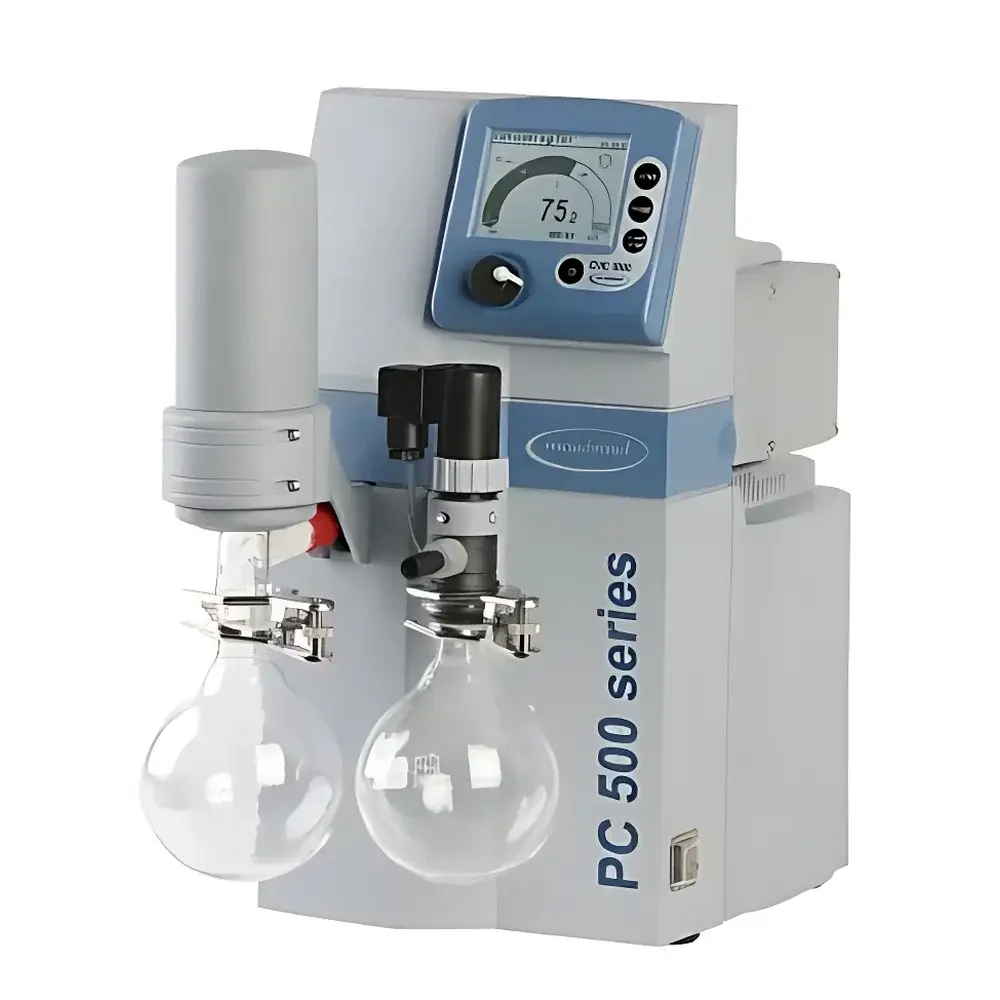
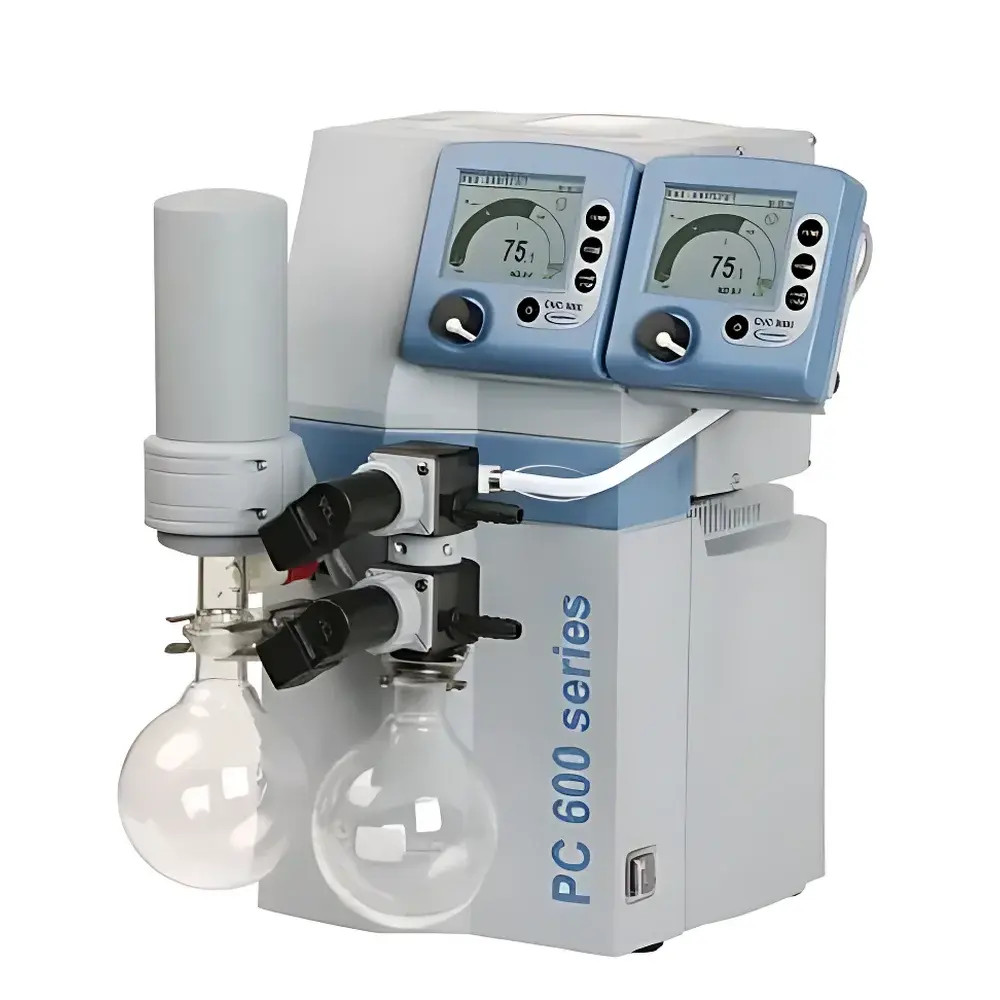
VACUUBRAND PC, AK, EK Chemical-Resistant Diaphragm Vacuum Pump Systems
| Brand | VACUUBRAND® |
|---|---|
| Origin | Germany |
| Pump Type | Oil-Free Diaphragm Vacuum Pump |
| Model Series | PC, AK, EK |
| Ultimate Vacuum | 12 mbar (abs) |
| Pumping Speed (60 Hz) | 3.8 L/min |
| Weight | 13.6 kg |
| Construction | Fluoropolymer-Lined, Chemically Inert Architecture |
| Compliance | Designed for GLP/GMP environments |
Overview
The VACUUBRAND PC, AK, and EK series represent a family of chemically resistant, oil-free diaphragm vacuum pump systems engineered for demanding laboratory and pilot-scale applications involving aggressive vapors, solvents, and corrosive process gases. These systems operate on positive displacement principles using a dual-acting PTFE “sandwich” diaphragm—comprising a reinforced elastomeric core encapsulated between two layers of virgin polytetrafluoroethylene—to ensure long-term integrity under cyclic mechanical stress and chemical exposure. Unlike rotary vane or water-ring pumps, the PC/AK/EK architecture physically isolates the drive mechanism from the gas path via hermetically sealed chambers, eliminating lubricant contamination risks and enabling operation in solvent-laden or condensable vapor streams without performance degradation. Each system integrates an integrated gas ballast (air bleed) valve to maintain stable vacuum during intermittent condensate ingress—a critical feature when interfacing with rotary evaporators, vacuum ovens, centrifugal concentrators, or reaction vessels undergoing solvent removal or drying cycles.
Key Features
- Chemically inert wetted materials: All internal gas-path components—including diaphragms, valves, inlet/outlet manifolds, and tubing—are fabricated from fluoropolymers (PTFE, ETFE, ECTFE) or fluoroelastomers (FKM), ensuring compatibility with HCl, HF, Cl₂, SO₂, acetone, THF, chlorinated hydrocarbons, and other aggressive media.
- Multi-stage configuration options: Available in two-stage (PC), three-stage (AK), and four-stage (EK) variants to achieve progressively deeper ultimate vacuums and higher pumping speeds across varying pressure ranges (1000–12 mbar).
- Extended service life design: The PTFE-clad diaphragm exhibits >10,000 hours MTBF under typical lab usage; modular valve assemblies allow field replacement without disassembling the pump head.
- Low-noise, low-vibration operation: Equipped with a precision-balanced eccentric drive and vibration-damping feet (NT-series enhancements), achieving sound pressure levels ≤45 dB(A) at 1 m distance.
- Sealed separation architecture: Drive motor, crankshaft, and lubricated bearings reside in a fully isolated chamber, preventing cross-contamination and enabling maintenance intervals exceeding 24 months under standard operating conditions.
- Integrated gas ballast valve: Enables continuous operation during condensable vapor load without oil emulsification or diaphragm fatigue—essential for reproducible rotary evaporation and lyophilization workflows.
Sample Compatibility & Compliance
These pumps are validated for use with volatile organic compounds (VOCs), acidic and alkaline fumes, halogenated solvents, and mixed-phase vapors commonly encountered in pharmaceutical synthesis, polymer processing, environmental sample preparation, and semiconductor cleaning protocols. The fluoropolymer construction conforms to ISO 10993-5 (cytotoxicity) and USP Class VI biocompatibility requirements where applicable. System-level documentation supports IQ/OQ/PQ execution per FDA 21 CFR Part 11-compliant validation protocols. All models meet CE marking requirements under the EU Machinery Directive 2006/42/EC and Electromagnetic Compatibility Directive 2014/30/EU.
Software & Data Management
While the PC/AK/EK series operate as standalone analog devices, they integrate seamlessly into automated vacuum control networks via optional analog (0–10 VDC) or digital (RS-485 Modbus RTU) interfaces. When paired with VACUUBRAND’s VacuGraph® software (via USB-to-RS485 adapter), users can log real-time vacuum level, runtime, temperature, and fault diagnostics—supporting audit trails required under GLP and GMP quality systems. Data export is compliant with CSV and XML formats for LIMS integration and electronic record retention.
Applications
- Rotary evaporation of acid-sensitive or halogenated solvents (e.g., DCM, chloroform, TFA)
- Vacuum drying of hygroscopic or oxidation-prone APIs in pharmaceutical R&D
- Gas extraction from reaction flasks during Grignard, lithiation, or catalytic hydrogenation steps
- Back-up pumping for high-vacuum systems (e.g., mass spectrometers, electron microscopes)
- Filtration of corrosive filtrates in environmental wastewater analysis (EPA Method 505, 525.3)
- Evaporative concentration of trace metals in ICP-MS sample prep workflows
- Controlled degassing of photoresist formulations in microelectronics fabrication
FAQ
What is the difference between the PC, AK, and EK models?
The PC is a two-stage pump optimized for general-purpose vacuum (12 mbar ultimate vacuum, 3.8 L/min at 60 Hz); the AK adds a third stage for improved mid-range performance and lower base pressure; the EK incorporates a fourth stage for enhanced deep-vacuum capability and higher tolerance to variable inlet loads.
Can these pumps handle saturated solvent vapors continuously?
Yes—when operated with the gas ballast valve open, they tolerate intermittent condensate formation without loss of performance or diaphragm damage. For sustained high-condensate loads, pairing with a cold trap is recommended.
Is routine maintenance required?
No scheduled oil changes or lubrication are needed. Recommended preventive actions include quarterly inspection of inlet filters and annual verification of diaphragm integrity and valve seating—typically performed in <15 minutes without tools.
Do these pumps comply with cleanroom or ISO Class 5 environments?
While not rated for direct cleanroom installation due to non-hermetic motor enclosures, their oil-free, particle-free exhaust and low outgassing fluoropolymer construction make them suitable for adjacent utility rooms feeding ISO Class 5–8 controlled environments.
How is calibration documented for regulatory submissions?
VACUUBRAND provides factory calibration certificates traceable to PTB (Physikalisch-Technische Bundesanstalt). Users may perform in-house verification using NIST-traceable digital vacuum gauges; full calibration SOPs are available upon request for 21 CFR Part 11 compliance.



