
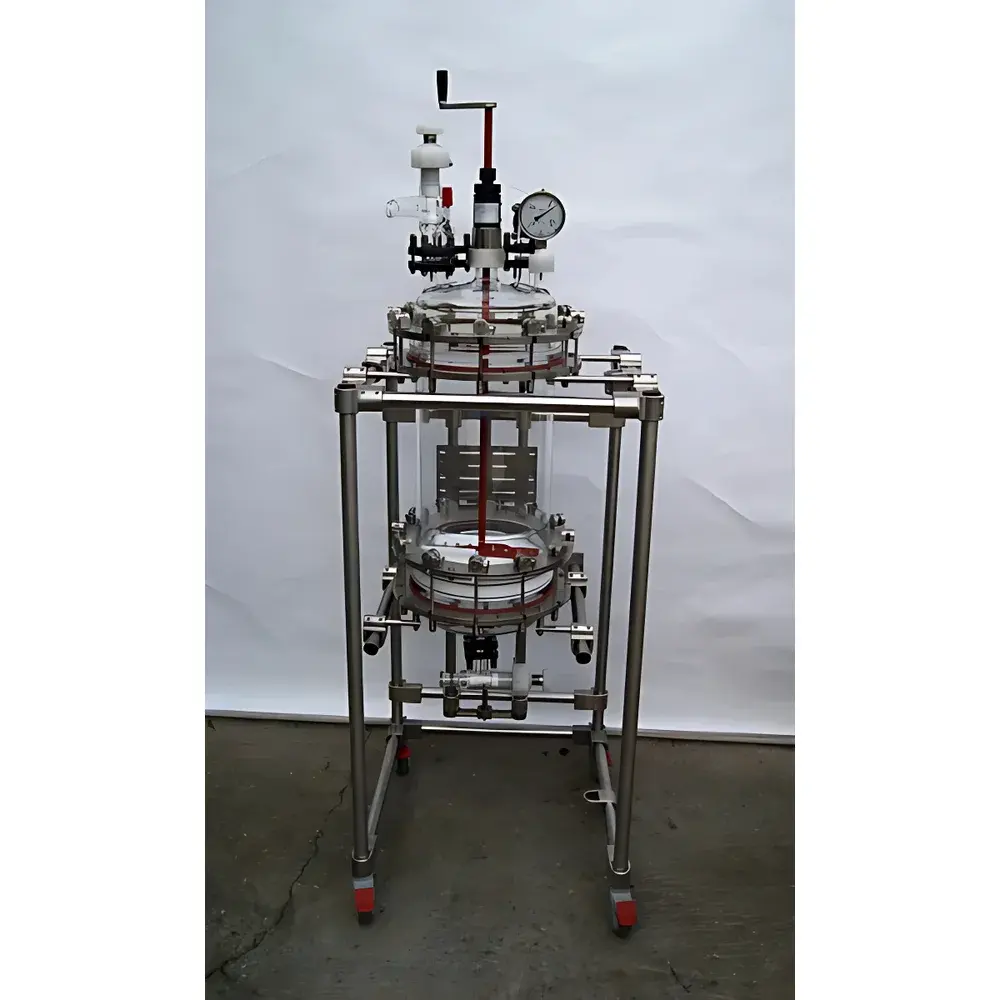
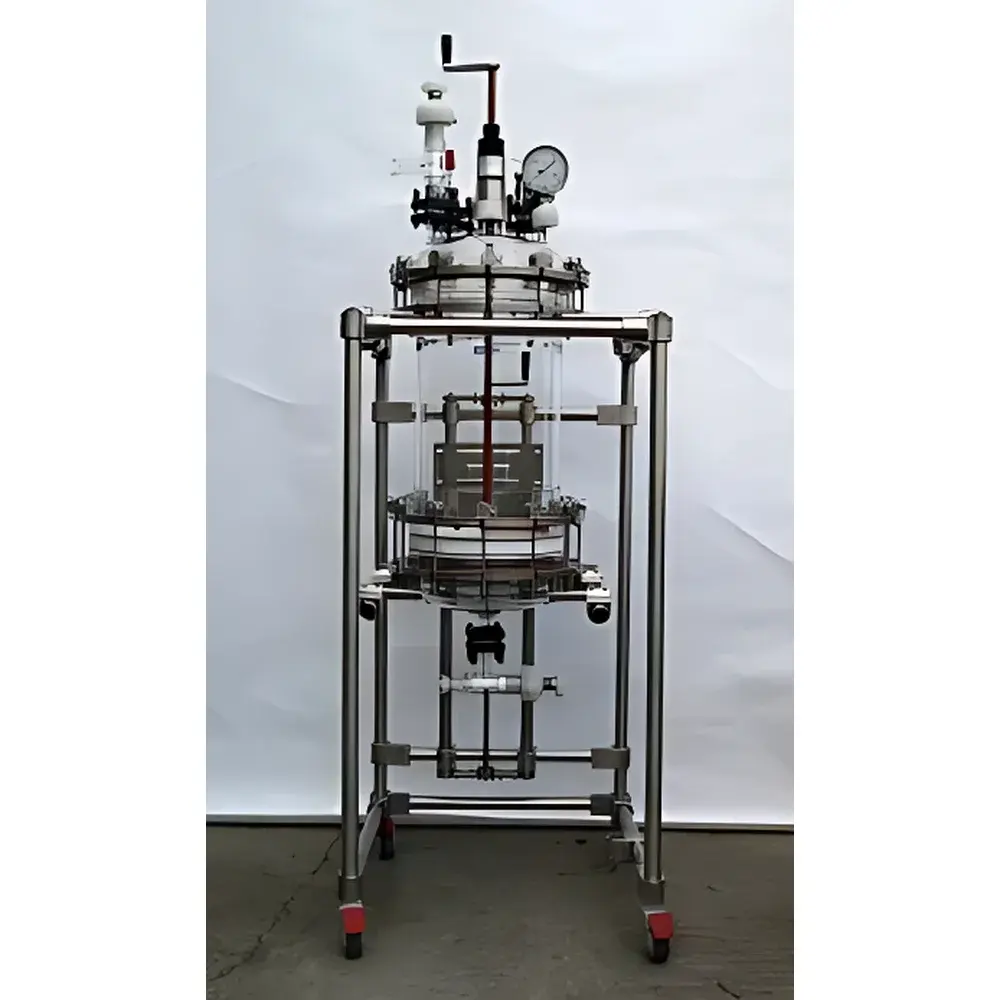
DIEHM Kilogram-Scale Filtration Reactor
| Brand | DIEHM |
|---|---|
| Origin | Germany |
| Model | 10 L, 20 L, 30 L, 50 L |
| Construction Material | Borosilicate Glass 3.3 (DURAN®-grade) |
| Jacket Type | Single or Double Jacket |
| Max Working Pressure | ≤ 0.5 bar (gauge) |
| Vacuum Rating | ≤ 1 mbar (absolute) |
| Stirring Drive | Manual or Motorized Lift Mechanism |
| Stirrer Shaft & Impeller | SS316Ti with 0.5 mm FPA anti-corrosion coating |
| Filter Plate | PTFE-coated stainless steel support with replaceable PP membrane filters (pore sizes: 0.2–10 µm, diameters: DN200–DN500) |
| Sealing System | Chemically resistant elastomeric gaskets (FKM/FFKM), quick-release clamps |
| Bottom Valve | PTFE-lined diaphragm valve, zero-dead-volume design |
| Temperature Monitoring | Integrated Pt100 sensor port |
| Jacket Inlet/Outlet | Standardized G1" BSP ports compatible with LAUDA, JULABO, Huber, and other external circulators |
| Structural Support | GMP-compliant stainless steel frame with adjustable leveling feet |
| Compliance | Designed per ISO 15891, ASTM E2500 (for lab-scale process equipment), and aligned with EU GMP Annex 15 principles for equipment qualification |
Overview
The DIEHM Kilogram-Scale Filtration Reactor is a modular, jacketed glass reactor system engineered for controlled synthesis, crystallization, filtration, and solvent exchange in pharmaceutical development, fine chemical R&D, and pilot-scale process optimization. Built from high-purity borosilicate glass 3.3 (equivalent to DURAN® or Pyrex®), the reactor operates under low-pressure and deep-vacuum conditions (down to 1 mbar abs), enabling efficient distillation, drying, and inert-atmosphere reactions. Its integrated bottom filtration assembly—comprising a PTFE-coated SS316Ti support plate and interchangeable polypropylene membrane filters—allows inline solid–liquid separation without vessel opening, minimizing operator exposure and cross-contamination risk. The double-jacket configuration supports precise temperature control via external thermal circulators, while the zero-dead-volume PTFE diaphragm discharge valve ensures quantitative product recovery and facilitates cleaning-in-place (CIP) validation.
Key Features
- Modular construction with standardized G1″ BSP jacket ports for seamless integration with LAUDA, Huber, JULABO, and other industrial-grade temperature control units.
- Motorized or manual vertical lift mechanism for precise positioning of stirrer shaft and condenser assembly—reducing mechanical stress on glass joints and improving operational repeatability.
- SS316Ti impeller and shaft coated with 0.5 mm fluoropolymer-aluminized (FPA) protective layer, delivering enhanced resistance to halogenated solvents, strong acids, and oxidizing media.
- GMP-aligned structural frame fabricated from electropolished AISI 316L stainless steel, including height-adjustable leveling feet and reinforced load-bearing brackets rated for full liquid weight at 50 L capacity.
- Quick-release clamp system with calibrated torque indicators ensures consistent sealing force across all flange interfaces—critical for vacuum integrity and long-term gasket performance.
- PTFE-lined bottom valve with sanitary diaphragm actuation enables complete drainage, residue-free transfer, and compatibility with sterilization-in-place (SIP) protocols when paired with steam-capable circulators.
Sample Compatibility & Compliance
The reactor accommodates a broad range of chemically aggressive reagents—including anhydrous HF, fuming nitric acid, molten alkali metal hydrides, and chlorinated solvents—without compromising structural integrity or dimensional stability. All wetted surfaces are either borosilicate glass 3.3 or FPA-coated SS316Ti; non-metallic components (gaskets, filter membranes, valve linings) conform to USP Class VI and FDA 21 CFR 177.1550 standards. The system supports IQ/OQ documentation packages per ASTM E2500 and ICH Q5A/Q7 guidelines. Optional traceability add-ons include calibrated Pt100 sensors with 4–20 mA output, digital pressure transducers (0–1 bar, ±0.25% FS), and audit-trail-enabled control modules compliant with FDA 21 CFR Part 11.
Software & Data Management
While the base reactor operates as a stand-alone unit, it is fully interoperable with third-party process monitoring platforms such as LabVIEW-based SCADA systems, DeltaV DCS modules, and Siemens Desigo CC environments. Optional digital instrumentation kits provide real-time logging of jacket inlet/outlet temperatures, internal vessel pressure, stirrer torque (via strain-gauge coupling), and filtrate mass flow (with Coriolis or gravimetric integration). All data streams adhere to OPC UA (IEC 62541) protocol standards, enabling secure, timestamped export to LIMS or ELN systems with configurable metadata tagging (batch ID, operator ID, SOP version).
Applications
- Crystallization screening and polymorph isolation under controlled supersaturation and cooling profiles.
- Multi-step catalytic hydrogenations requiring simultaneous H2 sparging, filtration of heterogeneous catalysts (e.g., Pd/C, Raney Ni), and solvent swap prior to lyophilization.
- API salt formation and isolation with in-situ particle size monitoring via inline FBRM or laser diffraction probes (compatible with standard side-port adapters).
- Continuous slurry washing using counter-current displacement with minimal solvent volume—validated for residual solvent carryover < 50 ppm per ICH Q3C.
- Process analytical technology (PAT) implementation: integration with Raman spectroscopy cells, ATR-FTIR flow cells, and automated pH/conductivity probes for real-time reaction endpoint detection.
FAQ
What temperature ranges can the double-jacketed reactor sustain?
With compatible external circulators, the system supports operation from –80 °C (using ethylene glycol/dry ice mixtures) to +200 °C (with silicone oil), limited only by the thermal stability of the glass and gasket materials.
Is the filtration plate autoclavable?
The PTFE-coated SS316Ti support plate is autoclavable at 134 °C / 2 bar for up to 60 minutes; PP membranes are single-use and must be replaced after each batch.
Can the reactor be validated for GMP manufacturing?
Yes—DIEHM provides Factory Acceptance Test (FAT) documentation, material traceability certificates (EN 10204 3.1), and optional User Requirement Specification (URS)-driven Installation/Operational Qualification (IQ/OQ) support through certified partners.
Are custom port configurations available?
All reactors are manufactured to order; standard configurations include 2× DN25 side ports, 1× DN40 top port, and 1× DN25 bottom filtrate outlet—with additional ports, sight glasses, or gas dispersion spargers available upon request.
Does the system meet explosion-proof requirements for solvent-based processes?
The base unit is not intrinsically safe; however, motorized drives and digital sensors can be supplied with ATEX Zone 1/2 or IECEx certification when specified at time of order.



