
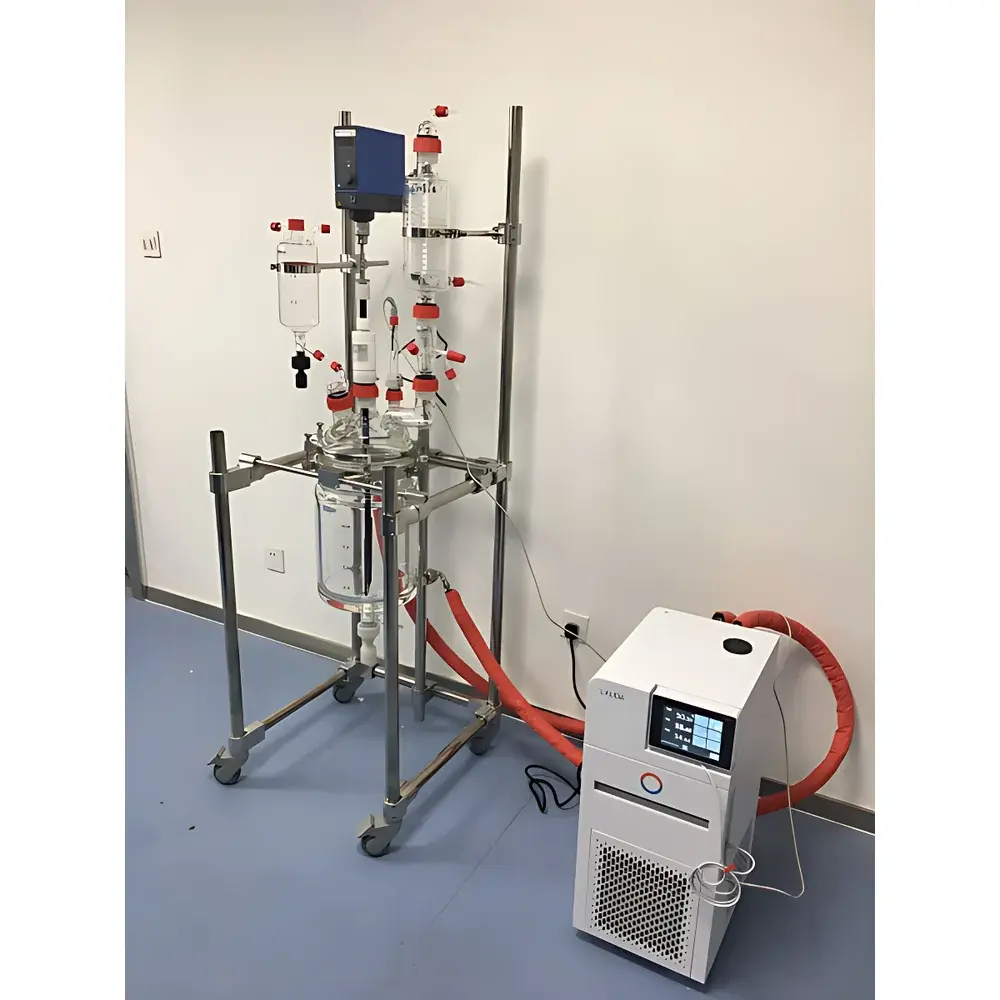
DIEHM Quartz Glass Reactor (DN100–DN450, 0.1–150 L, High-Pressure, Semiconductor-Grade)
| Brand | DIEHM |
|---|---|
| Origin | Germany |
| Reactor Type | Jacketed Quartz Glass Reactor |
| Diameter Range | DN100–DN450 |
| Capacity | 0.1 L to 150 L |
| Construction Material | Fused Silica (Heraeus Suprasil® Grade) |
| Maximum Operating Temperature | 280 °C |
| Pressure Rating | High-Pressure (Design per AD 2000 Merkblatt B3 / PED 2014/68/EU) |
| Vacuum Performance | ≤1 mbar (absolute) |
| Sealing System | Fluoropolymer (FFKM/PTFE) Gaskets with Sanitary Clamp Connections |
| Stirring Assembly | PTFE-Coated or All-PTFE Impeller, High-Torque Motor Options (Explosion-Proof ATEX Zone 1 Available) |
| Compliance | ISO 9001 Manufacturing, ASTM E438 Class I Type I Glass Specification Equivalent, Semiconductor Cleanroom-Compatible (ISO Class 5–7 Compatible Mounting & Surface Finish) |
Overview
The DIEHM Quartz Glass Reactor is a high-integrity, semiconductor-grade laboratory and pilot-scale reaction system engineered for chemically aggressive, ultra-pure, and thermally demanding synthesis processes. Built on fused silica (Suprasil®-grade quartz) from Heraeus—selected for its exceptional UV transparency, near-zero metallic impurity leaching (<0.1 ppb total metal content), and thermal shock resistance—the reactor operates reliably under simultaneous high temperature (up to 280 °C), high pressure (design-certified per PED 2014/68/EU), and deep vacuum (≤1 mbar abs). Its monolithic quartz construction eliminates catalytic surface contamination common in borosilicate glass or metal-lined reactors, making it indispensable for photoredox catalysis, organometallic synthesis, HF-based etching chemistry, and pharmaceutical process development requiring strict elemental purity control.
Key Features
- Fused silica vessel body (Heraeus Suprasil® 312 or 313) with certified trace-metal assay reports available upon request
- Jacketed design supporting precise external temperature control via integration with LAUDA, JULABO, or Huber circulators (standardized 1/2″–2″ NPT or DIN 11851 fittings)
- Modular top plate with 4–8 standardized ISO-KF or DIN 28178 ports for condensers, gas inlets, pH/temperature probes, reflux controllers, and automated dosing modules
- Zero-dead-volume bottom discharge valve fabricated from perfluoroelastomer (FFKM) and PTFE, compliant with USP Class VI and FDA 21 CFR 177.1550
- Stirring system featuring PTFE-sheathed shafts and impellers; optional magnetic coupling for leak-tight operation under vacuum or inert atmosphere
- Structural support frame in electropolished AISI 316L stainless steel or anodized aluminum alloy—designed for ISO Class 5 cleanroom installation with static-dissipative coating options
- Integrated Pt100 RTD sensors (reaction mass, jacket fluid, distillate line) with 0.1 °C resolution and NIST-traceable calibration documentation
Sample Compatibility & Compliance
The reactor demonstrates full compatibility with hydrofluoric acid (HF), hot concentrated phosphoric acid, chlorine dioxide, ozone, and other highly oxidizing or corrosive reagents incompatible with standard borosilicate glass. Its quartz composition meets ASTM E438 Type I, Class I specifications for optical and chemical grade fused silica. All wetted elastomers conform to FDA 21 CFR 177.2600 (FFKM) and 177.1550 (PTFE); mechanical joints follow ISO 15883-1 for cleaning validation readiness. Systems can be supplied with IQ/OQ documentation packages aligned with GMP Annex 15 and EU GMP Part I, including material certificates (3.1), pressure test records (hydrostatic + pneumatic), and surface roughness verification (Ra ≤ 0.4 µm on polished interfaces).
Software & Data Management
While the base reactor is analog-operated, it is fully compatible with third-party process automation platforms—including DeltaV, Siemens Desigo, and LabVIEW-based SCADA systems—via 4–20 mA or Modbus RTU outputs from optional digital transmitters. Temperature, pressure, stirrer torque, and feed mass flow signals can be logged with ≥1 Hz sampling frequency. For standalone operation, optional integrated controllers (e.g., Watlow F4T) provide PID-regulated heating/cooling with audit trail functionality compliant with FDA 21 CFR Part 11 (electronic signatures, user role management, immutable event logs). Data export supports CSV, PDF report generation, and direct integration into ELN systems (e.g., Benchling, LabArchives).
Applications
- High-purity precursor synthesis for semiconductor CVD/ALD processes (e.g., TiCl₄, SiH₄ derivatives)
- Photochemical reactions requiring >190 nm UV transmission (e.g., [2+2] cycloadditions, singlet oxygen generation)
- Hydrothermal crystallization of MOFs and perovskites under controlled p/T gradients
- Continuous-flow microreactor scale-up studies with inline Raman/FTIR coupling
- GMP-compliant API intermediate synthesis where metallic catalyst residue must remain below ICH Q3D Stage 2 limits
- Corrosion testing of novel alloys and coatings in aggressive halogen environments
FAQ
What quartz grade is used, and is material certification provided?
All vessels use Heraeus Suprasil® 312 or 313 fused silica with full CoA (Certificate of Analysis) including Fe, Cr, Ni, Cu, Al, Na, K, and Cl impurity levels — available upon order confirmation.
Can the reactor be validated for GMP manufacturing use?
Yes. Full qualification packages (DQ/IQ/OQ/PQ) are available, including risk assessments (FMEA), cleaning validation protocols, and calibration traceability to national standards (DKD/DAkkS-accredited labs).
Is explosion-proof motor integration supported?
Standard configurations include ATEX-certified motors (II 2G Ex db IIB T4 Gb) with IP66 enclosures; custom IECEx or NEC Class I Div 1 configurations are available.
How is temperature uniformity maintained across large-volume reactors (e.g., 100–150 L)?
Through optimized jacket geometry, segmented heating/cooling zones, and CFD-validated internal baffle design—ensuring ΔT ≤ ±1.5 °C across working volume at steady state.
Do you offer turnkey process skids with integrated distillation, quench, or filtration modules?
Yes. DIEHM collaborates with engineering partners to deliver fully integrated, CE-marked reaction skids—including condensers (vertical/horizontal), cryogenic traps, membrane filters (0.1–5 µm), and gravimetric dosing stations—with FAT/SAT documentation.



