
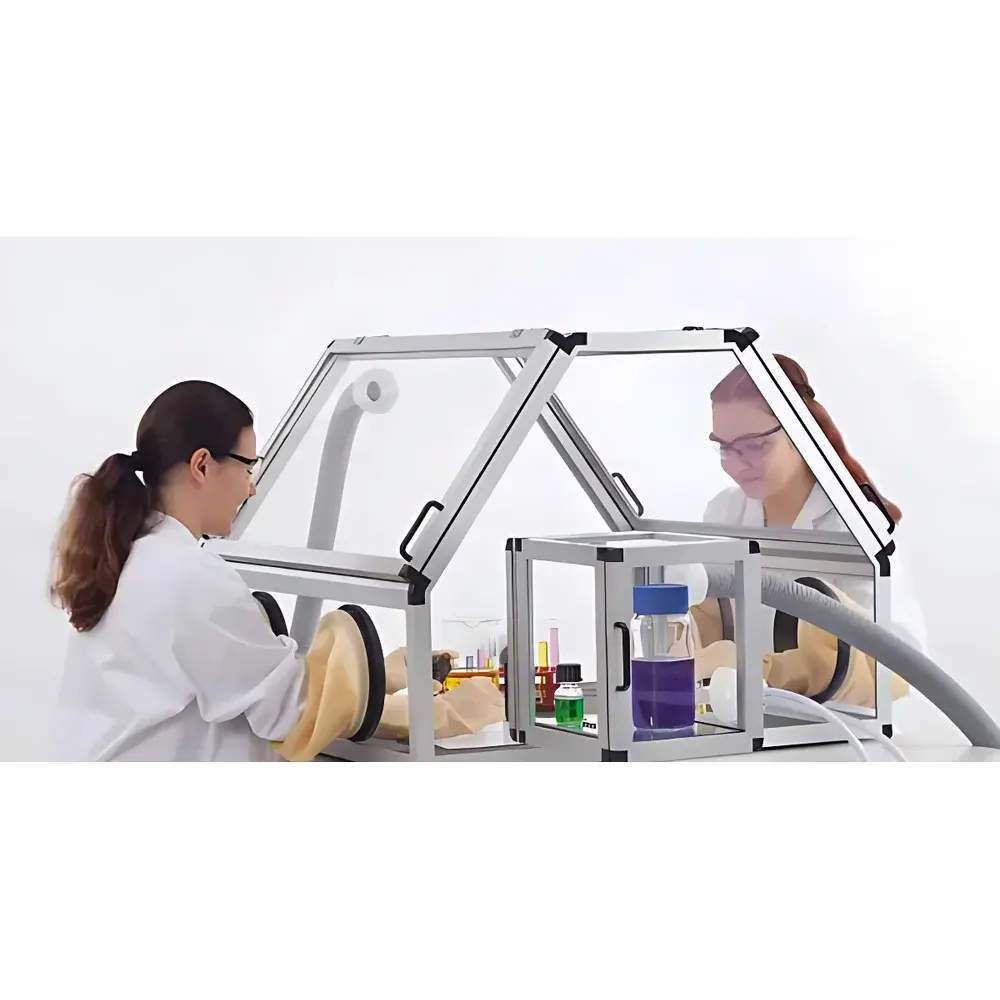
SICCO V1710-08 Glove-Box Style Vacuum Drying Chamber
| Brand | SICCO |
|---|---|
| Origin | Germany |
| Model | V1710-08 |
| Instrument Type | Vacuum Drying Oven |
| Temperature Range | -20 °C to 70 °C |
| Temperature Uniformity | ±1.75 °C |
| External Dimensions (W×H×D) | 1200×710×890 mm |
| Internal Chamber Dimensions (W×H×D) | 850×665×845 mm |
| Internal Volume | 475 L |
| Chamber Material | PMMA (Polymethyl Methacrylate) |
| Heating Method | Forced-Air Convection |
Overview
The SICCO V1710-08 Glove-Box Style Vacuum Drying Chamber is an engineered solution for controlled-atmosphere drying, solvent removal, and moisture-sensitive sample conditioning in research laboratories, pharmaceutical QC labs, and advanced materials development facilities. Unlike conventional benchtop ovens, this system integrates vacuum capability with a sealed glove-box architecture—enabling operator access without atmospheric exposure while maintaining precise thermal and pressure control. Its core operation relies on simultaneous vacuum-assisted desorption and forced-air convection heating, significantly reducing drying time for hygroscopic, oxygen-sensitive, or thermally labile substances. The chamber operates across a wide temperature range from –20 °C to +70 °C, supporting both cryo-drying and low-temperature vacuum stabilization protocols. Designed and manufactured in Germany, the unit complies with fundamental safety and electromagnetic compatibility requirements per EN 61000-6-3 and EN 61000-6-4, and its structural integrity meets DIN 12880 standards for laboratory drying equipment.
Key Features
- Glove-box integrated design with two ESD-safe natural rubber gloves mounted on PMMA viewing panels—enabling manual manipulation of samples under inert or vacuum conditions without compromising chamber integrity.
- Transparent PMMA (polymethyl methacrylate) inner chamber walls provide full visual monitoring while resisting chemical fogging and mechanical abrasion typical of repeated vacuum cycling.
- Forced-air convection heating system ensures uniform thermal distribution; validated temperature uniformity of ±1.75 °C across the entire 475 L working volume at setpoints between 20 °C and 60 °C.
- Dual-port gas handling interface: one dedicated to inert gas purging (e.g., N₂ or Ar), the other to vacuum evacuation via external pump connection—both fitted with stainless-steel quick-coupling fittings and integrated solenoid valves.
- Aluminum frame structure with polyethylene base plate provides mechanical stability and electrical grounding continuity, essential for electrostatic discharge (ESD)-sensitive applications such as battery electrode drying or semiconductor packaging.
- Front-access flip lid (850 mm × 425 mm) with silicone gasket seal and dual-point pneumatic latching ensures rapid loading/unloading while maintaining vacuum integrity down to ≤10 mbar.
Sample Compatibility & Compliance
The V1710-08 accommodates heterogeneous sample forms—including powder batches, coated substrates, polymer films, lithium-ion cathode slurries, and lyophilized biological matrices—without risk of oxidation or ambient moisture reabsorption. Its PMMA chamber material is compatible with common organic solvents (e.g., acetone, IPA, ethyl acetate) and non-oxidizing acids at room temperature. The system supports compliance workflows aligned with ISO 17025 calibration traceability when paired with external Class I accredited temperature probes. While not certified for GMP manufacturing environments out-of-the-box, it meets prerequisite engineering controls for GLP-compliant drying validation studies (e.g., residual solvent analysis per ICH Q3C). Optional integration with digital vacuum gauges and data loggers enables audit-ready records compliant with FDA 21 CFR Part 11 when configured with appropriate software and user access controls.
Software & Data Management
The V1710-08 operates via a front-panel PID controller with real-time display of chamber temperature, vacuum level (when interfaced), and elapsed cycle time. It does not include embedded PC-based software; however, analog 0–10 V and RS485 Modbus RTU outputs are provided for integration into centralized lab automation systems (e.g., LabWare LIMS, Siemens Desigo, or custom SCADA platforms). Temperature profiles can be logged externally using calibrated USB data loggers (e.g., Omega OM-DAQPRO-5300) synchronized with vacuum pump status signals. All operational parameters—including door open/close events, temperature deviations >±2 °C, and vacuum loss alarms—are recorded with timestamps for post-process review and deviation investigation.
Applications
- Drying of moisture-sensitive active pharmaceutical ingredients (APIs) prior to tablet compression or encapsulation.
- Removal of residual solvents from printed electronics inks and OLED layer precursors under nitrogen blanket.
- Conditioning of supercapacitor electrode materials and solid-state electrolyte films under controlled dew point.
- Stabilization of calibration standards for gravimetric moisture analyzers (e.g., Mettler Toledo HR83).
- Pre-treatment of silica aerogel monoliths before supercritical CO₂ drying.
- Low-temperature vacuum annealing of perovskite thin films in photovoltaic R&D.
FAQ
Can the V1710-08 operate under full vacuum while maintaining sub-zero temperatures?
Yes—the chamber’s refrigeration-assisted cooling system allows stable operation at –20 °C under vacuum pressures down to 10 mbar, provided the connected vacuum pump is oil-free and rated for condensable vapor handling.
Is PMMA suitable for long-term exposure to chlorinated solvents?
No—PMMA exhibits limited resistance to chloroform, methylene chloride, and carbon tetrachloride. Users should consult the SICCO Chemical Compatibility Guide and consider optional borosilicate glass viewport inserts for aggressive solvent applications.
Does the unit include vacuum pump and inert gas regulator?
No—these are specified as external accessories. SICCO recommends pairing with a two-stage diaphragm vacuum pump (e.g., KNF N86 KT.18) and a dual-stage stainless-steel pressure regulator for N₂/Ar supply lines.
What maintenance intervals are recommended for the convection fan and door seal?
Fan bearings require lubrication every 12 months; silicone door gaskets should be inspected quarterly and replaced if surface cracking or compression set exceeds 15% of original thickness.
Is remote monitoring supported via Ethernet or Wi-Fi?
Not natively—but RS485 Modbus output enables connection to industrial gateways (e.g., Moxa EDS-G205A) for TCP/IP bridging into enterprise networks with appropriate firewall segmentation.
Related Products



