
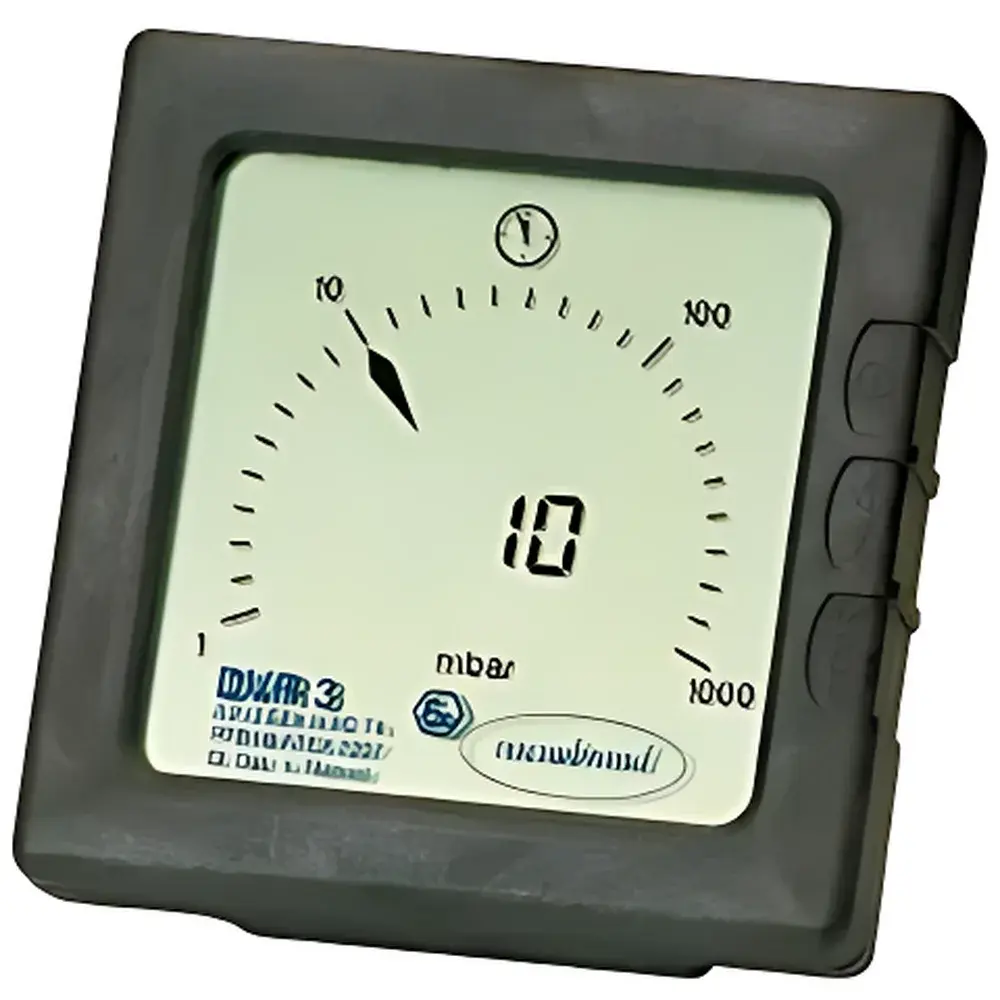
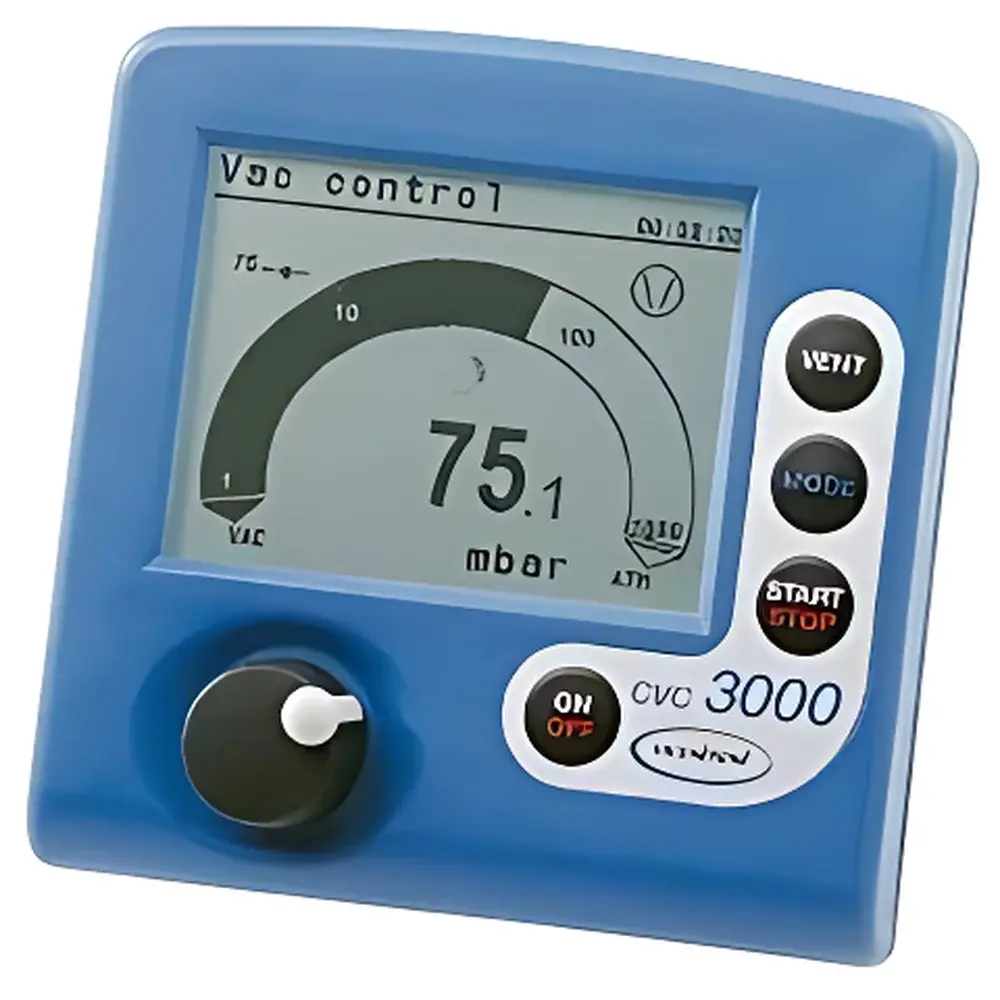
VACUUBRAND DVR3 ATEX-Certified Intrinsically Safe Vacuum Controller with Ceramic Capacitive Sensor
| Brand | VACUUBRAND® |
|---|---|
| Origin | Germany |
| Model | DVR3 |
| Certification | ATEX II 2G EEx ia IIC T4 |
| Power Supply | 9 V Battery (BVE) |
| Measurement Range | 1–1080 mbar |
| Sensor Material | Alumina Ceramic Capacitive Diaphragm |
| Weight | 0.43 kg |
| Compliance | Mercury- and Cadmium-Free, GLP-Compatible Operation |
Overview
The VACUUBRAND DVR3 is an intrinsically safe, battery-powered vacuum controller engineered for continuous, reliable pressure monitoring in potentially explosive atmospheres classified under ATEX Zone 2 (II 2G EEx ia IIC T4). Unlike conventional vacuum gauges requiring external power cabling—introducing ignition risks in hazardous areas—the DVR3 operates entirely on a single 9 V BVE battery, eliminating electrical interface hazards while maintaining full measurement integrity. Its core sensing element is a precision alumina ceramic capacitive diaphragm, offering exceptional long-term stability, chemical inertness, and resistance to aggressive vapors commonly encountered in pharmaceutical synthesis, solvent recovery, and chemical process development. The device implements a dual-mode display architecture: a high-resolution digital readout for absolute pressure quantification (in mbar), paired with an analog bar graph for real-time trend visualization—enabling rapid operational assessment without compromising metrological accuracy. Designed for compliance-driven laboratory and pilot-plant environments, the DVR3 supports traceable vacuum control workflows aligned with ISO/IEC 17025, ASTM D3610, and EU Directive 2014/34/EU.
Key Features
- Intrinsically safe design certified to ATEX II 2G EEx ia IIC T4—suitable for use in Zone 2 gas atmospheres containing hydrogen, ethylene, or acetylene-class mixtures
- Alumina ceramic capacitive sensor with <1 % FS long-term drift per year and immunity to condensable vapors, acids, and solvents including HCl, acetone, and THF
- True battery-only operation: no mains connection, no signal cables, no grounding loops—reducing installation complexity and explosion risk
- Dual-format display: 4-digit LED digital readout (0.1 mbar resolution) + dynamic analog bar graph (20-segment scale) for intuitive trend recognition
- Configurable sampling rate (1–60 s intervals) and auto-power-down mode extend battery life to ≥12 months under typical lab usage
- EMI-hardened electronics with <3 V/m radiated immunity (per IEC 61326-1) ensuring stable performance near induction heaters, RF sealers, and variable-frequency drives
- Mercury- and cadmium-free construction compliant with RoHS 2011/65/EU and WEEE 2012/19/EU directives
Sample Compatibility & Compliance
The DVR3 is compatible with all standard KF-16, ISO-KF, and NW16 vacuum fittings via its integrated G1/4″ male thread. Its ceramic sensor exhibits no hysteresis when exposed to repeated cycling between atmospheric pressure and 1 mbar, making it suitable for batch vacuum drying, distillation under reduced pressure, and glovebox leak-check protocols. It meets the essential health and safety requirements of the ATEX Directive 2014/34/EU and carries CE marking under the Equipment and Protective Systems Intended for Use in Potentially Explosive Atmospheres Regulation. For regulated industries, the DVR3 supports audit-ready documentation: calibration certificates (traceable to PTB Braunschweig), factory test reports, and material declarations are available upon request. While not FDA 21 CFR Part 11–enabled (as it lacks network connectivity), its standalone operation satisfies GLP Annex 11 requirements for non-computerized systems used in quality-critical vacuum processes.
Software & Data Management
The DVR3 is a self-contained hardware instrument with no embedded firmware update capability or USB/Bluetooth interface. All configuration—including unit selection (mbar, Torr, Pa), backlight timeout, and sampling interval—is performed via front-panel push-button navigation. Readings are not stored internally; however, analog output (0–10 V DC, linear vs. log pressure scale) is available via optional accessory cable (DVR3-ANALOG-KIT) for integration into PLC-based control systems or SCADA historians. For laboratories requiring electronic record retention, users may pair the DVR3 with third-party data loggers (e.g., Omega OM-DAQPRO-5300) using its analog output channel. Calibration verification is performed using NIST-traceable reference manometers; VACUUBRAND recommends annual verification in accordance with ISO/IEC 17025 Clause 6.5.
Applications
- Explosive atmosphere vacuum monitoring in API synthesis reactors and solvent recovery units
- Inert-gas purged gloveboxes handling pyrophoric reagents (e.g., organolithiums, metal hydrides)
- Vacuum-assisted filtration in fine chemical manufacturing where solvent vapors exceed LEL thresholds
- Quality control of vacuum packaging integrity for pharmaceutical blister packs (per ISO 11607-2)
- Field-deployable vacuum validation in offshore chemical processing modules subject to IEC 60079-0 certification
- Teaching labs conducting flammable vapor experiments under controlled ATEX conditions
FAQ
Does the DVR3 require recalibration after battery replacement?
No—sensor zero and span are factory-trimmed and retained across power cycles. Battery change does not affect calibration.
Can the DVR3 be mounted directly on a vacuum chamber wall?
Yes, provided the mounting surface temperature remains within –10 °C to +50 °C and mechanical vibration is below 2 g RMS (per IEC 60068-2-6).
Is the ceramic sensor susceptible to water vapor condensation?
No—alumina’s hydrophobic surface and hermetic ceramic-to-metal seal prevent moisture ingress and dew-point-related drift.
What is the minimum measurable pressure with guaranteed accuracy?
Full-scale accuracy of ±1.5 % of reading applies from 10 mbar to 1080 mbar; at 1 mbar, typical deviation is ±0.2 mbar (±20 % FS), consistent with capacitive gauge physics.
How does the DVR3 compare to thermocouple or Pirani gauges in corrosive service?
Unlike filament-based gauges, the ceramic capacitor exhibits no catalytic decomposition of reactive gases and requires no filament burn-in or periodic replacement—reducing total cost of ownership over 5+ years.



