
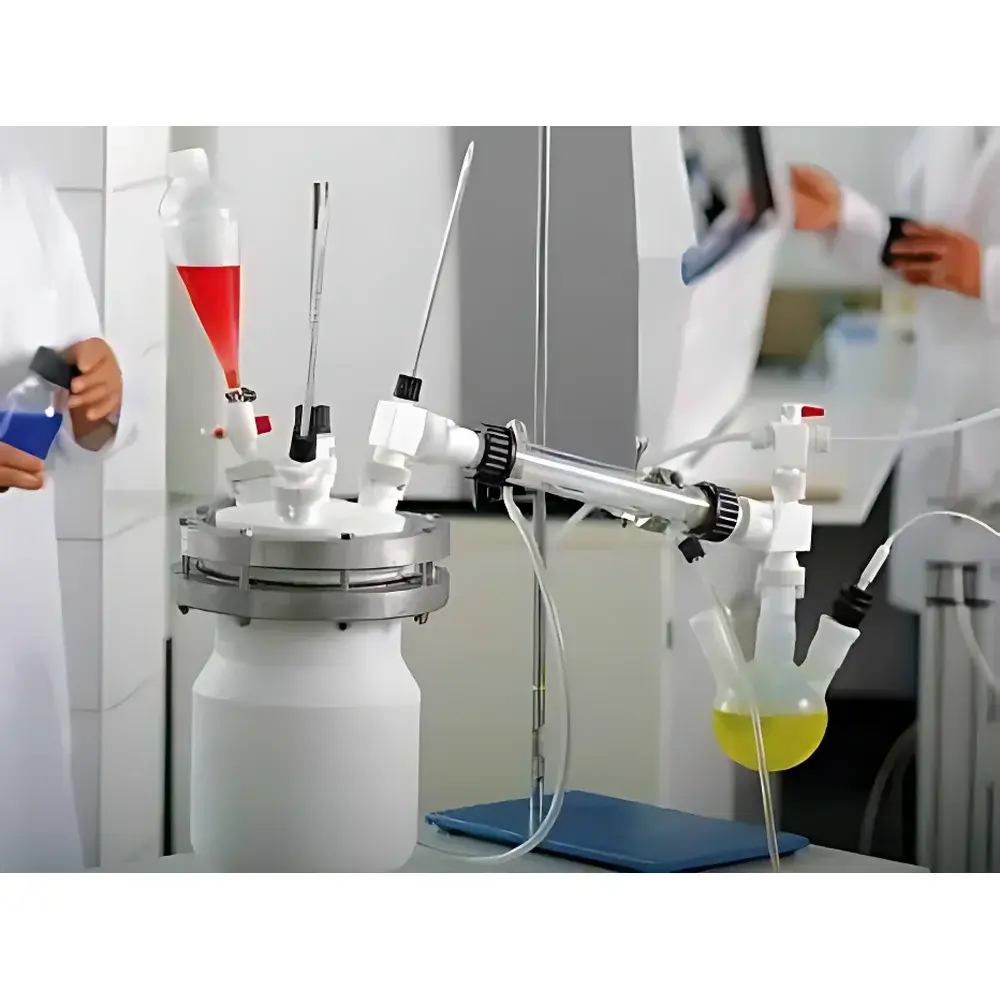
BOLA PTFE-Lined Reactor Vessel with Distillation Assembly (Model B280 Series)
| Brand | BOLA |
|---|---|
| Origin | Germany |
| Vessel Material | PTFE / PFA Liner |
| Operating Temperature Range | –200 °C to +250 °C |
| Maximum Working Pressure | Low-Pressure (≤ 1 bar gauge) |
| Vacuum Capability | ≤ 10 mbar (absolute) |
| Nominal Capacity | 600 mL |
| Flange Standard | NW100 / NW150 |
| Compliance | Designed for GLP-compliant synthesis and distillation workflows under ISO 9001-manufactured conditions |
Overview
The BOLA PTFE-Lined Reactor Vessel with Distillation Assembly (Model B280 Series) is a modular, chemically inert laboratory reactor system engineered for high-purity synthetic chemistry, solvent-sensitive reactions, and fractional distillation under controlled vacuum or inert atmosphere. Constructed with a robust stainless-steel outer jacket and an internally lined reaction chamber of virgin polytetrafluoroethylene (PTFE) or perfluoroalkoxy alkane (PFA), the vessel delivers exceptional resistance to aggressive reagents—including hydrofluoric acid, fuming nitric acid, molten alkali metals, and halogenated solvents—where glass or standard stainless-steel reactors would fail. Its operating temperature range of –200 °C to +250 °C enables cryogenic organometallic couplings as well as high-boiling-point solvent refluxes. The system adheres to fundamental principles of batch reaction engineering: precise thermal management via external heating/cooling jackets, controlled mass transfer through standardized NW-flanged connections, and vapor-phase separation governed by Raoult’s law and relative volatility differentials during distillation.
Key Features
- Chemically inert PTFE or PFA liner with seamless, non-porous surface finish—eliminates catalytic leaching and adsorption artifacts common in borosilicate or Hastelloy systems
- Modular NW100 and NW150 conflat-style flange interfaces compatible with ISO-KF and DIN 28403 vacuum standards
- Integrated mechanical stirring via precision-machined PTFE-coated shafts (Φ10 mm, lengths from 350–600 mm) with ceramic or fluoropolymer bearings (B288 series)
- Dual-port distillation head (2× DN29/32) supporting simultaneous addition and condensate collection; Liebig-type condenser (300–600 mL capacity) with PTFE-tipped inlet/outlet fittings
- Vacuum-rated construction validated to ≤10 mbar absolute; includes PTFE-sealed flat法兰 gaskets (B282 series), clamping hardware, and vacuum tubing (B293 series)
- Calibrated temperature monitoring: ASTM E77-compliant glass thermometers (0–250 °C, ±1 °C accuracy) with PTFE-sheathed probes (B287 series) and DN29/32 adapters (B286 series)
Sample Compatibility & Compliance
This reactor system is validated for use with moisture- and oxygen-sensitive compounds (e.g., Grignard reagents, lithium aluminum hydride, phosphines), highly corrosive media (e.g., HF, ClF₃, BrF₅), and high-vapor-pressure solvents (e.g., THF, diethyl ether, dichloromethane). All wetted components comply with USP Class VI biocompatibility requirements and meet EU Regulation (EC) No 1935/2004 for food-contact materials. The modular design supports audit-ready documentation per FDA 21 CFR Part 11 when paired with electronic data loggers (not included). System assembly follows ISO/IEC 17025 guidelines for method validation in contract research laboratories performing API synthesis or polymerization kinetics.
Software & Data Management
While the B280 Series is a manually operated, hardware-centric platform, it integrates seamlessly with third-party process monitoring systems via standardized 4–20 mA or Pt100 RTD inputs (compatible with LAUDA Alpha controller modules or Eurotherm 2408 units). Temperature, pressure, and stir speed data can be logged using compliant software platforms such as LabVIEW™ with NI DAQmx drivers or DeltaV™ DCS configurations. Audit trails, user access control, and electronic signature functionality are implemented at the supervisory SCADA level—not within the reactor itself—ensuring alignment with ALCOA+ data integrity principles.
Applications
- Synthesis of air- and moisture-sensitive organometallic complexes (e.g., Cp₂ZrCl₂, Ni(cod)₂)
- High-yield esterification and transesterification under reduced pressure to shift equilibrium
- Purification of thermally labile natural products via short-path distillation
- Catalytic hydrogenation screening using Pd/C or PtO₂ in fluorinated solvents
- Preparation of battery electrolyte precursors (e.g., LiTFSI, LiFSI) requiring HF-free environments
- Scale-down kinetic studies for continuous flow process development (batch-to-CSTR correlation)
FAQ
What is the maximum allowable vacuum level for long-term operation?
The system is rated for continuous operation at ≤10 mbar absolute; intermittent exposure to ≤1 mbar is permissible with prior validation of seal integrity.
Can the PTFE liner be autoclaved?
No—PTFE softens above 260 °C and degrades under saturated steam; cleaning must be performed with solvent rinses followed by nitrogen purging.
Is this reactor suitable for exothermic polymerizations?
Yes, provided external temperature control (e.g., LAUDA refrigerated circulator) maintains jacket ΔT ≤ 15 K and stir rate exceeds 200 rpm to ensure adequate heat transfer coefficient.
Are replacement parts traceable to material certifications?
All BOLA PTFE and PFA components ship with CoA (Certificate of Analysis) per ASTM D4894 and ISO 1043-4, including melt flow index and ash content reports.
Does the system support GMP documentation packages?
BOLA provides IQ/OQ protocols upon request; PQ execution requires site-specific qualification using calibrated reference standards per USP .



