
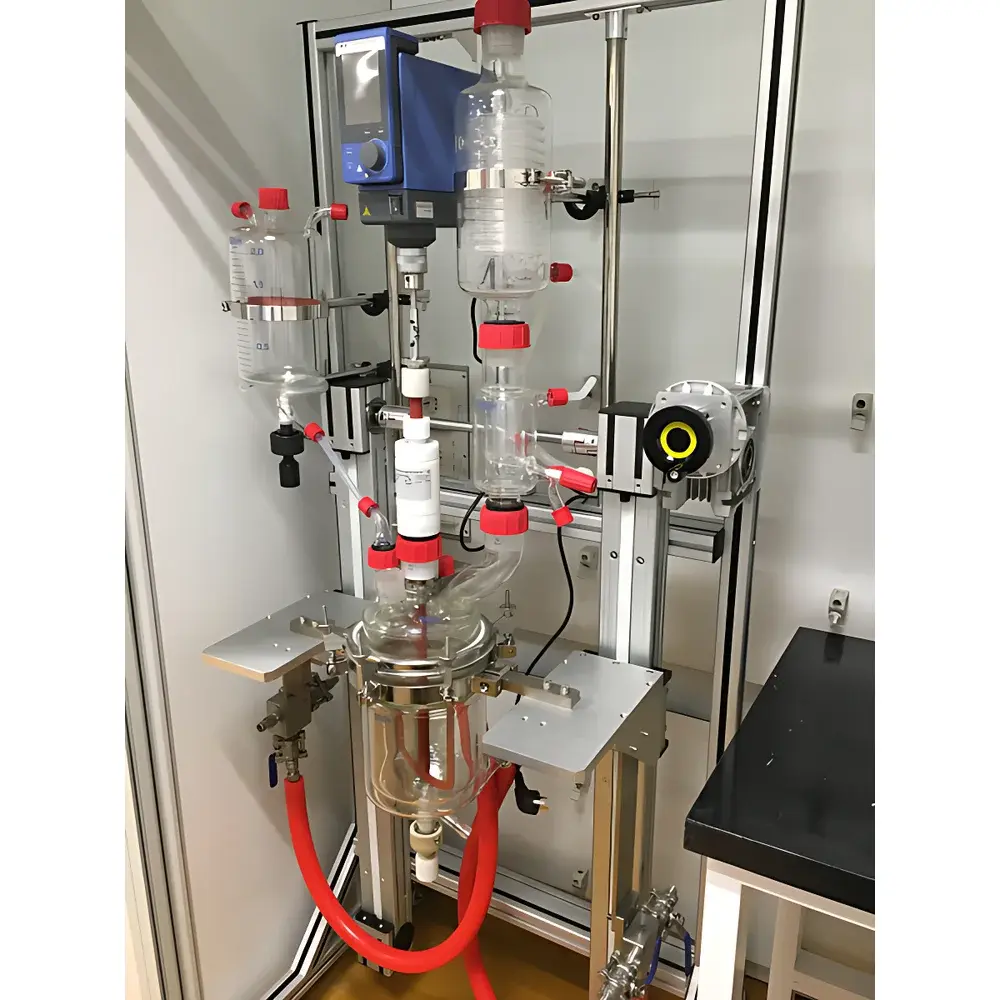
DIEHM 280°C High-Temperature Borosilicate Glass Reactor
| Brand | DIEHM |
|---|---|
| Origin | Germany |
| Model | 280°C Glass Reactor |
| Vessel Capacity | 50 L |
| Construction Material | ASTM E438 Type I, Class A Borosilicate Glass (3.3) |
| Maximum Operating Temperature | 280°C |
| Maximum Working Pressure | Up to 10 bar (g) |
| Vacuum Rating | ≤ 1 mbar (abs) |
| Jacketed Design | Yes (thermal fluid circulation) |
| Stirring System | PTFE-coated impeller with high-torque explosion-proof motor option |
| Sealing System | Fluoropolymer (FFKM/PTFE) gaskets with quick-release clamps |
| Vessel Geometry | Double-jacketed cylindrical vessel with calibrated volume markings |
| Port Configuration | 4–8 standardized ISO-KF or DIN 28178 flanged ports |
| Compliance | Designed per PED 2014/68/EU (Category II), ISO 15891, and GMP-relevant design principles for pharmaceutical R&D |
Overview
The DIEHM 280°C High-Temperature Borosilicate Glass Reactor is an engineered solution for controlled chemical synthesis, process development, and pilot-scale reaction studies under elevated temperature and pressure conditions. Built on over three decades of German glass apparatus engineering expertise, this reactor leverages Type I, Class A borosilicate glass (3.3) — certified to ASTM E438 — for exceptional thermal shock resistance, chemical inertness, and optical clarity. Unlike standard jacketed glass reactors limited to 200°C, the DIEHM system integrates proprietary high-temperature sealing technology using perfluoroelastomer (FFKM) and reinforced PTFE components, enabling sustained operation up to 280°C while maintaining vacuum integrity down to ≤1 mbar (abs). Its double-jacketed construction supports precise thermal management via external heating/cooling circulators, and its modular port layout accommodates inline sensors, reflux condensers, feed vessels, and sampling systems — all without compromising structural integrity or process containment.
Key Features
- High-temperature capability: Continuous operation at 280°C with full pressure/vacuum rating (up to 10 bar g / ≤1 mbar abs)
- Borosilicate glass 3.3 vessel: Compliant with ISO 3585 and DIN 7080; calibrated volume markings etched directly into the glass wall
- Modular port architecture: 4–8 ISO-KF or DIN 28178 flanged interfaces for flexible integration of thermocouples, pH probes, gas inlets, distillation heads, and automated dosing units
- Zero-dead-volume bottom valve: Fluoropolymer-lined diaphragm valve with sanitary flush design, eliminating product retention and enabling CIP compatibility
- PTFE-sheathed stirring assembly: Chemically resistant impeller with adjustable pitch and shaft sealing compliant with ISO 20816 vibration standards
- Integrated thermal monitoring: Three independent Pt100 RTD inputs (reaction mass, jacket fluid, vapor phase) with optional 4–20 mA output
- Structural support frame: Customizable stainless steel or anodized aluminum support system with height-adjustable leveling feet and seismic anchoring provisions
Sample Compatibility & Compliance
The reactor is suitable for corrosive, solvent-based, and moisture-sensitive chemistries including Grignard reactions, hydrogenations, nitration, polymerization, and active pharmaceutical ingredient (API) crystallization. Its all-glass wetted path ensures no metal ion leaching, making it compatible with USP , EP 3.2.1, and ISO 10993-12 testing requirements. The design conforms to Pressure Equipment Directive (PED) 2014/68/EU Category II for glass pressure equipment and incorporates hazard mitigation features aligned with IEC 61511 for safety instrumented systems (SIS) integration. Documentation packages include material traceability (EN 10204 3.1), dimensional inspection reports, and hydrostatic test certificates.
Software & Data Management
While the base unit operates as a standalone hardware platform, it is fully compatible with third-party process control systems (e.g., Siemens Desigo, DeltaV, or LabVIEW-based SCADA) via analog I/O and Modbus RTU. Optional digital interfaces support 21 CFR Part 11-compliant electronic recordkeeping when paired with validated data acquisition software. Audit trails, user access levels, and electronic signatures can be implemented through integrated PLC controllers — supporting GLP/GMP environments where raw data integrity, change control, and retrospective review are mandated.
Applications
- Process intensification studies requiring simultaneous high-T/high-P conditions
- Thermal stability screening of intermediates and final APIs under ICH Q1A(R3) guidelines
- Kinetic modeling of exothermic reactions with real-time temperature profiling across multiple zones
- Solvent recovery optimization using vacuum-assisted distillation with inline condensate monitoring
- Scale-up validation from lab-scale (500 mL) to pilot (50 L) with geometric similarity maintained per AIChE scale-up criteria
- Reaction calorimetry integration (e.g., with Mettler Toledo RC1mx) via jacket heat flow correlation
FAQ
What is the maximum allowable working pressure for the 50 L vessel at 280°C?
The reactor is rated for 10 bar gauge pressure at 280°C, verified per EN 13445-3 Annex C hydrostatic test protocol.
Can the glass vessel be inspected for microcracks prior to first use?
Yes — each unit ships with a certified visual inspection report per ISO 10545-12 and optional dye-penetrant testing upon request.
Is the system compliant with FDA requirements for pharmaceutical process development?
The design follows GAMP5 principles for Category 3/4 systems; qualification documentation (IQ/OQ/PQ templates) and vendor-supplied risk assessments (FMEA) are available.
How is temperature uniformity maintained across the 50 L reaction volume?
Jacket flow dynamics are optimized via CFD-simulated baffle geometry; typical axial/radial ΔT remains ≤ ±1.5°C under steady-state operation.
Are replacement glass components supplied with material certification?
All borosilicate glass parts ship with EN 10204 3.1 mill certificates confirming composition, hydrolytic class (HGB 1), and annealing history.



