
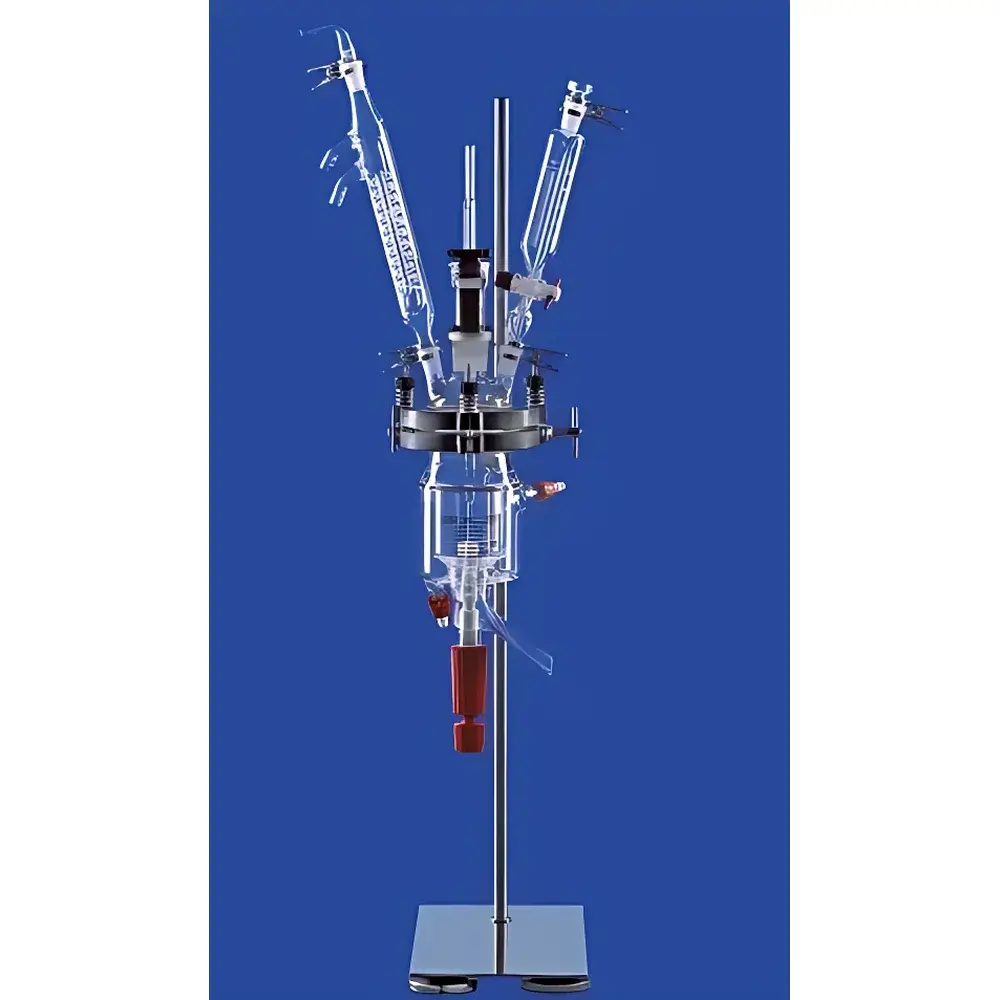
LENZ DURAN Glass Reactor with Double-Jacketed Design
| Brand | LENZ |
|---|---|
| Origin | Germany |
| Construction Material | Schott DURAN® borosilicate glass 3.3 |
| Volumes Available | 100 mL to 30 L |
| Jacket Type | Double-walled (GL or KF flange options) |
| Operating Pressure | Low-pressure (≤ 0.5 bar gauge) |
| Sealing | PTFE gaskets with quick-release clamps |
| Stirring System | PTFE-coated anchor, paddle, or propeller impellers |
| Temperature Control | External circulation via jacket (compatible with LAUDA/LAUDA-type chillers/heaters) |
| Vacuum Compatibility | Down to 5 mbar |
| Vessel Geometry | Cylindrical or spherical bottom |
| Calibration | Graduated scale etched on vessel body |
| Compliance | Designed per DIN ISO 3585 (borosilicate glass 3.3), compatible with GLP/GMP lab environments |
Overview
The LENZ DURAN Glass Reactor is a precision-engineered double-jacketed laboratory reactor system designed for controlled synthesis, distillation, crystallization, and multi-step reaction workflows under inert, vacuum, or reflux conditions. Constructed entirely from Schott DURAN® borosilicate glass 3.3 — certified to DIN ISO 3585 — the reactor offers exceptional thermal shock resistance (ΔT ≤ 150 °C), chemical inertness against organic solvents, concentrated acids (except HF), and alkalis, and optical clarity for real-time process observation. The double-jacketed design enables precise temperature regulation via external fluid circulation (e.g., LAUDA refrigerated/heating circulators), supporting operation from –80 °C to +200 °C depending on heat transfer medium. All standard configurations feature standardized GL or KF flange interfaces, enabling modular integration with condensers, dropping funnels, gas inlets, thermowells, and vacuum manifolds — fully compliant with common European and U.S. laboratory infrastructure standards.
Key Features
- Monolithic DURAN® glass construction: Seamless vessel body with laser-etched volumetric graduations (±1% accuracy) for reliable liquid-level monitoring.
- Double-jacket architecture: Independently sealed inner/outer walls with GL24, GL29, or KF16/KF25 outlet ports; optimized for low thermal inertia and uniform heat distribution.
- PTFE-sealed quick-clamp system: DIN 1587-compliant stainless-steel clamps with fluoropolymer gaskets ensure leak-tight performance at ≤0.5 bar pressure and down to 5 mbar vacuum.
- Modular top-plate configuration: 3–5 standardized neck ports (e.g., 24/29, 29/32, 34/45) accommodate simultaneous stirring, temperature sensing, addition, and gas purging.
- Stirring assembly: PTFE-coated magnetic or overhead drive impellers (paddle, anchor, or propeller) with corrosion-resistant shafts; optional explosion-proof motor drives available for Class I Div 1 environments.
- Drainage & sampling: Bottom-mounted PTFE stopcock with zero-dead-volume design and integrated valve stem lubrication channel for long-term sealing integrity.
Sample Compatibility & Compliance
The LENZ reactor is suitable for batch processing of organic, inorganic, and organometallic reaction mixtures, including Grignard reagents, lithium aluminum hydride reductions, and catalytic hydrogenations (with appropriate H₂-rated accessories). Its DURAN® glass composition meets ASTM E438 Type I, Class A specifications for laboratory glassware and complies with ISO 17025 calibration traceability requirements when used with NIST-traceable temperature probes. All PTFE components conform to FDA 21 CFR §177.1550 for repeated food-contact use, making the system appropriate for pharmaceutical process development under cGMP-aligned protocols. Full documentation packages (including material certificates, dimensional drawings, and pressure test reports) are provided upon request for audit readiness.
Software & Data Management
While the base reactor operates manually, it integrates seamlessly with third-party digital control platforms such as LAUDA Proline software, Huber Unistat controllers, or LabVIEW-based DAQ systems via analog 4–20 mA or RS485 Modbus RTU outputs (when paired with optional PT100 sensor housings and jacket flow meters). Real-time logging of jacket inlet/outlet temperatures, stirrer RPM, and internal bath pressure supports 21 CFR Part 11-compliant electronic records when deployed with validated timestamped acquisition modules and role-based user access controls.
Applications
- Synthesis of fine chemicals and active pharmaceutical ingredients (APIs) under anhydrous or inert atmosphere (N₂/Ar).
- Controlled crystallization studies with in-situ FBRM or PVM monitoring via side-port optical access.
- Distillation and solvent recovery using vertical or Liebig condensers mounted on standard necks.
- Kinetic profiling of exothermic reactions with jacket temperature ramping and feedback-controlled cooling.
- Photochemical reactions using UV-transparent DURAN® glass and quartz lamp adapters.
- Scale-down modeling for pilot-plant reactor validation (100 mL – 5 L range aligns with QbD principles).
FAQ
What temperature ranges are supported with the double-jacketed design?
Standard operation spans –80 °C to +200 °C, contingent on circulating fluid selection (e.g., silicone oil, ethanol/water, or specialized low-temp heat transfer fluids). Thermal stability is verified per DIN EN 15552.
Is the reactor suitable for hydrogenation reactions?
Yes — when equipped with H₂-rated pressure fittings, reinforced PTFE seals, and explosion-proof stirring motors (optional), it supports low-pressure (<1 bar) catalytic hydrogenations under GMP-relevant conditions.
Can volume graduations be customized or calibrated for specific densities?
Graduations are factory-etched based on water displacement at 20 °C. For non-aqueous media, volumetric correction factors can be applied using density tables; custom calibration certificates (ISO/IEC 17025-accredited) are available upon request.
Are spare parts and replacement gaskets stocked internationally?
All critical consumables — including DURAN® glass vessels, PTFE stopcocks, GL/KF O-rings, and clamp sets — are maintained in regional distribution hubs across EU, North America, and APAC to support <72-hour lead times.
Related Products



