
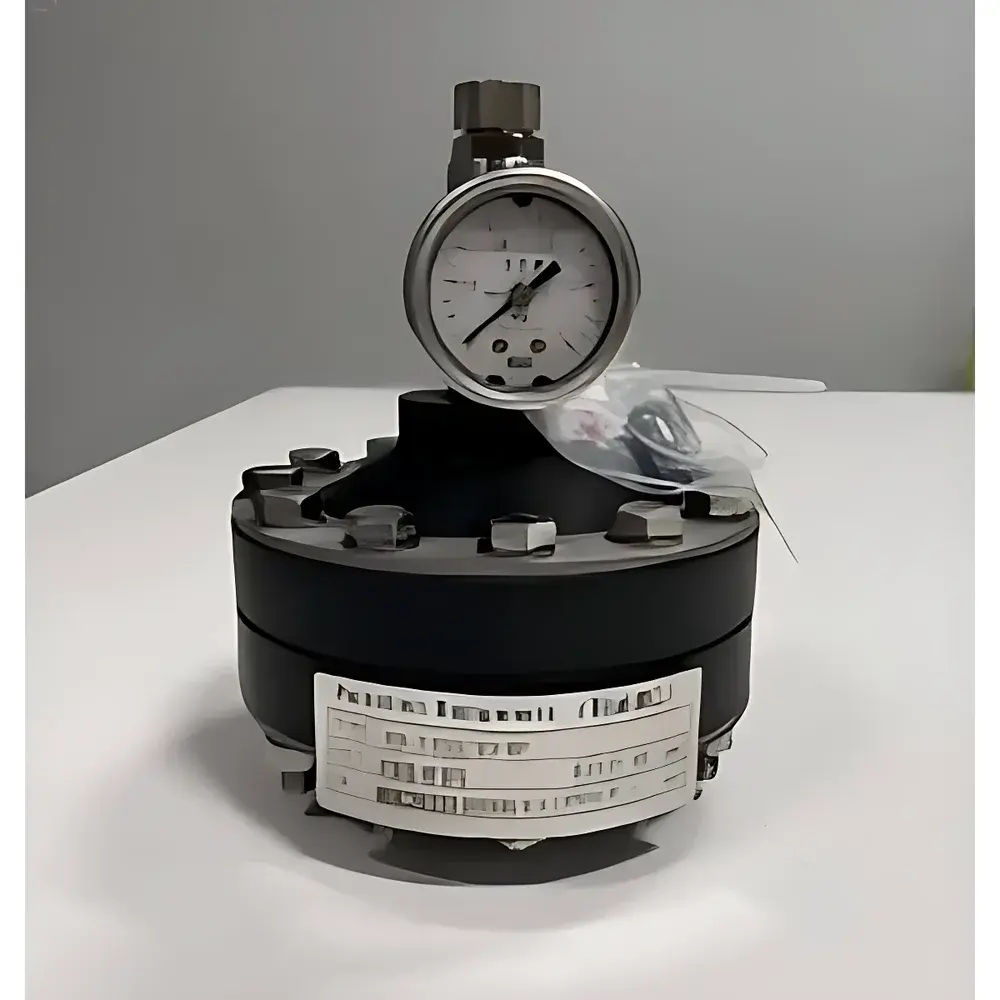
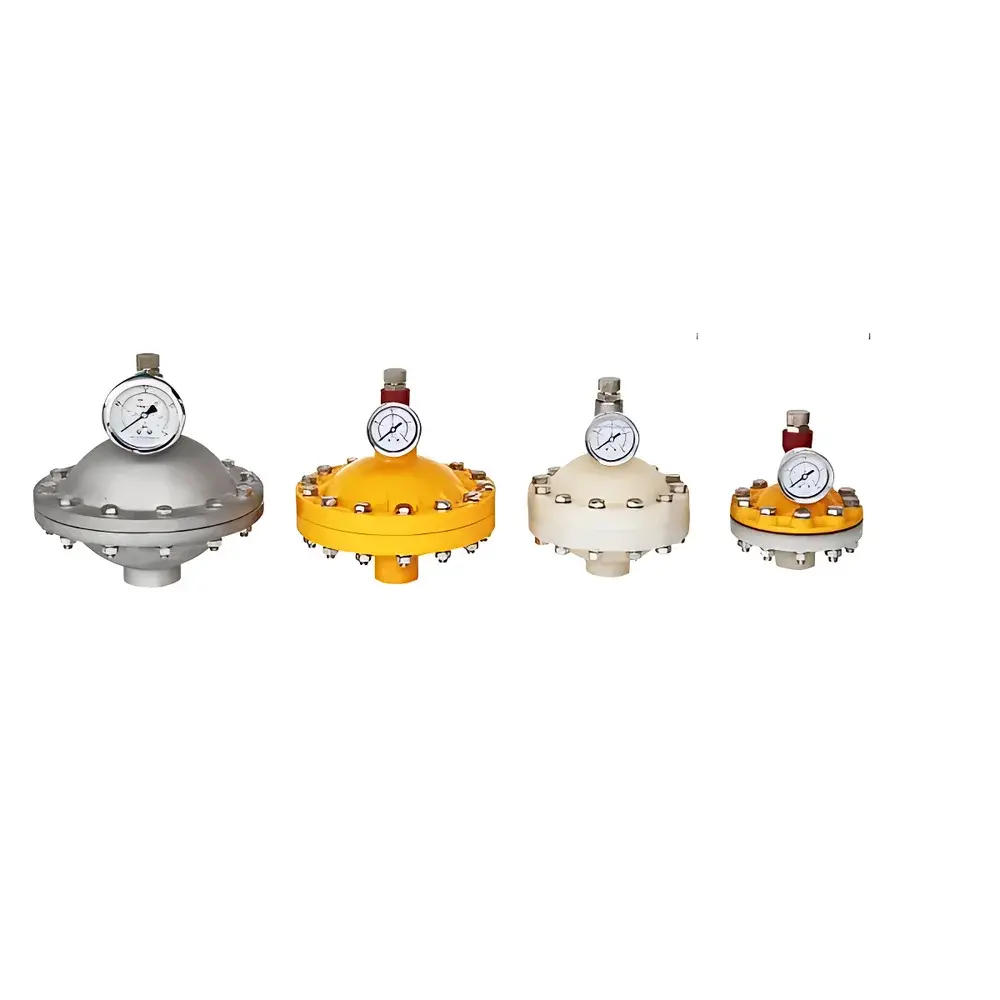
ProMinent Single-Diaphragm Pulse Dampener
| Brand | ProMinent |
|---|---|
| Origin | Germany |
| Model | Single-Diaphragm Pulse Dampener |
| Type | Inline Hydraulic Pulse Dampening Device |
| Compliance | Designed for ISO 8503-2, DIN 24960, and EN 13480-3 compliant metering systems |
| Material Options | Standard SS316L housing |
| Operating Pressure Range | Up to 40 bar (custom variants up to 100 bar) |
| Temperature Range | –10 °C to +120 °C (with optional thermal jacket: –40 °C to +200 °C) |
| Volume Capacity | 0.5 L to 12 L (standard series) |
Overview
The ProMinent Single-Diaphragm Pulse Dampener is an engineered hydraulic accumulator designed specifically for precision metering pump systems. It operates on the principle of gas-charged elastomeric diaphragm compression, where a pre-charged inert nitrogen (N₂) chamber absorbs pressure fluctuations generated by reciprocating positive displacement pumps—particularly diaphragm metering pumps, plunger pumps, and peristaltic dosing units. By decoupling transient flow spikes from the downstream fluid path, the device transforms pulsating volumetric delivery into a near-steady-state laminar flow profile. This functional stabilization is critical in applications demanding high dosing accuracy, low process variability, and long-term system integrity—especially where sensitive instrumentation, narrow-bore tubing, or shear-sensitive media are involved.
Key Features
- Single-elastomer diaphragm construction with fully welded, leak-tight SS316L body—eliminates dead volume and ensures full drainability for hygienic and GMP-compliant operation.
- Pre-charged nitrogen gas chamber with calibrated pressure relief and monitoring port—enables precise damping ratio tuning per ISO 5167-4 guidelines.
- Modular mounting interface compatible with DIN 259/2999 (G-thread), ISO 228, and ANSI B16.5 flanged connections—facilitates retrofit integration into existing chemical feed skids and laboratory dosing loops.
- Optional thermal jacket (steam, thermal oil, or electric trace heating) maintains process fluid temperature stability within ±1.5 °C across ambient variations—essential for viscosity-critical dosing of resins, adhesives, or bioactive solutions.
- Chemical compatibility extended via certified diaphragm materials: FFKM (Kalrez®), EPDM, Viton®, and PTFE-laminated variants—validated against ASTM D471 and ISO 1817 immersion testing protocols.
- No moving parts or seals subject to wear—provides >100,000 pressure-cycle service life with zero scheduled maintenance under nominal operating conditions.
Sample Compatibility & Compliance
The dampener supports continuous duty with aqueous solutions, organic solvents, acids (e.g., HCl, HNO₃ up to 65 wt%), alkalis (NaOH ≤ 50 wt%), glycols, polymers, and suspensions containing particles <50 µm. It meets PED 2014/68/EU Category II requirements for pressure equipment and carries CE marking with conformity to EN 13445-3. For pharmaceutical and food-grade applications, units configured with FDA 21 CFR Part 177-compliant elastomers and 3-A Sanitary Standard #68-03 certification are available. All units undergo hydrostatic proof testing at 1.5× MAWP and helium leak testing to ≤1×10⁻⁹ mbar·L/s.
Software & Data Management
While the dampener itself is a passive mechanical component, its performance integration is validated through ProMinent’s DULCOSMART control ecosystem. When paired with ProMinent gamma/ sigma metering pumps equipped with integrated flow verification sensors, real-time pulse suppression efficacy can be quantified via harmonic amplitude reduction analysis (FFT-based) logged in DULCOMETER® software. Audit trails—including installation date, nitrogen charge pressure history, and calibration verification timestamps—are stored in accordance with FDA 21 CFR Part 11 requirements when deployed in regulated QC/QA environments.
Applications
- Continuous reagent dosing in ICP-MS and HPLC mobile phase delivery systems—reducing baseline noise and improving peak resolution.
- Stabilized catalyst injection in lab-scale polymerization reactors (e.g., PUR adhesive synthesis) to ensure stoichiometric consistency.
- Corrosive chemical feed (e.g., NaOCl, FeCl₃) in pilot-scale water treatment units—preventing valve seat erosion and sensor drift.
- Uniform spray coating in R&D electrospinning and thin-film deposition setups—enabling reproducible droplet size distribution (DSD) and film thickness CV <2.3%.
- Shear-sensitive biopolymer (e.g., alginate, chitosan) delivery in 3D bioprinting platforms—avoiding molecular degradation and gelation instability.
FAQ
What is the recommended pre-charge pressure for optimal pulse suppression?
Pre-charge pressure should be set to 80–90% of the system’s minimum operating pressure—verified using a calibrated digital pressure gauge and adjusted per ISO 5167-4 Annex E methodology.
Can this dampener be installed vertically or only horizontally?
It is orientation-independent; however, vertical installation with gas chamber upward is preferred to minimize diaphragm sag and extend service life under cyclic loading.
Is recalibration required after nitrogen top-up?
Yes—any nitrogen replenishment must be followed by re-verification of pre-charge pressure and subsequent harmonic analysis to confirm damping coefficient retention.
Does the unit require periodic inspection under GLP guidelines?
Per EU GLP Principle 5.2.12, visual inspection and pressure decay testing (per EN 13445-3 Annex J) are mandated every 12 months or after 5,000 operating hours—whichever occurs first.
Are explosion-proof variants available for Zone 1 hazardous areas?
Yes—ATEX-certified models (II 2G Ex db IIB T4 Gb) with intrinsically safe pressure monitoring interfaces are offered upon request.



