
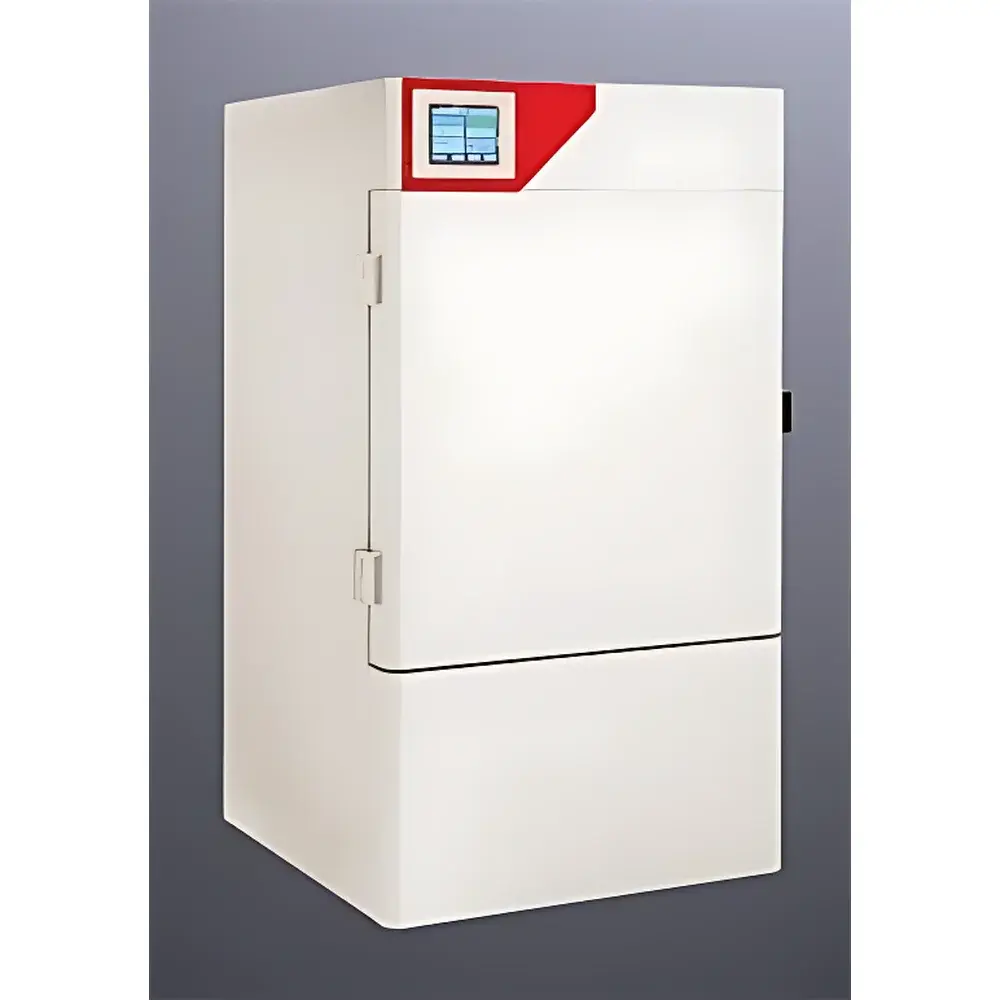
Suying YP-GSD & YP-GSP Series Comprehensive Pharmaceutical Stability Chambers
| Brand | Suying |
|---|---|
| Origin | Shanghai, China |
| Model | YP-GSD, YP-GSP150/250/500/1000 |
| Temperature Range | 0–65 °C (dark), 10–65 °C (with illumination) |
| Temperature Uniformity | ±0.5 °C |
| Humidity Range | 40–95 %RH |
| Humidity Uniformity | ±0.5 %RH |
| Illuminance Range | 0–4500 lx (adjustable) |
| Illuminance Accuracy | ≤±500 lx |
| Internal Volume | 150–1000 L |
| Refrigeration | Danfoss hermetic compressor |
| Refrigerant | R404A/R23 |
| Control System | Fuji or TEMI880 programmable controller with Pt100 sensor and imported humidity transmitter |
| Compliance | Chinese Pharmacopoeia (2010 Ed.), GB 10586-8, ICH Q1A–Q1E, FDA 21 CFR Part 11 (audit trail enabled), WHO TRS 953 Annex 2 |
Overview
The Suying YP-GSD and YP-GSP Series Comprehensive Pharmaceutical Stability Chambers are engineered for precision-controlled long-term and accelerated stability testing of pharmaceutical products in full compliance with international regulatory frameworks—including ICH Q1A(R3) through Q1E, USP , WHO Technical Report Series No. 953 Annex 2, and the Chinese Pharmacopoeia (2010 Edition). These chambers implement a balanced heating–cooling–humidification–dehumidification architecture to maintain highly uniform environmental conditions across the entire working chamber, enabling reproducible simulation of storage conditions such as 25 °C/60 %RH (long-term), 30 °C/65 %RH (intermediate), and 40 °C/75 %RH (accelerated). The integrated photostability module conforms to ICH Q5C and Q1B guidelines, delivering calibrated visible light irradiance (0–4500 lx) with traceable spectral distribution and minimal spatial deviation—critical for forced degradation studies of light-sensitive APIs and formulations. All models feature dual- or triple-compartment configurations (e.g., YP-GSD two-chamber, YP-TSD three-chamber) to support parallel condition testing without cross-contamination or thermal/hygrometric interference.
Key Features
- Robust stainless-steel interior (SUS304B mirror-finish) resistant to corrosion, cleaning agents, and repeated sterilization cycles
- Patented arc-shaped cabinet design optimizing airflow distribution and minimizing thermal stratification
- High-efficiency Danfoss hermetic compressors with R404A/R23 refrigerant blend, ensuring stable low-temperature operation down to 0 °C and rapid recovery after door opening
- Advanced air circulation system with centrifugal blower and optimized duct geometry achieving ≤±0.5 °C temperature uniformity and ≤±0.5 %RH humidity uniformity (per ISO 16770:2017 test protocol)
- Large-view vacuum-insulated tempered glass door with magnetic seal and anti-condensation heating film for uninterrupted visual monitoring
- Modular sample rack system with height-adjustable shelves and standardized 50-mm-diameter cable ports on the left wall for real-time sensor integration
- Dual-sensor redundancy: Pt100 platinum resistance thermometer + high-stability capacitive humidity transmitter with auto-calibration capability
Sample Compatibility & Compliance
These chambers accommodate a broad range of sample formats—including vials, blister packs, ampoules, syringes, and primary packaging materials—within configurable internal volumes (150 L to 1000 L). Each unit is pre-validated per ASTM E2500-13 and GAMP5 principles and supports full 3Q qualification (IQ/OQ/PQ) documentation packages aligned with EU Annex 15 and FDA guidance on process validation. All control software logs meet ALCOA+ criteria (Attributable, Legible, Contemporaneous, Original, Accurate, Complete, Consistent, Enduring, Available) and include electronic signatures compliant with 21 CFR Part 11. Environmental parameters are continuously monitored and archived with time-stamped audit trails, supporting GLP/GMP audits and regulatory submissions. Units are certified to GB 10586-8 (Environmental Test Equipment General Specifications) and designed to withstand continuous operation for ≥43,800 hours (5 years) under nominal load.
Software & Data Management
Equipped with either Fuji PXR series or TEMI880 programmable controllers, the system offers multi-segment ramp-soak profiles, real-time trend visualization, and remote access via Ethernet or RS485. The embedded PID algorithm enables dynamic correction of temperature–humidity coupling effects, while humidity bias compensation adjusts for sensor drift during extended runs. Data export is supported in CSV and PDF formats; optional cloud-based platform integration enables centralized fleet monitoring, predictive maintenance alerts, and automated report generation (e.g., stability summary reports per ICH Q5C). All firmware updates are digitally signed and version-controlled, with rollback capability to ensure data integrity across lifecycle upgrades.
Applications
- ICH-compliant long-term, intermediate, and accelerated stability studies for drug substances and products
- Photostability testing per ICH Q1B (Option 1 & 2) and USP
- Excipient compatibility screening under controlled humidity gradients
- Package integrity evaluation under cyclic temperature–humidity stress
- Biological product shelf-life modeling (e.g., monoclonal antibodies, vaccines)
- Reference standard storage verification per USP
- Method suitability assessment for dissolution, assay, and impurity profiling
FAQ
What regulatory standards does this chamber comply with?
It meets ICH Q1A–Q1E, WHO TRS 953 Annex 2, Chinese Pharmacopoeia (2010), GB 10586-8, and supports 21 CFR Part 11 compliance when configured with audit-trail-enabled software.
Can the chamber operate continuously for extended periods?
Yes—designed for unattended 24/7 operation over 5+ years, validated for >43,800 hours MTBF under nominal environmental loads.
Is photostability testing fully compliant with ICH Q1B?
Yes—the illuminance range (0–4500 lx), spectral output, and spatial uniformity are calibrated and documented per ICH Q1B Option 1 requirements.
How is temperature and humidity uniformity verified?
Per ISO 16770:2017, using 9-point sensor mapping at three vertical levels; results are included in factory OQ documentation.
Do you provide 3Q qualification support?
Yes—comprehensive IQ/OQ/PQ protocols, executed by qualified engineers, with full traceability to NIST-traceable standards and deliverables in English.






