
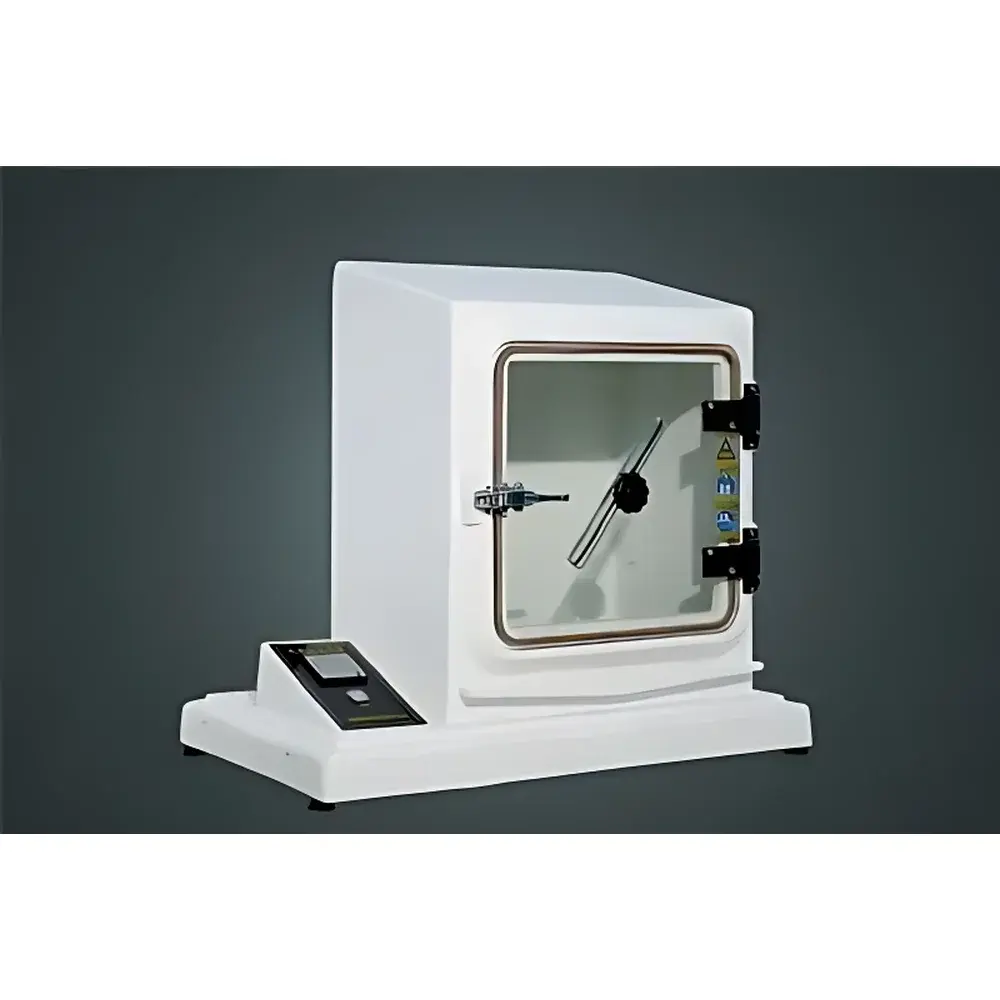
Condensation Water Test Chamber GS-250 / GS-500 / GS-1000
| Origin | Shanghai, China |
|---|---|
| Manufacturer Type | Authorized Distributor |
| Regional Origin | Domestic (PRC) |
| Model Variants | GS-250, GS-500, GS-1000 |
| Pricing | Upon Request |
Overview
The Condensation Water Test Chamber GS-250 / GS-500 / GS-1000 is an environmental test system engineered to simulate and accelerate condensation-driven corrosion and moisture-induced degradation mechanisms under controlled temperature and humidity conditions. Based on the fundamental principle of saturated water vapor condensation on cooled specimen surfaces—governed by thermodynamic equilibrium between chamber air and test substrate—the chamber replicates natural dew formation cycles critical for evaluating long-term material stability in humid or marine-influenced service environments. Unlike general-purpose climate chambers, this system prioritizes precise control of surface condensation kinetics through regulated cooling plate temperature, relative humidity gradients, and programmable wet/dry cycle sequencing. It is designed specifically for compliance-driven testing per internationally recognized standards including ISO 6270-2 (Paints and varnishes — Determination of resistance to condensation water), DIN 50017 (Kondenswasser-Klima – Constant condensation water climate), and GB/T 1740–2020 (Evaluation of resistance to condensation water for coatings). The unit operates within a defined temperature range of +10 °C to +60 °C and supports sustained relative humidity levels up to 98 % RH, with calibrated condensation onset detection via integrated cold-finger sensors.
Key Features
- Three scalable chamber volumes (250 L, 500 L, 1000 L) accommodating diverse sample configurations—from single-panel coupons to multi-tier racks of coated metal substrates
- Independent dual-zone temperature control: upper chamber air zone and lower specimen support plate zone—enabling differential thermal gradients essential for reproducible condensate formation
- Stainless steel 316L interior construction with seamless welded corners and non-porous epoxy-coated insulation to prevent microbial growth and corrosion residue accumulation
- Integrated PID-controlled refrigeration circuit with cascade cooling capability for rapid plate cooldown to 0 °C–15 °C below ambient, ensuring reliable condensate nucleation across varied ambient conditions
- Calibrated platinum RTD (Pt100) sensors at multiple locations—including specimen surface contact points—for traceable temperature uniformity verification per IEC 60068-3-5
- Compliant with Class II safety requirements per IEC 61010-1; includes overtemperature cutoff, refrigerant leak detection, and emergency power-off interlock
Sample Compatibility & Compliance
The chamber accommodates flat or low-profile specimens up to 3 mm thickness and 300 mm × 300 mm footprint per rack level. Standard test fixtures include adjustable stainless steel sample holders, non-reactive silicone gaskets for edge sealing, and optional UV-transparent quartz viewing ports for in-situ visual inspection without cycle interruption. All models are validated for conformance to ISO/IEC 17025:2017 calibration traceability requirements when operated with accredited external verification services. Test reports generated using this equipment satisfy documentation prerequisites for ISO 9001:2015 quality management audits and ASTM D1654-compliant coating performance evaluations. While not inherently GLP-certified, the system supports audit-ready operation when paired with externally validated data logging systems meeting FDA 21 CFR Part 11 electronic record integrity criteria.
Software & Data Management
Equipped with embedded controller firmware supporting up to 99 programmable test profiles with nested step logic (e.g., 4-hr condensation phase at 40 °C/95 % RH → 2-hr drying phase at 50 °C/30 % RH → repeat × 20 cycles). Real-time monitoring of chamber air temperature, plate temperature, RH, and cumulative condensate duration is logged at user-selectable intervals (1 s to 60 min) and exported in CSV or XML format via USB or Ethernet interface. Optional PC-based software provides graphical trend analysis, statistical deviation reporting (±0.3 °C temperature uniformity, ±2 % RH accuracy), and automated pass/fail flagging against preloaded standard-specific acceptance thresholds. All data files include embedded metadata: operator ID, timestamp, calibration certificate ID, and firmware revision—supporting full chain-of-custody traceability required for third-party certification submissions.
Applications
- Evaluation of corrosion resistance in pre-treated steel substrates (e.g., zinc-phosphate, chromate conversion coatings) prior to painting
- Accelerated aging assessment of automotive OEM clearcoats and aerospace polyurethane topcoats under cyclic condensation stress
- Validation of anti-corrosion primer adhesion loss (ASTM D3359 cross-hatch rating) following standardized wet exposure protocols
- Qualification of architectural cladding materials—including aluminum composite panels and fiber-cement boards—for coastal installation specifications
- Supporting R&D of water-repellent nanocoatings by quantifying time-to-wetting and droplet retention behavior under controlled dew point differentials
FAQ
What standards does the GS-series condensation chamber explicitly support?
ISO 6270-2, DIN 50017, GB/T 1740–2020, and JIS K 5600-7-4 are natively supported through preconfigured profile templates and documented validation reports.
Can the chamber operate continuously for extended test durations (e.g., >1000 hours)?
Yes—designed for unattended operation up to 30 days with scheduled maintenance intervals; refrigeration system includes redundant oil return management and automatic defrost sequencing.
Is external calibration certification included with purchase?
Factory calibration certificates (traceable to NIM, China) are provided; ISO/IEC 17025-accredited field calibration services are available as an add-on option.
How is condensation volume quantified during testing?
Condensate mass is not directly measured; instead, onset time, duration, and spatial distribution are inferred via thermal gradient mapping and validated against gravimetric reference tests per ISO 6270-2 Annex B.
Does the system comply with CE or UKCA marking requirements?
CE marking is applied per Machinery Directive 2006/42/EC and EMC Directive 2014/30/EU; UKCA conformity documentation is available upon request for post-Brexit market deployment.



