
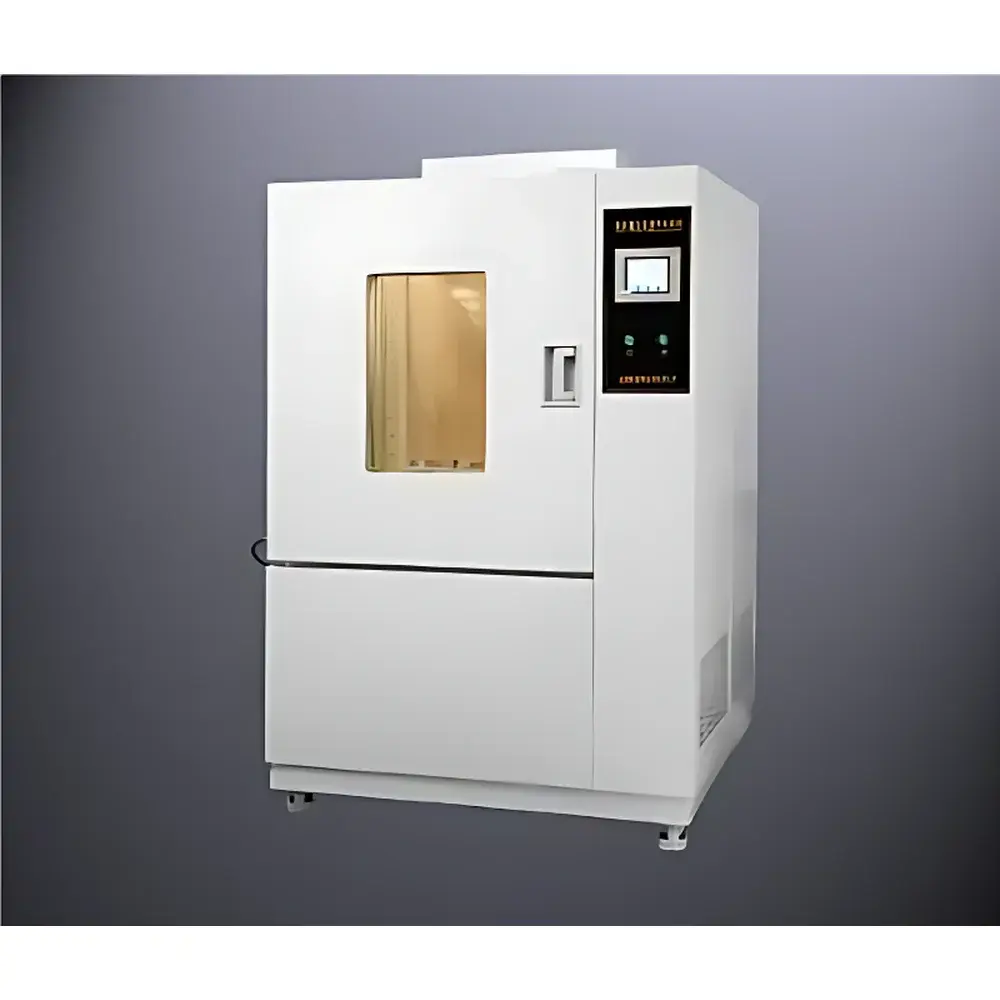
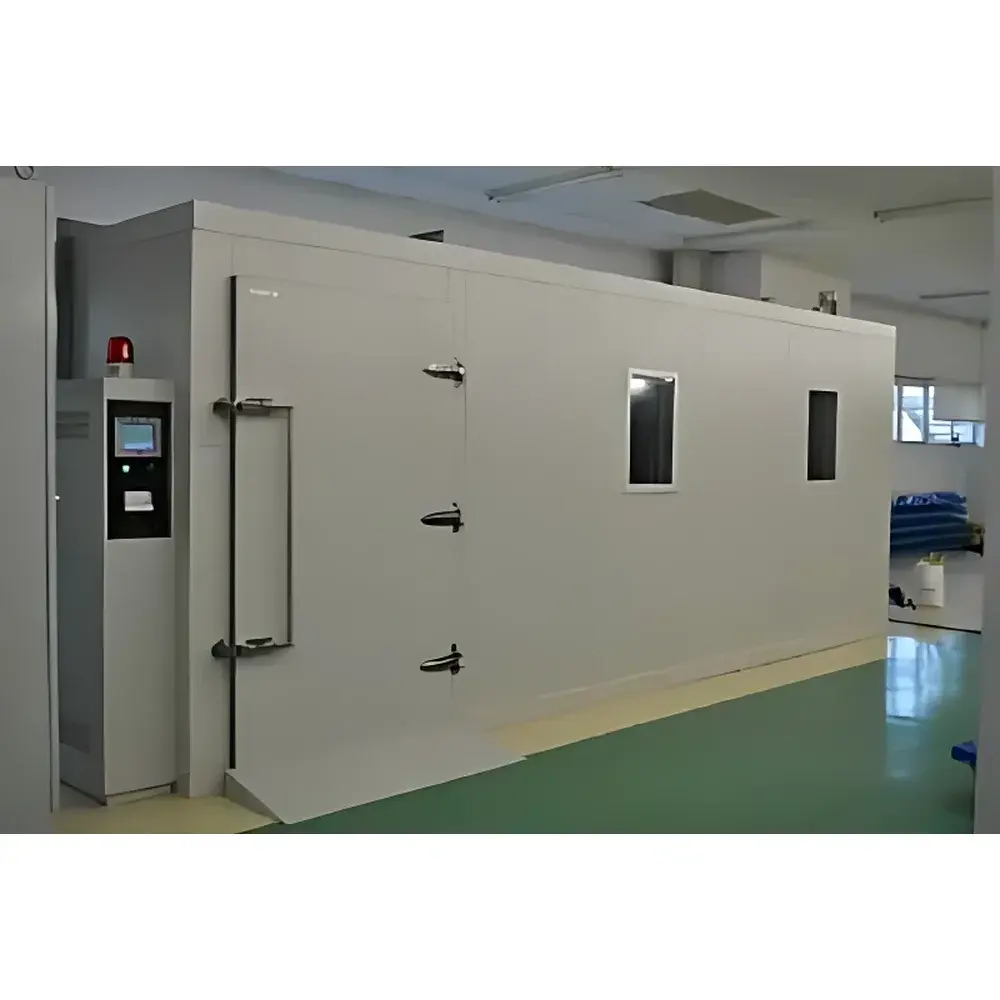
Suying GSJ Series Temperature and Humidity Controlled Environmental Test Chamber
| Brand | Suying |
|---|---|
| Origin | Shanghai, China |
| Model | GSJ-100 / GSJ-250 / GSJ-500 / GSJ-1000 |
| Temperature Range | -20°C to 150°C (A), -40°C to 150°C (B), -60°C to 150°C (C), -70°C to 150°C (D) |
| Humidity Range | 20–98% RH |
| Temp. Uniformity | ≤±2°C |
| Temp. Stability | ≤±0.5°C |
| Humidity Stability | ±2.5% RH |
| Heating Rate | -20°C → 100°C in ~35 min |
| Cooling Rate | 25°C → -40°C in ~50 min |
| Internal Dimensions (W×D×H, mm) | 450×450×500 (GSJ-100) to 1000×1000×1000 (GSJ-1000) |
| External Dimensions (W×D×H, mm) | 1150×450×500 to 1650×1480×2200 |
| Power Supply | AC 380V ±10%, 50 ±0.5 Hz, 3-phase 5-wire |
| Compliance | GB/T 2423.1–2001, GB/T 2423.2–2001 |
| Controller | Imported PID-based microprocessor with touch interface, data logging capability, optional RS485/USB for PC connectivity and printer output |
Overview
The Suying GSJ Series Temperature and Humidity Controlled Environmental Test Chamber is an engineered solution for accelerated environmental stress testing under precisely regulated thermal and hygrothermal conditions. Designed in accordance with IEC 60068-2 and aligned with the test methodologies defined in GB/T 2423.1 (cold), GB/T 2423.2 (dry heat), and GB/T 2423.3 (damp heat), this chamber enables rigorous evaluation of material stability, component reliability, and functional integrity across wide-ranging temperature (-70°C to +150°C) and relative humidity (20–98% RH) profiles. Its dual-loop refrigeration architecture—employing either single-stage or cascade compression systems—ensures stable low-temperature performance while minimizing thermal lag during transition cycles. The chamber’s airflow management system utilizes multi-blade centrifugal fans and optimized duct geometry to maintain uniform temperature distribution (≤±2°C) and rapid recovery (<3 min after door opening), critical for repeatable qualification testing in electronics, automotive, aerospace, and polymer R&D environments.
Key Features
- High-precision microprocessor controller with PID auto-tuning, ±0.1°C setpoint resolution, and real-time deviation compensation for enhanced thermal stability
- Double-layer insulated chamber construction: inner lining of polished SUS304 stainless steel (mirror finish) and outer shell of A3 steel with electrostatic powder coating
- Large observation window with embedded heating element and LED illumination for distortion-free internal monitoring without condensation
- Standard 50 mm diameter test port on left side wall, fitted with silicone gasket and removable plug for signal/power line feedthrough
- Independent heating (nickel-chromium alloy) and cooling (French Tecumseh hermetic compressors + Italian CASTEL solenoid valves) circuits to minimize cross-interference and extend service life
- Four-tier power configuration (A/B/C/D) supporting diverse operational envelopes—from standard high-low temperature cycling to ultra-low -70°C operation with humidity control
- Comprehensive safety suite including over-temperature cutoff, compressor high-pressure protection, motor overheat detection, ground-fault interruption, and phase-loss monitoring
Sample Compatibility & Compliance
The GSJ series accommodates a broad spectrum of test specimens—from printed circuit boards and lithium-ion battery modules to elastomeric seals and composite aerospace laminates—within its standardized internal volumes (100 L to 1000 L). All models conform to national mandatory standards GB/T 2423.1–2001 (cold testing) and GB/T 2423.2–2001 (dry heat), and support protocol development aligned with ISO 16750-4 (road vehicles), MIL-STD-810H (environmental engineering considerations), and ASTM D4332 (conditioning containers). Optional validation packages—including IQ/OQ documentation templates and traceable NIST-calibrated PT100 sensors—are available to support GLP-compliant laboratories and regulated manufacturing facilities subject to FDA 21 CFR Part 11 requirements.
Software & Data Management
The integrated controller supports programmable ramp-soak profiles, multi-segment cycling, and real-time graphing of temperature/humidity trajectories. Logged data (timestamped at user-selectable intervals down to 1 second) is exportable via USB or RS485 to external PCs running Windows-compatible analysis software. Optional Ethernet module enables remote monitoring and alarm notification via SMTP or Modbus TCP. Audit trail functionality records all parameter changes, operator logins, and system events—meeting traceability expectations for quality management systems certified to ISO 9001 and IATF 16949. Printer interface supports direct hardcopy generation of test reports with header metadata (test ID, operator, start/end time, chamber serial number).
Applications
- Accelerated aging of polymer encapsulants and conformal coatings under combined thermal-hygric stress
- Qualification testing of automotive ECUs per ISO 16750-4 temperature/humidity cycling requirements
- Pre-conditioning of lithium-ion cells prior to electrical performance characterization
- Stability assessment of pharmaceutical packaging materials under ICH Q1A(R2) long-term and accelerated storage conditions
- Evaluation of solder joint reliability in PCB assemblies subjected to thermal shock and humidity soak protocols
- Material compatibility screening for gaskets, adhesives, and optical components exposed to tropical or arctic climatic profiles
FAQ
What is the difference between GSJ and GDS model designations?
GSJ denotes “Temperature-Humidity Cycling Chamber” (capable of programmed transitions between setpoints), whereas GDS refers to “Constant Temperature-Humidity Chamber” (optimized for steady-state dwell testing only).
Can the chamber operate at full humidity range across the entire temperature span?
At temperatures below 0°C, maximum achievable RH is limited by dew point constraints; full 20–98% RH coverage is guaranteed only within the +10°C to +85°C operating band.
Is third-party calibration certification included with delivery?
Factory calibration using traceable PT100 probes is performed pre-shipment; formal ISO/IEC 17025 calibration certificates are available as an add-on service.
What maintenance intervals are recommended for optimal performance?
Compressor oil inspection every 2,000 hours; condenser coil cleaning every 6 months; sensor verification annually or per internal QA schedule.
Does the system support custom test profile import via CSV or XML?
Yes—the controller accepts ASCII-formatted time-step profiles via USB stick, enabling replication of complex industry-standard test sequences such as EIA/JESD22-A104F or JEDEC J-STD-020.



