
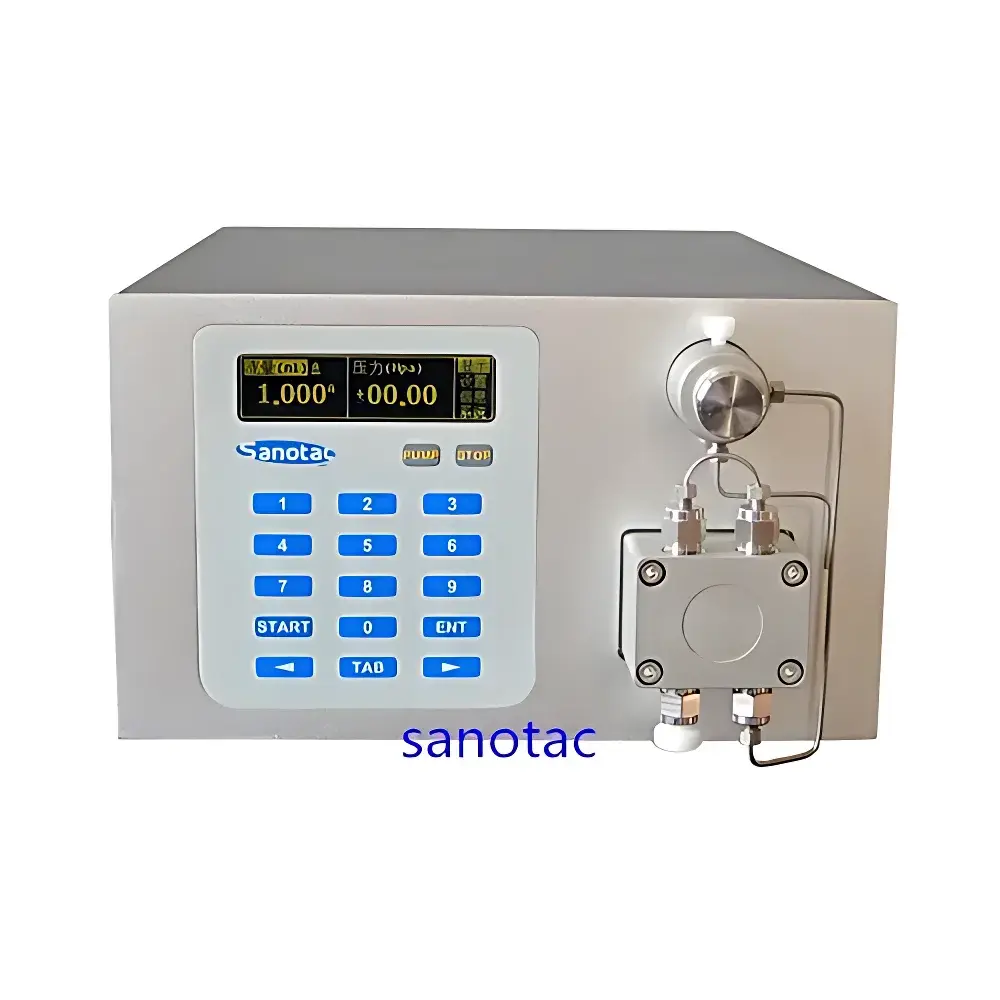
Sanotac AP0010 Analytical High-Pressure Liquid Chromatography Pump
| Brand | Sanotac |
|---|---|
| Origin | Shanghai, China |
| Manufacturer Type | Original Equipment Manufacturer (OEM) |
| Product Category | Domestic |
| Model | AP0010 |
| Instrument Type | Isocratic Pump |
| Maximum Pressure | 42 MPa |
| Flow Range | 0.001–9.999 mL/min |
| Flow Accuracy | ±0.1% |
| Flow Precision (RSD) | ≤0.1% |
| Pressure Pulsation | ≤0.1 MPa |
| Pump Head Volume | 10 mL |
| Fluidic Path Materials | 316L Stainless Steel, Sapphire, PTFE, Ceramic |
| Connection Standard | 1/16" tubing ports |
| Display | 256×64 dot-matrix backlit LCD |
| Control Interface | Front-panel keypad + RS232/485/422, USB, Ethernet (Modbus RTU/ASCII, Profibus DP, Profinet), Analog I/O, Digital I/O |
| Power Supply | 85–264 VAC, 50 Hz |
| Dimensions | 370 × 240 × 152 mm |
Overview
The Sanotac AP0010 Analytical High-Pressure Liquid Chromatography (HPLC) Pump is an isocratic solvent delivery system engineered for precision, stability, and long-term operational reliability in analytical-scale liquid chromatography applications. It operates on a dual-piston serial pumping architecture with floating piston design—a configuration that minimizes mechanical backlash and enhances volumetric consistency across the full flow range. The pump employs real-time electronic flow pulsation suppression, cam-profile compensation, and liquid compressibility correction algorithms to maintain pressure stability under dynamic load conditions, particularly critical when coupled with narrow-bore columns or low-diffusion detection systems. Designed to meet the stringent fluidic demands of regulatory-compliant laboratories, the AP0010 delivers calibrated flow accuracy of ±0.1% and repeatability (RSD) ≤0.1%, supporting method robustness required by pharmacopeial standards such as USP , EP 2.2.46, and ISO/IEC 17025-accredited workflows.
Key Features
- Dual-piston serial drive with floating piston mechanism for reduced wear and extended service life
- Multi-point flow calibration across the entire range (0.001–9.999 mL/min) enabling trace-level accuracy at sub-mL/min flows
- Integrated electronic pulsation damping and cam curve optimization to limit pressure ripple to ≤0.1 MPa
- Compressibility-compensated flow control logic, dynamically adjusting for solvent density and temperature-induced volume changes
- Column piston back-flush function to remove particulate buildup and reduce seal degradation
- Configurable safety pressure limits with zero-point offset correction to mitigate environmental thermal drift effects
- Modular communication architecture supporting RS232/485/422, USB, wired/wireless Ethernet, analog voltage/current inputs, and discrete digital I/O
- Firmware-upgradable protocol stack compliant with Modbus RTU/ASCII, Profibus DP, and Profinet for seamless integration into industrial SCADA, DCS, or PLC environments
Sample Compatibility & Compliance
The AP0010 accommodates a broad spectrum of HPLC-compatible solvents—including aqueous buffers, acetonitrile, methanol, THF, and chlorinated organics—via its chemically inert fluid path composed of 316L stainless steel, sapphire check valves, PTFE seals, and ceramic plungers. All wetted materials conform to USP Class VI biocompatibility requirements and exhibit resistance to corrosion from acidic (pH ≥1) and basic (pH ≤12) mobile phases. The pump complies with CE electromagnetic compatibility (EMC) Directive 2014/30/EU and Low Voltage Directive 2014/35/EU. Its firmware architecture supports audit trail generation, electronic signature capability, and user-access-level permissions—features aligned with FDA 21 CFR Part 11 and EU Annex 11 expectations for computerized system validation in GxP environments.
Software & Data Management
The AP0010 supports both standalone operation via its high-contrast 256×64 backlit LCD and remote supervision through optional PC-based control software. The software provides real-time visualization of flow rate vs. pressure profiles, programmable ramp/step gradient sequences (even in isocratic mode for method development), and synchronized data logging at configurable intervals (100 ms to 10 s resolution). Exported datasets include CSV-formatted time-stamped records of flow, pressure, and system status flags, compatible with LIMS and ELN platforms. Calibration routines allow user-defined flow verification points; factory default parameters can be restored without hardware reset. Remote monitoring functionality—when enabled—supports secure TLS-encrypted connections for off-site diagnostics and parameter adjustment, facilitating centralized instrument fleet management.
Applications
- Analytical HPLC method development and validation in pharmaceutical QC/QA labs
- Stability-indicating assays requiring ultra-low flow stability (e.g., nano-LC coupling, chiral separations)
- Process analytical technology (PAT) integration in continuous manufacturing lines
- Academic research involving reaction monitoring, kinetic studies, or microfluidic interface development
- Food safety testing (e.g., pesticide residue analysis per AOAC 2012.01)
- Environmental analysis of polar contaminants (e.g., PFAS, pharmaceuticals in wastewater) per EPA Method 1694
FAQ
What is the maximum operating pressure and flow range of the AP0010?
The AP0010 is rated for continuous operation up to 42 MPa (6090 psi) with a flow range of 0.001–9.999 mL/min and 0.001 mL/min resolution.
Does the pump support gradient elution?
The AP0010 is configured as an isocratic pump; however, it may be integrated with external low-dead-volume proportioning valves or binary solvent selectors to enable gradient programming within custom system architectures.
Can the AP0010 be validated under GMP/GLP requirements?
Yes—the firmware includes configurable audit trails, role-based access control, and electronic signature support, meeting foundational requirements for computerized system validation per FDA 21 CFR Part 11 and EU GMP Annex 11.
What communication protocols are natively supported?
Standard interfaces include RS232, RS485, RS422, USB, and Ethernet with protocol stacks for Modbus RTU/ASCII, Profibus DP, and Profinet.
Is column backflushing automated or manually triggered?
Backflushing is initiated via front-panel command or remote software instruction and executes a pre-programmed sequence using dedicated purge valves and flow reversal logic.
Related Products






