
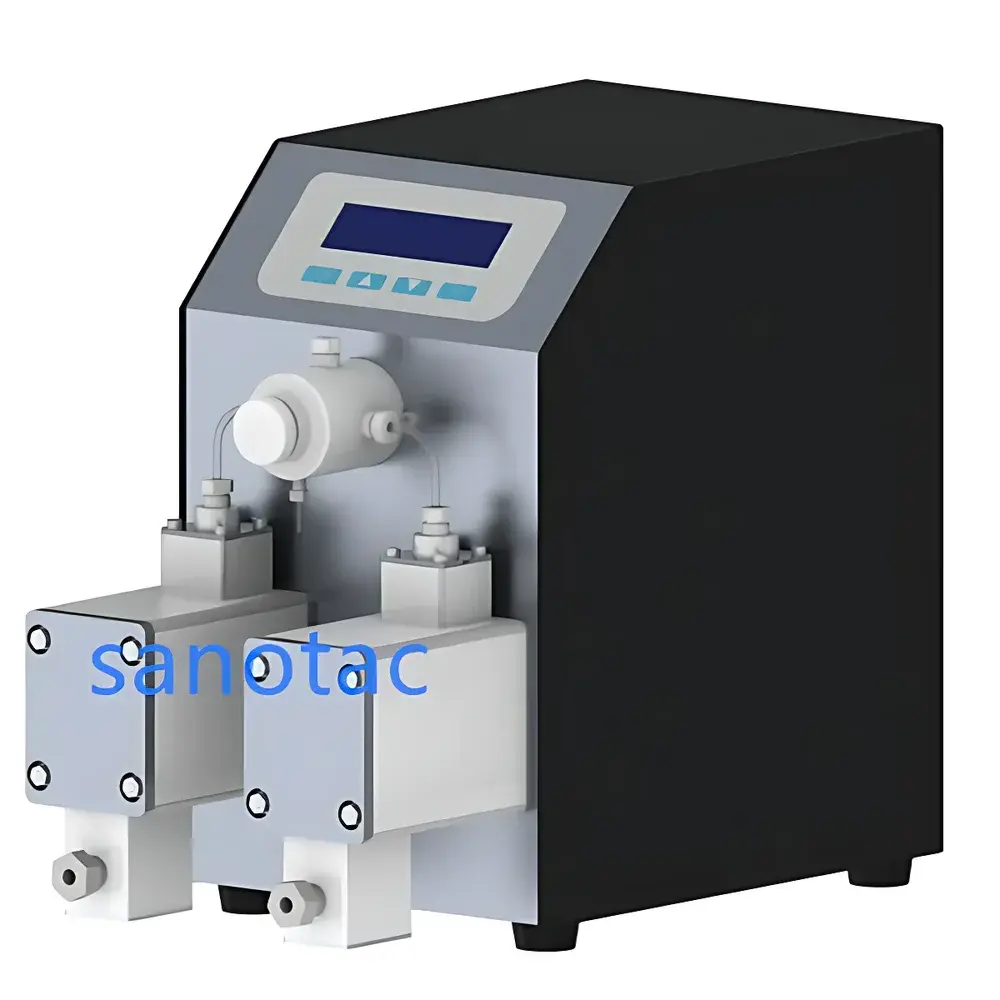
Sanotac BM-200 Electric Dual-Bellows Precision Metering Pump for High-Purity Chemical Delivery
| Brand | Sanotac |
|---|---|
| Model | BM-200 |
| Flow Rate Range | 1.0–200.0 mL/min |
| Viscosity Handling | up to 300 cP |
| Flow Resolution | 0.1 mL/min |
| Flow Accuracy | ±1% |
| Max Operating Pressure | ≤0.5 MPa |
| Inlet Port | φ6 mm × φ4 mm |
| Outlet Port | φ3.175 mm × φ1.58 mm |
| Wetted Materials | PTFE, PFA, Specialty Ceramic |
| Communication | USB, RS232, RS485 (Modbus) |
| Power Supply | 85–264 VAC, 50 Hz |
| Power Consumption | 20 W |
| Weight | 8 kg |
| Dimensions | 362 × 169 × 278 mm |
Overview
The Sanotac BM-200 Electric Dual-Bellows Precision Metering Pump is an engineered solution for ultra-high-purity, low-particulate, and pulse-free fluid delivery in advanced microfabrication and electrochemical manufacturing environments. Based on positive displacement actuation via dual, synchronized fluoropolymer bellows—each driven by a precision lead-screw mechanism—the pump achieves volumetric metering without dynamic seals, rotating shafts, or sliding wetted surfaces. This architecture eliminates particle generation from mechanical wear and prevents ambient gas ingress or process fluid leakage—critical requirements for handling aggressive chemistries such as hydrofluoric acid (HF), photoresists, and lithium-ion battery electrolytes. Unlike peristaltic or diaphragm-based systems, the BM-200 delivers true continuous flow with sub-1% volumetric repeatability across its full 1.0–200.0 mL/min range, while maintaining consistent shear profile and minimal backpressure sensitivity. Its design complies with cleanroom-compatible construction standards (ISO Class 4 compatible when installed with appropriate filtration and inert gas purging), and supports integration into automated wet bench platforms requiring traceable, auditable fluid dispensing.
Key Features
- Dual-bellows architecture enables uninterrupted, pulse-dampened continuous flow—eliminating flow interruption inherent in single-bellows or piston-based systems
- Entire fluid path constructed from PTFE, PFA, and specialty ceramic—no metal contact; fully compatible with HF, TMAH, organic solvents, and LiPF6-based electrolytes
- Lead-screw-driven actuation ensures digital control resolution of 0.1 mL/min and guaranteed flow accuracy of ±1% (as verified per ASTM D3417 for volumetric calibration traceability)
- No dynamic seals or sliding interfaces in wetted zones—reducing particle shedding to <0.1 particles ≥0.3 µm per mL (tested per ISO 21501-4 under Class 4 cleanroom conditions)
- Integrated pressure monitoring circuit with programmable over-pressure cutoff (setpoint range: 0.1–0.5 MPa); automatically halts operation if downstream resistance exceeds safe threshold
- Multi-protocol industrial communications: native support for Modbus RTU over RS485 (addressable node), RS232 for local diagnostics, and USB for firmware updates and configuration backup
Sample Compatibility & Compliance
The BM-200 is validated for use with non-aqueous and aqueous high-purity process fluids including g-line/i-line/DUV photoresists, developer solutions (e.g., 2.38% TMAH), etchants (HF/NH4F mixtures), rinse media (UPW, SC1/SC2), and battery electrolytes (LiPF6 in EC/DMC). All wetted materials meet USP Class VI biocompatibility and ASTM F2136 chemical resistance specifications. The pump’s control firmware supports audit trail logging and user-access-level configuration (admin/operator), aligning with FDA 21 CFR Part 11 requirements for electronic records in regulated GMP environments. It is CE-marked per EN 61000-6-2 (immunity) and EN 61000-6-4 (emissions), and conforms to SEMI F57 guidelines for semiconductor process equipment safety.
Software & Data Management
Sanotac’s PumpControl Suite (v3.2+) provides Windows-based configuration, real-time flow/pressure trending, and batch parameter archiving. Each dispensing event—including volume dispensed, timestamp, pressure reading, and error flags—is logged with SHA-256 hash integrity verification. Data export supports CSV and SQLite formats for LIMS integration. Remote operation is supported via TCP/IP gateway (optional add-on), enabling centralized fleet management across multiple tools in a fab environment. Firmware updates preserve all calibration coefficients and user-defined profiles, ensuring continuity during qualification revalidation.
Applications
- Semiconductor photolithography: spin-coating resist delivery with <±0.8% run-to-run volume variation across 10,000+ wafers (validated per SEMI E10)
- Lithium-ion battery electrode coating and electrolyte filling lines—enabling controlled wetting of porous separators without crystallization or void formation
- Advanced packaging: underfill and encapsulant dosing for flip-chip and 2.5D/3D IC assembly
- MEMS and compound semiconductor processing: precise delivery of BOE, piranha, and dilute HNO3 solutions in closed-loop recirculation systems
- R&D labs requiring GLP-compliant, repeatable liquid handling for formulation screening and viscosity-dependent process development
FAQ
What maintenance intervals are recommended for the BM-200 in high-purity applications?
Bellows lifetime is rated for ≥2 million cycles at nominal stroke; no scheduled maintenance is required within first 12 months of continuous operation. Annual verification of flow accuracy and pressure sensor calibration is advised.
Can the BM-200 be integrated with SECS/GEM protocol?
Yes—via optional RS485-to-GEM gateway module (Sanotac SG-MOD-01), supporting HSMS communication and standard equipment data collection models.
Is the pump suitable for vacuum-assisted priming?
No—bellows actuation requires positive inlet pressure ≥0.02 MPa; external booster or gravity feed is required for self-priming below atmospheric pressure.
How is flow accuracy validated across temperature gradients?
Built-in temperature compensation algorithm adjusts for thermal expansion of PFA tubing and bellows modulus drift; accuracy remains within ±1% across 15–30°C ambient range (per IEC 60068-2-14 testing).
Does the BM-200 support multi-step dispensing sequences?
Yes—up to 99 programmable steps per recipe, each with independent flow rate, volume, acceleration ramp, and pressure limit settings; stored recipes persist through power loss.



