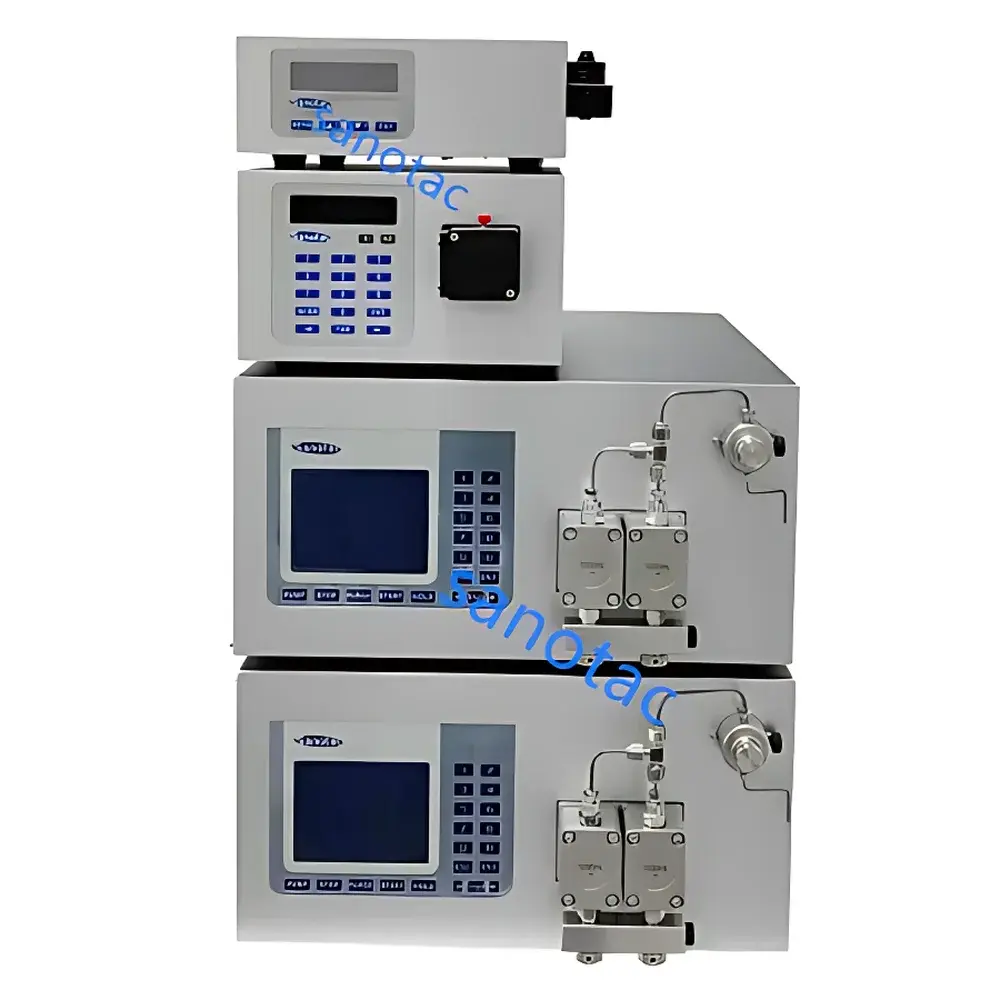
Sanotac Biolot 1000 High-Capacity Preparative Protein Purification System with 1/8″ PEEK Flow Path
| Brand | Sanotac |
|---|---|
| Origin | Shanghai, China |
| Manufacturer Type | OEM Manufacturer |
| Origin Category | Domestic (China) |
| Model | Biolot 1000 |
| Price Range | USD 14,000–42,500 |
| Purification Principle | Affinity Chromatography (AC) |
| Detector Types | UV-Vis Absorbance Detector, Conductivity Detector, pH Detector |
| Detection Wavelength Range | 190–800 nm |
| Flow Rate | 0.1–1000 mL/min |
| Max Throughput | 60 L/h |
| Pressure Range | 0–10 MPa |
| Gradient Accuracy | ±0.5% ABS (dual-pump system) |
| Material of Construction | PEEK (all fluidic path) |
| Software Compliance | FDA 21 CFR Part 11–compliant control software |
Overview
The Sanotac Biolot 1000 is a high-throughput, modular preparative protein purification system engineered for robust, scalable chromatographic separation of biomolecules—including recombinant proteins, monoclonal antibodies, peptides, and nucleic acids—under laboratory and pilot-scale conditions. Based on low-dead-volume PEEK fluidic architecture and dual high-precision plunger pumps, the system implements gradient-elution affinity chromatography (AC) as its primary purification mode, supporting orthogonal methods such as ion exchange (IEX), size exclusion (SEC), and hydrophobic interaction chromatography (HIC) via interchangeable column modules and method reconfiguration. Its maximum flow capacity of 60 L/h enables rapid transition from analytical optimization to process development and early-stage manufacturing support, while maintaining full traceability, pressure stability (<0.2 MPa pulsation), and reproducible gradient formation (±0.5% absolute accuracy). Designed for compliance-driven environments, the system integrates hardware-level safeguards—including automatic pump head rinsing, buffer crystallization prevention logic, and real-time sensor diagnostics—with software architecture aligned to GLP/GMP workflows.
Key Features
- Modular PEEK-based fluidic path (1/8″ tubing, valves, mixers, and pump heads) ensuring exceptional chemical resistance, low protein adsorption, and biocompatibility across acidic, basic, and organic solvent gradients.
- Dual high-accuracy PEEK plunger pumps (0.1–1000 mL/min, ±0.5% flow precision) with integrated gradient mixing and online gradient editing capability—supporting step, linear, and custom multi-segment profiles.
- Simultaneous dual-wavelength UV-Vis detection (190–800 nm) using auto-switching deuterium/tungsten lamp source; absorbance linearity maintained from 0–2 AU (full range: –3 to +3 AU); wavelength accuracy ±1 nm.
- Integrated inline conductivity (0–500 mS/cm) and pH (0–14) sensors with temperature compensation, enabling real-time monitoring of mobile phase composition and elution integrity.
- Automated fraction collector with programmable collection modes (time-, peak-, threshold-, or volume-triggered), compatible with standard 15–50 mL conical tubes, microtiter plates, and custom rack formats.
- Fully automated pump head cleaning cycle—activated pre/post-run—to prevent salt crystallization, buffer carryover, and cross-contamination between purification campaigns.
Sample Compatibility & Compliance
The Biolot 1000 accommodates a broad range of sample matrices, including clarified cell lysates, fermentation supernatants, plasma fractions, and purified oligonucleotide solutions. Its PEEK wetted surfaces minimize nonspecific binding and leachables, making it suitable for purification of sensitive therapeutic proteins and regulatory-grade intermediates. The system conforms to ISO 13485 design controls for medical device-related instrumentation and supports audit-ready operation under Good Manufacturing Practice (GMP) and Good Laboratory Practice (GLP) frameworks. All electronic records—including method parameters, run logs, detector outputs, and fraction metadata—are timestamped, user-authenticated, and secured in accordance with FDA 21 CFR Part 11 requirements, including electronic signatures, audit trails, and role-based access control.
Software & Data Management
BioView™ workstation software (Windows-based, USB/RS-232 interface) provides centralized control of all hardware modules, real-time chromatogram visualization, and method storage/retrieval. It supports method cloning, parameter locking, version history tracking, and export of raw data in ASCII, CSV, and vendor-neutral .chm formats compliant with ASTM E1785 and ISO/IEC 17025 reporting standards. The software includes built-in validation tools for system suitability testing (SST), peak integration consistency checks, and calibration certificate management. Audit trail records capture operator ID, timestamp, action type (e.g., “gradient modified”, “fraction collected”), and before/after parameter values—retained for ≥36 months per default configuration.
Applications
- Process development of monoclonal antibody (mAb) purification trains—from Protein A capture through polishing steps (e.g., cation exchange, SEC).
- Rapid screening of resin-binding kinetics and elution condition optimization for His-tagged, GST-fused, or FLAG-labeled proteins.
- Scalable purification of viral vectors (AAV, lentivirus) and mRNA-LNP complexes under non-denaturing conditions.
- Multi-step isolation of CRISPR-Cas ribonucleoprotein (RNP) complexes with concurrent UV and conductivity monitoring for complex stability assessment.
- Preparative isolation of synthetic peptides (>5 kDa) and cyclic oligonucleotides where PEEK compatibility with TFA/acetonitrile gradients is critical.
FAQ
What chromatographic techniques does the Biolot 1000 support beyond affinity purification?
The system natively supports ion exchange (IEX), size exclusion (SEC), hydrophobic interaction (HIC), and reversed-phase (RP) chromatography through compatible column hardware, gradient programming flexibility, and solvent-resistant PEEK flow path.
Is the UV detector capable of simultaneous dual-wavelength acquisition?
Yes—the detector acquires absorbance at two user-selectable wavelengths concurrently (e.g., 280 nm and 260 nm), enabling real-time A260/A280 ratio calculation for nucleic acid contamination assessment during protein elution.
How is system suitability verified prior to GMP-compliant runs?
BioView software includes predefined SST protocols—such as backpressure stability test, gradient accuracy verification, and baseline noise measurement—that generate PDF reports with pass/fail criteria aligned to ICH Q5A and USP .
Can the system be integrated into a larger automation environment?
Yes—via OPC UA or Modbus TCP interfaces (optional add-on), the Biolot 1000 supports bidirectional communication with MES, LIMS, and robotic liquid handlers for unattended multi-system workflows.
What maintenance intervals are recommended for the PEEK pump seals and UV lamp?
PEEK pump seals require replacement every 12 months or after 5,000 operational hours; the deuterium lamp has a rated lifetime of 2,000 hours and is monitored via internal usage counter with predictive alerting in BioView.