
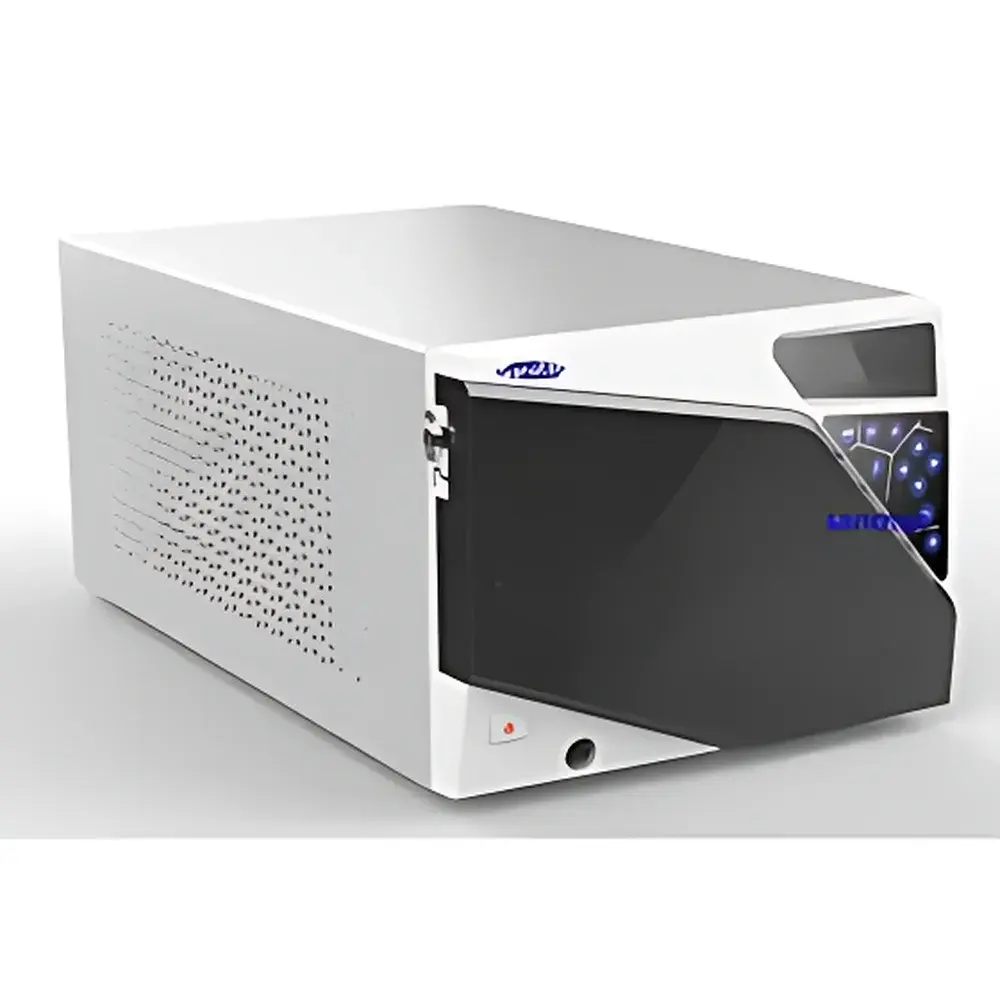
Sanotac ELSD5000 Evaporative Light Scattering Detector
| Brand | Sanotac |
|---|---|
| Origin | Shanghai, China |
| Manufacturer Type | Original Equipment Manufacturer (OEM) |
| Model | ELSD5000 |
| Detection Principle | Evaporative Light Scattering Detection (ELSD) |
| Light Source | 650 nm Semiconductor Laser |
| Wavelength | 650 nm |
| Detection Mode | Low-Temperature Evaporation Mode |
| Dimensions (W×H×D) | 26 × 19 × 46 cm |
| Weight | 10 kg |
| Evaporation Temperature Range | Ambient to 130 °C (1 °C increment) |
| Nebulization Temperature Range | Ambient to 56 °C (1 °C increment) |
| Temperature Control Accuracy | ±1 °C |
| Carrier Gas | Clean Compressed Air or Nitrogen |
| Gas Pressure Range | 2–5 bar |
| Gas Pressure Sensing Accuracy | 0.01 bar |
| Gas Flow Rate | 1–4 L/min |
| Gas Flow Control Accuracy | ≤1% or 0.02 L/min |
| Mobile Phase Flow Rate Compatibility | 0.01–3 mL/min |
| Baseline Noise | ≤0.04 mV |
| Baseline Drift | ≤0.4 mV / 30 min |
| Minimum Detectable Mass | <1 ng |
| Typical Quantitative Range | 0.1–30 µg |
| Quantitative Repeatability (RSD) | ≤2% |
| Analog Output Range | −1200 to +1200 mV |
| Gain Adjustment Range | 0.3–30 (continuous) |
| Data Acquisition Rate | 100 Hz (digital), 20 Hz (analog) |
| Communication Interfaces | RS-232, RS-485, USB, LAN (TCP/HTTP), Programmable External Event I/O |
| Power Supply | 120/240 V, 50/60 Hz |
| Regulatory Compliance | FDA 21 CFR Part 11 (audit trail enabled in Clarity®-compatible software) |
Overview
The Sanotac ELSD5000 is a compact, high-performance evaporative light scattering detector engineered for universal detection in liquid chromatography systems. Unlike UV-Vis absorbance detectors—whose sensitivity depends on chromophore presence and molar absorptivity—the ELSD5000 operates on the principle of nebulization, solvent evaporation, and light scattering from non-volatile analyte particles. This physical detection mechanism enables consistent response across a broad range of compounds lacking UV chromophores, including carbohydrates, lipids, surfactants, polymers, and natural product aglycones. The detector employs a 650 nm semiconductor laser source coupled with a photomultiplier tube (PMT) for high-sensitivity particle detection. Its low-temperature evaporation architecture minimizes thermal degradation of labile compounds while maintaining robust signal stability under gradient elution conditions typical in preparative and analytical HPLC workflows.
Key Features
- Compact Footprint & Modular Integration: With dimensions of only 26 × 19 × 46 cm and weight of 10 kg, the ELSD5000 is designed for benchtop stacking with HPLC pumps, autosamplers, and fraction collectors—ideal for space-constrained labs and multi-instrument purification platforms.
- Precision Thermal Control: Dual independent temperature zones—evaporation chamber (ambient to 130 °C, ±1 °C accuracy) and nebulizer block (ambient to 56 °C)—are digitally regulated in 1 °C increments to optimize aerosol formation and desolvation efficiency across diverse mobile phases.
- Intelligent Nebulization System: Adjustable nozzle angle and programmable heating enhance雾化 (nebulization) consistency for viscous or oily samples; integrated gas pressure and flow monitoring (0.01 bar resolution, ≤1% flow control accuracy) ensures reproducible droplet generation.
- Automated Diagnostics & Safety Protocols: Built-in 16-point self-test routine verifies critical subsystems—including gas integrity, heater status, PMT voltage, and optical alignment—prior to run initiation. Flow-path interlocks prevent mobile phase ingress into the detection chamber, reducing maintenance frequency and extending PMT lifetime.
- Flexible Signal Optimization: Continuous gain adjustment (0.3–30), linear analog output (±1200 mV), and real-time baseline offset compensation allow fine-tuned response scaling without hardware recalibration.
- Energy-Efficient Operation: Adaptive standby mode engages automatically during idle periods, reducing power consumption by >60% while preserving thermal equilibrium for rapid method reactivation.
Sample Compatibility & Compliance
The ELSD5000 detects any non-volatile or semi-volatile analyte with volatility lower than that of the mobile phase—making it especially suitable for gradient-compatible applications where UV detection fails due to solvent front interference. It supports flow rates from 0.01 mL/min (microbore/UHPLC) to 3 mL/min (medium-pressure prep LC), accommodating reversed-phase, HILIC, and normal-phase separations. All wetted parts are chemically inert (stainless steel, PEEK, fused silica), compatible with common organic solvents (acetonitrile, methanol, THF) and aqueous buffers (including volatile additives like ammonium acetate/formate). The system complies with ISO/IEC 17025 calibration traceability requirements and supports GLP/GMP workflows through full audit trail functionality in its FDA 21 CFR Part 11–compliant software environment.
Software & Data Management
The ELSD5000 integrates seamlessly with third-party chromatography data systems via Clarity® dynamic link library (DLL) support and native drivers for Chromeleon™, Empower™, and OpenLAB CDS. Its embedded firmware supports simultaneous analog output (for legacy integrators) and digital streaming over RS-232, RS-485, USB, or TCP/IP (HTTP-based REST API). The included Sanotac Chromatographic Acquisition Software provides method editor with 10 configurable method groups (25 parameters each), structured menu navigation, real-time parameter logging, and automated report generation. All user actions—including method changes, calibration events, and alarm acknowledgments—are timestamped and cryptographically signed within the audit trail, satisfying regulatory documentation requirements for pharmaceutical QC, nutraceutical validation, and contract research laboratories.
Applications
- Quantification of non-UV-absorbing natural products (e.g., saponins, triterpenes, glycosides)
- Method development and purity assessment in oligosaccharide and polysaccharide purification
- Residual solvent and excipient analysis in biopharmaceutical formulation studies
- Stability-indicating assays for lipid-based drug delivery systems (liposomes, micelles, nanoemulsions)
- Quality control of surfactants, fatty acids, and sterols in food and cosmetic raw materials
- Support for orthogonal detection strategies in ICH Q5/Q6-compliant characterization of biosimilars
FAQ
Does the ELSD5000 require column heating or post-column derivatization?
No. ELSD is a label-free, post-column detection technique that does not require chemical modification or elevated column temperatures.
Can it be used with gradient elution methods?
Yes. Its low-temperature evaporation design and real-time drift compensation enable stable baseline performance across steep organic solvent gradients.
What carrier gases are supported, and is nitrogen mandatory?
Both clean compressed air and nitrogen are supported; nitrogen is recommended for enhanced sensitivity and reduced background noise, but not required for operation.
How is calibration performed, and is NIST-traceable reference material available?
Calibration is performed using standard solutions of known mass (e.g., sucrose, sodium taurocholate); Sanotac provides certified calibration kits with CoA traceable to NIST SRM 1891c (sodium chloride).
Is remote monitoring and control possible?
Yes. Via LAN interface, users can access instrument status, adjust parameters, initiate diagnostics, and download logs through a web browser or custom SCADA integration.





