
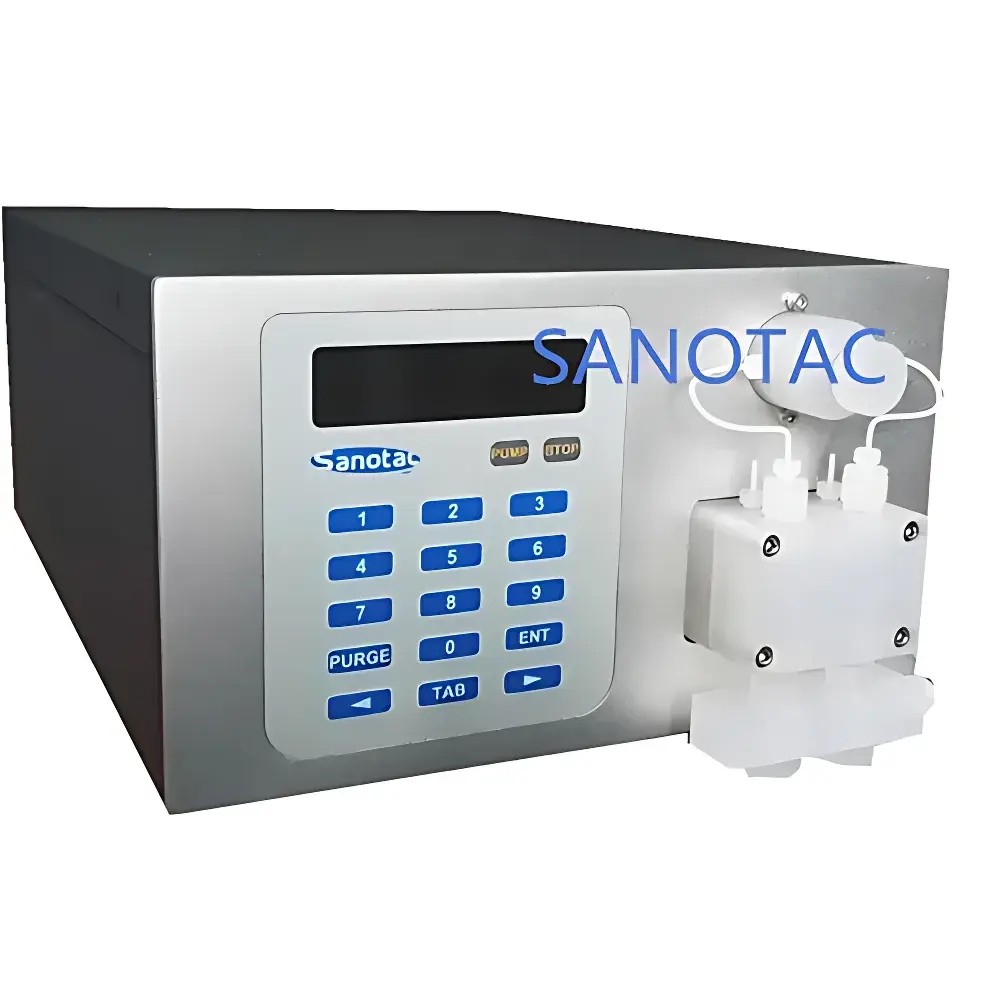
Sanotac WPF1002 PTFE-Based Constant-Flow High-Pressure Micro-Reactor Pump
| Brand | Sanotac |
|---|---|
| Origin | Shanghai, China |
| Manufacturer Type | Direct Manufacturer |
| Region of Origin | Domestic (China) |
| Model | WPF1002 |
| Flow Rate | 0.01–100.00 mL/min |
| Pressure Rating | ≤ 2 MPa |
| Flow Accuracy | ±0.5% |
| Flow Precision (RSD) | ≤ 0.1% |
| Pressure Pulsation | ≤ 0.2 MPa |
| Fluidic Path Materials | PTFE, PCTFE, Sapphire, Ceramic |
| Connection Standard | 1/16″ tubing ports |
| Display | 256×64 dot matrix backlit LCD |
| Control Modes | Front-panel keypad + RS232/USB computer remote control (open protocol) |
| Power Supply | 85–264 VAC, 50 Hz |
| Dimensions | 370 × 240 × 152 mm |
Overview
The Sanotac WPF1002 is a precision-engineered, PTFE-based constant-flow high-pressure pump specifically designed for integration with microreactor systems and continuous-flow chemistry platforms. Operating on dual parallel plunger architecture with floating plunger mechanics, it delivers stable, low-pulse fluid delivery across a wide dynamic range—from trace-level synthesis (0.01 mL/min) to preparative-scale flow chemistry (100 mL/min) at pressures up to 2 MPa. Its core measurement principle relies on microprocessor-controlled stepper motor actuation combined with solvent compressibility compensation and multi-point flow calibration, ensuring metrological traceability in demanding chemical process environments. Unlike conventional peristaltic or syringe pumps, the WPF1002 employs positive displacement via ceramic-sapphire check valves and chemically inert fluoropolymer fluid paths—making it suitable for aggressive reagents (e.g., strong acids, halogenated solvents, organometallics) commonly used in microchannel reaction engineering.
Key Features
- Ultra-low pulsation design: Integrated cam-profile compensation and real-time electronic pulse suppression reduce pressure ripple to ≤ 0.2 MPa (RMS), critical for maintaining laminar flow stability in microstructured reactors.
- High-accuracy flow delivery: Achieves ±0.5% absolute accuracy and ≤0.1% RSD over full flow range via dual-plunger synchronization, solvent compressibility modeling, and factory-calibrated flow curves.
- Chemically inert fluid path: Entire wetted surface comprises PTFE, PCTFE, sapphire, and ceramic—fully compatible with ASTM D471-rated aggressive media; eliminates metal ion leaching and surface catalysis artifacts.
- Modular gradient capability: Supports isocratic, linear, and step-gradient profiles through embedded firmware—enabling automated reaction parameter screening (e.g., residence time, stoichiometry sweep) without external mixing hardware.
- Open communication architecture: Implements documented ASCII-based RS232/USB command protocol compliant with common chromatography data systems (CDS); supports bidirectional status reporting and firmware-upgradable control logic.
- Robust mechanical design: Swiss-sourced sapphire check valves, hardened ceramic plungers, and dynamically balanced cam drive ensure >10,000 hours MTBF under continuous operation at rated pressure.
Sample Compatibility & Compliance
The WPF1002 is validated for use with organic solvents (THF, DMF, DCM), aqueous mineral acids (HCl, HNO₃ ≤ 6 M), bases (NaOH ≤ 2 M), and air/moisture-sensitive reagents when paired with inert gas purging. Its PTFE/PCTFE construction meets USP Class VI biocompatibility requirements and complies with ISO 8536-4 for infusion equipment material safety. While not certified as a medical device, its design adheres to GLP-relevant documentation standards—including audit-trail-capable event logging (via optional software module) and user-accessible calibration records traceable to NIST-traceable flow standards. It supports IQ/OQ protocols for lab-based GMP environments where pump performance verification is required per FDA 21 CFR Part 11 Annex 11 guidelines.
Software & Data Management
The pump operates standalone via intuitive front-panel interface with 10 programmable method slots storing flow rate, gradient profile, hold time, and pressure limit parameters. For integrated system control, Sanotac provides a Windows-compatible SDK with source-code examples (C#, Python, LabVIEW) enabling seamless incorporation into custom reactor orchestration software. All commands and responses are human-readable ASCII strings, facilitating interoperability with third-party platforms such as MATLAB, Python-based flow automation frameworks (e.g., Pycroscopy, FlowSolve), or commercial chromatography data systems. Optional data logging captures timestamped flow/pressure values at 10 Hz resolution, exportable as CSV for post-run kinetic analysis or PAT (Process Analytical Technology) correlation studies.
Applications
- Microreactor feed control in continuous-flow pharmaceutical API synthesis (e.g., nitration, hydrogenation, photochemical cyclization)
- Multi-stream reagent metering for segmented flow or droplet-based microfluidics
- Automated catalyst screening under precisely controlled residence time and stoichiometric ratio
- On-line dilution and standard addition in ICP-MS or IC sample introduction systems
- Long-duration stability testing of nanomaterial dispersions under shear-controlled conditions
- Preparative-scale electrochemical flow cells requiring inert, pulse-free electrolyte delivery
FAQ
Is the WPF1002 compatible with corrosive halogenated solvents such as sulfuryl chloride or phosphorus oxychloride?
Yes—the entire fluidic path is constructed from PTFE, PCTFE, sapphire, and ceramic, all rated for continuous exposure to Class C aggressive solvents per ASTM D471. No stainless steel or elastomer components contact the fluid stream.
Can the pump be operated in gradient mode while maintaining constant total flow rate across two independent channels?
The WPF1002 is a single-channel pump. For dual-channel gradient operation with sum-flow constancy, two synchronized WPF1002 units are required, coordinated via external TTL triggering or master-slave RS232 handshaking using the open protocol.
Does the pump support analog input for external flow setpoint modulation?
No analog voltage input is provided; flow setpoints are exclusively digital (RS232/USB). However, real-time flow feedback (0–5 V proportional output) is available for closed-loop PID integration with external controllers.
What maintenance intervals are recommended for the sapphire check valves and PTFE seals?
Under typical laboratory use (≤1 MPa, non-abrasive solvents), sapphire valves require inspection every 6 months; PTFE sealing elements are rated for ≥12 months continuous operation before replacement. A full service kit and torque-spec calibration checklist are supplied with each unit.
Related Products



