
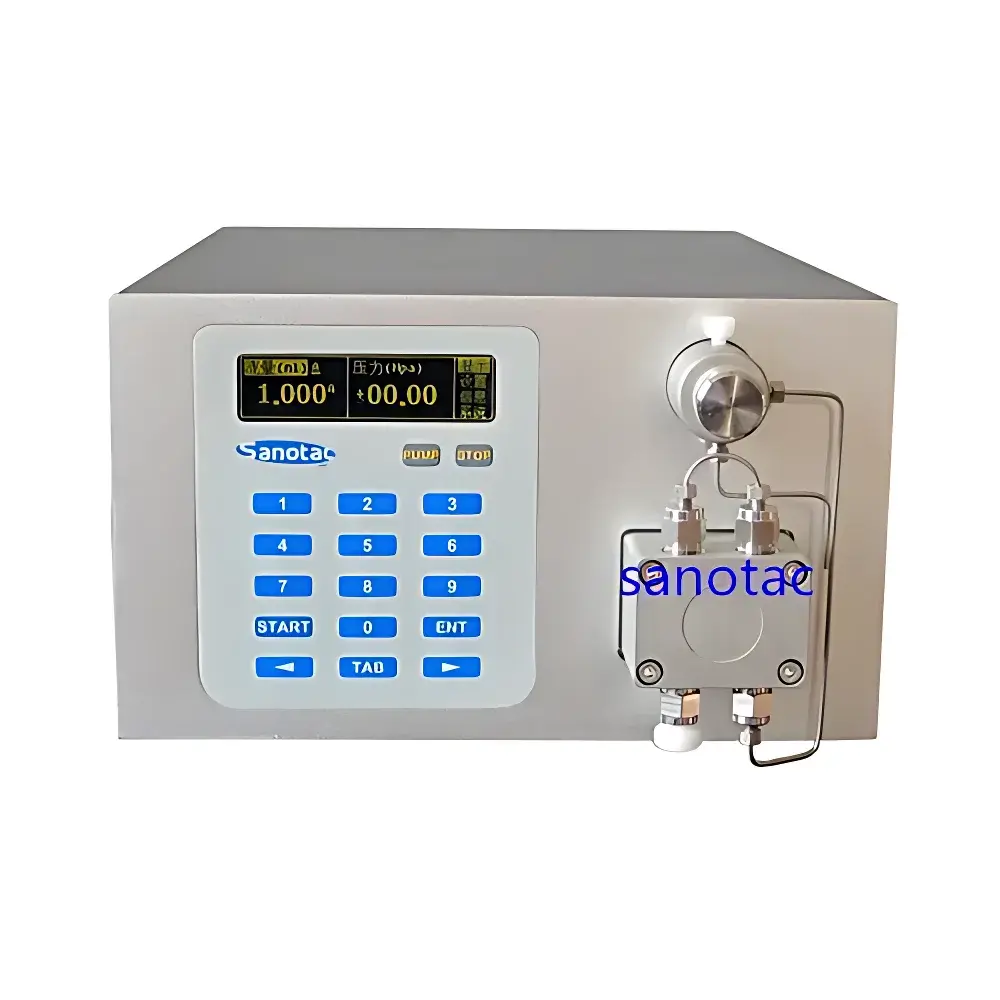
Sanotac JQ0011 Analytical High-Pressure Constant Flow Pump for Hydrogenation Test Systems
| Brand | Sanotac |
|---|---|
| Origin | Shanghai, China |
| Manufacturer Type | OEM/ODM Manufacturer |
| Country of Origin | China |
| Model | JQ0011 |
| Price Range | USD 1,400 – 2,800 |
| Flow Range | 0.001–9.999 mL/min |
| Flow Increment | 0.001 mL/min |
| Flow Accuracy | ±0.1% |
| Flow Precision (RSD) | ≤0.1% |
| Max Pressure | 42 MPa |
| Pressure Pulsation | ≤0.1 MPa |
| Pump Head Volume | 10 mL |
| Drive Mechanism | Dual-piston serial configuration with floating piston design |
| Wetted Materials | 316L stainless steel, sapphire, PTFE, ceramic |
| Tubing Connection | 1/16″ standard fittings |
| Display | 256×64 dot matrix backlit LCD |
| Control Interface | Front-panel keypad + RS232/USB computer remote control (open protocol) |
| Power Supply | 85–264 VAC, 50 Hz |
| Dimensions | 370 × 240 × 152 mm |
Overview
The Sanotac JQ0011 Analytical High-Pressure Constant Flow Pump is an engineered solution designed specifically for demanding catalytic hydrogenation test systems and high-pressure liquid delivery applications in research and development laboratories. Built upon a dual-piston serial architecture with floating piston technology, the pump delivers exceptional flow stability and pressure integrity across its full operational range—from ultra-low flow rates (0.001 mL/min) to 9.999 mL/min—while sustaining continuous pressures up to 42 MPa (6,090 psi). Its core operation follows positive displacement principles, where microprocessor-controlled cam profiles, solvent compressibility compensation algorithms, and multi-point flow calibration curves collectively ensure traceable volumetric accuracy and long-term reproducibility. The JQ0011 is not a generic HPLC pump; it is purpose-built for reactive gas–liquid environments typical of bench-scale hydrogenation, hydrodeoxygenation, and hydrotreating studies—where pulse-free delivery, chemical compatibility, and pressure resilience are non-negotiable.
Key Features
- Dual-piston serial drive with floating piston design minimizes seal wear and extends service life under sustained high-pressure operation.
- Sub-microliter flow resolution (0.001 mL/min increment) and certified accuracy (±0.1%) validated per ISO 5725-2 guidelines for precision measurement systems.
- Low-pressure pulsation (≤0.1 MPa) achieved via integrated cam-profile compensation and real-time electronic pulse suppression—critical for maintaining catalyst bed integrity and avoiding column disturbance in fixed-bed reactors.
- Chemically inert fluid path constructed from 316L stainless steel, sapphire check valves, PTFE seals, and ceramic components—resistant to H2, organic solvents, acidic/basic reagents, and corrosive hydrotreatment intermediates.
- Open-protocol RS232/USB interface enables seamless integration with third-party chromatography data systems (CDS), LIMS, or custom automation platforms—fully compliant with ASTM E1381 and FDA 21 CFR Part 11 audit-trail requirements when deployed in regulated environments.
- Preloaded with 10 user-defined methods supporting programmable flow gradients (isocratic, linear, step), start/stop timing, and pressure limit triggers—enabling automated reaction profiling without external controllers.
Sample Compatibility & Compliance
The JQ0011 accommodates a broad spectrum of process fluids used in catalytic testing, including but not limited to methanol, ethanol, tetrahydrofuran, ethyl acetate, acetic acid, aqueous ammonia, and hydrogen-saturated hydrocarbon mixtures. Its wetted materials meet USP Class VI biocompatibility standards and conform to NACE MR0175/ISO 15156 for sour service applications. For laboratory quality assurance, the pump supports GLP-compliant operation through timestamped method logs, electronic signatures (when paired with validated CDS software), and configurable alarm thresholds for pressure deviation, flow error, or temperature anomaly. It is routinely deployed in facilities adhering to ISO/IEC 17025 accreditation requirements for method validation in catalyst evaluation labs.
Software & Data Management
The pump operates natively via its front-panel interface or remotely via ASCII-based command protocol—documented in Sanotac’s publicly available communication manual. When integrated into a networked lab environment, it accepts SCPI-like commands for flow setpoint adjustment, gradient profile upload, status polling, and fault diagnostics. Raw operational data—including actual flow rate, system pressure, motor current, and error codes—is streamed at 10 Hz and can be logged directly into CSV or HDF5 formats using Python, LabVIEW, or commercial DAQ software. All firmware updates are digitally signed and verified prior to installation, ensuring traceability and cybersecurity alignment with IEC 62443-3-3 SL2 requirements for industrial control devices.
Applications
- Bench-scale catalytic hydrogenation screening (e.g., nitroarene reduction, alkene saturation, deprotection reactions)
- Fixed-bed and trickle-bed reactor feed control in R&D units for petrochemical and biofuel upgrading
- High-pressure liquid delivery in supercritical fluid processing (e.g., scCO2-assisted hydrogenation)
- Method development for hydrotreating catalysts under simulated refinery conditions (ASTM D6274, D7502)
- Automated reaction calorimetry coupling where precise stoichiometric reagent dosing is required
- QC/QA workflows in pharmaceutical intermediate synthesis requiring GMP-aligned pump validation (IQ/OQ/PQ protocols supported)
FAQ
What certifications does the JQ0011 hold for use in regulated laboratories?
It complies with CE marking (EMC Directive 2014/30/EU and LVD Directive 2014/35/EU), RoHS 2011/65/EU, and carries factory-issued calibration certificates traceable to NIST standards. Full 21 CFR Part 11 compliance requires integration with a validated CDS platform.
Can the JQ0011 be used with hydrogen gas dissolved in solvent?
Yes—the fluid path is rated for H2-saturated liquids up to 42 MPa; however, users must implement appropriate gas-tight fittings, leak detection, and ventilation per OSHA 1910.103 and CGA G-1.10 safety guidelines.
Is gradient programming limited to binary solvent systems?
No—the open command protocol allows custom multi-solvent gradient tables to be uploaded externally; hardware supports up to four independently controlled inlet valves when configured with optional manifold modules.
What maintenance intervals are recommended for continuous operation?
Primary seal replacement is recommended every 6,000 hours of cumulative runtime or after 12 months—whichever occurs first—under typical hydrogenation duty cycles (20–40 MPa, 1–5 mL/min).
Does Sanotac provide IQ/OQ documentation packages?
Yes—validated qualification templates (including test scripts, acceptance criteria, and raw data worksheets) are available upon request for GxP-regulated deployments.
Related Products



